Get Full Government Meeting Transcripts, Videos, & Alerts Forever!
Get email alerts on the Fleet Electrification topic
No spam. Unsubscribe anytime.
Fleet Services sets goal of 1,000 electric vehicles; cites charging, permitting and parts challenges
Summary
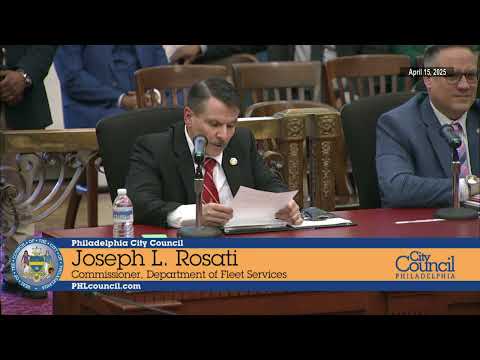
Commissioner Joseph Rosati told council the Department of Fleet Services requested $77.85 million for FY26 and outlined a goal to increase battery electric vehicles to 1,000, while noting constraints including limited municipal fast chargers, PECO service drops, L&I permits and supply chain delays.
Joseph Rosati, commissioner of the Department of Fleet Services, described the department’s FY2026 general fund budget request and outlined the department’s plan and constraints for electrifying the city vehicle fleet.
“The Department of Fleet Services FY26 general fund budget request is $77,850,000,” Rosati told council, adding that the request is about $7,480,000 less than FY25 estimated obligations and that the department employs 343 staff to maintain city vehicles and equipment.
Rosati provided a snapshot of the fleet’s current composition: roughly 6,800 total vehicles citywide, of which he said 1,201 are alternative‑fuel vehicles, including approximately 400 battery electric vehicles (BEVs), 767 hybrid electric vehicles (HEVs) and 34 compressed natural gas (CNG) trash compactors. Rosati said the department’s goal is to reach about 1,000 battery electric vehicles in service by the end of the Parker administration, contingent on building charging infrastructure and securing vehicle funding and orders.
“Our goal is to have about a thousand battery electric vehicles in service by the end of the Parker administration,” Rosati said. He noted the municipal fast‑charging infrastructure is currently limited: the city has one municipal fast charger at 26th and Master Street and plans to build four more municipal fast chargers. Rosati said the department expects to bring another fast charger online by the end of June in Southwest Philadelphia and hopes to complete three additional municipal fast‑charger sites during FY26; meanwhile the fleet is using vendor‑operated fast charging until city sites come online.
Rosati described operational constraints on installing Level‑3 fast chargers: obtaining construction permits from L&I, securing electrical service drops from PECO and earlier industry‑wide parts shortages that slowed installations. He pointed to the Norwich Drive body‑shop site, which can accommodate up to 70 trucks but currently houses 34, as an example of site capacity that will be activated as infrastructure is installed.
Councilmembers also discussed the role of CNG vehicles. Rosati said CNG remains a cleaner alternative to diesel and that the department will continue to use CNG assets while the EV program scales. He said Fleet coordinates with the Office of Sustainability on grants and shares data on electric and CNG vehicles.
Council members praised the departments’ internship programs. Rosati and deputy commissioners described Fleet’s two‑year internship pipeline: last fiscal year Fleet brought in 30 high‑school interns and expects to bring in 30 more this year; strong interns may advance into civil‑service automotive apprentice roles.
Members asked for additional details on fast‑charger availability across the city and on how the city will scale charging access for residents who lack private charging (rowhouse residents). Rosati said the department can report back with data on private fast chargers and discussed permitting and utility coordination as key implementation hurdles.