
Experts urge San Marino residents to prepare for earthquakes; water utility outlines resilience steps
Get AI-powered insights, summaries, and transcripts
Subscribe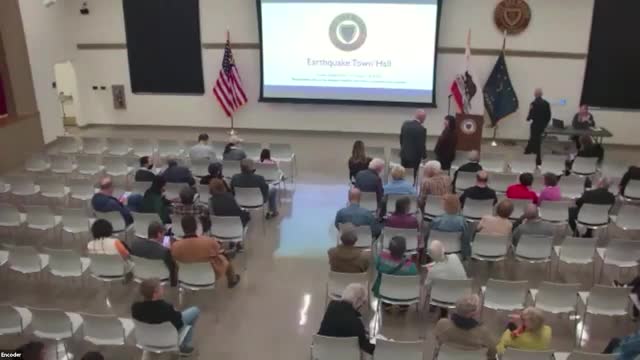
Summary
At a community preparedness meeting in San Marino, seismologist Dr. Lucy Jones reviewed regional earthquake risks and emphasized "Drop, cover and hold on," while the local water utility described steps to maintain water service after major quakes.
At a public preparedness session in San Marino, seismologist Dr. Lucy Jones and local water utility staff briefed residents on earthquake risks and how the city’s water system would respond if pipelines or supply sources were damaged.
Dr. Jones, who described decades of research with the U.S. Geological Survey, told attendees that large earthquakes and related effects such as ground rupture and liquefaction remain realistic risks for the region and that residents must prepare ahead of events. "Once a disaster happens, the preparation period is already past," she said, urging residents to practice the statewide ShakeOut drill and to remember the basic safety instruction: "Drop, cover and hold on."
The presentation outlined several technical points about earthquake hazards: FEMA categorizes multiple disaster types and, according to the talk, roughly 10 of those event types could affect the San Gabriel Valley; long fault ruptures can cause tens of meters of displacement in extreme cases; and soil liquefaction can temporarily turn saturated sediments into fluid-like material that undermines pipelines and other buried infrastructure. Dr. Jones cited historical quakes — including the 1906 and 1857 events mentioned in the presentation — and international examples to illustrate potential damage patterns.
Bryan, a representative of the local water utility, described the utility’s existing planning and operational measures to protect supply and speed recovery after an earthquake. The utility operates separate north and south distribution systems connected at several tie-in points; "we can move water from the south system to the north" in an emergency, he said. The utility maintains backup generators, stores fuel and can raise reservoir levels ahead of high-risk periods. Staff also run routine maintenance and testing under state and federal rules and have mutual-aid arrangements with the parent company and other systems to bring portable generators, tanker trucks and other resources into a disaster area.
Utility staff gave the following local details during the meeting: the San Marino system includes multiple storage sites and wells, more than 1,000 fire hydrants, and roughly 179 miles of distribution mains; the utility reported about $2 million in capital investment in 2024 and said longer-term pipeline upgrades are underway to increase capacity and reliability. The speaker advised residents to subscribe to the utility’s emergency notification system to receive text and email alerts about outages and boil-water notices.
In a question-and-answer period, attendees asked about water storage at home, the interplay of drought and seismic risk, and how long external supplies might take to be restored if regional transmission lines or imported sources are damaged. Utility staff said repairs to major imported supply lines could take months in severe scenarios and emphasized local storage, interconnections and mutual aid as the primary mitigations.
The meeting included a community reminder that Oct. 16 is the annual statewide ShakeOut drill and encouraged households to complete basic preparedness steps: secure heavy furniture, assemble several days’ supply of water, and coordinate neighborhood communications plans.
No formal votes or city actions were recorded at the session; the event was informational and focused on resident education and utility preparedness.