Get Full Government Meeting Transcripts, Videos, & Alerts Forever!
Get email alerts on the Public Comment Wildfire Water topic
No spam. Unsubscribe anytime.
Residents urge commission to challenge CAL FIRE map update and question SFPUC post‑quake water plan
Summary
Two public commenters told the Fire Commission on March 26 that the draft 2025 CAL FIRE wildfire hazard map omits hazard zones on Mount Sutro and that the SFPUC’s plan to use drinking-water reservoirs for post‑quake firefighting is unreliable.
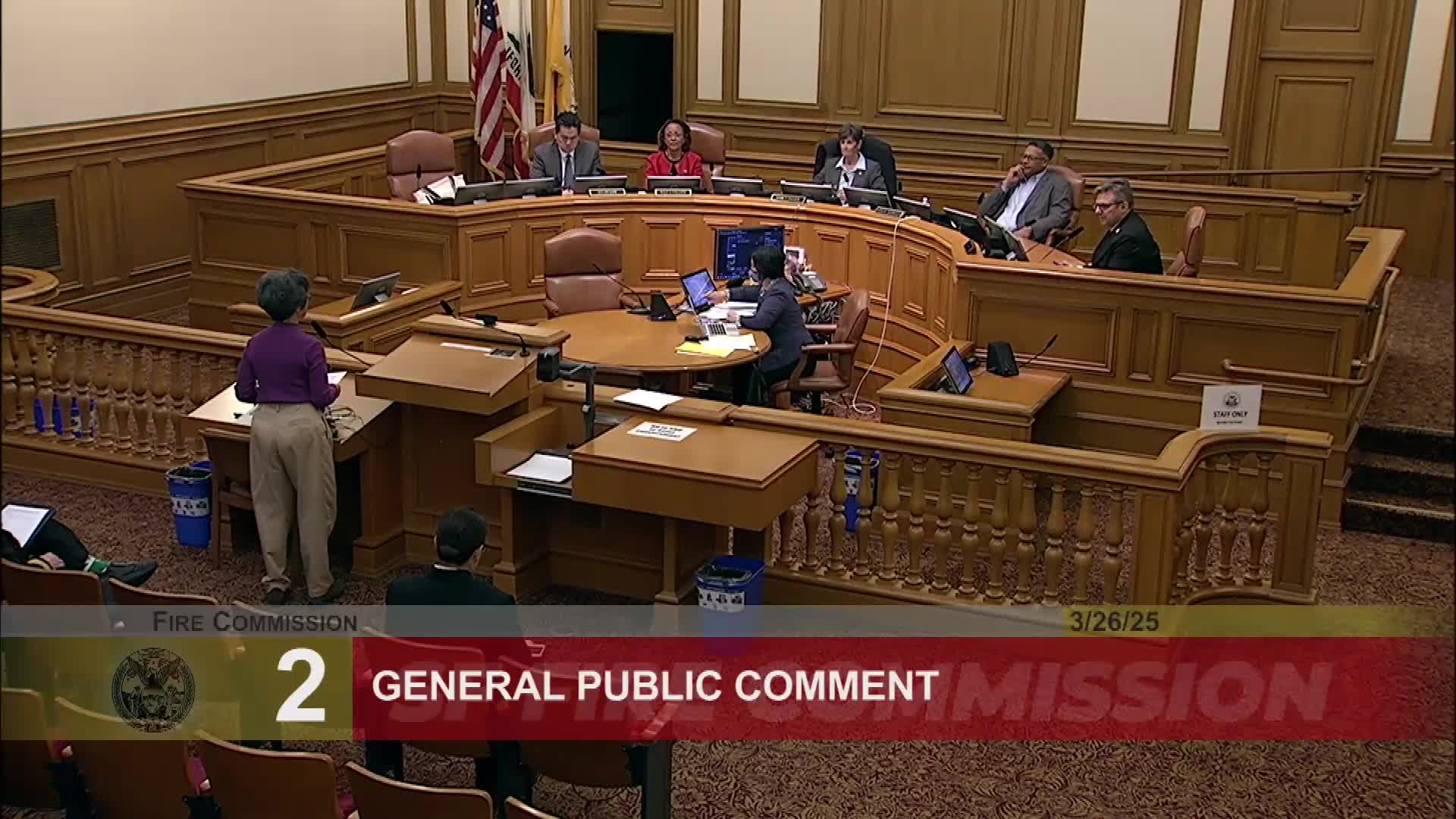
During the March 26 public-comment period, two speakers urged the San Francisco Fire Commission to scrutinize wildfire and water-supply planning.
Denise Louis, identifying herself as a San Francisco native and wildfire-risk advocate, said CAL FIRE’s 2025 draft wildfire hazard severity map does not show high-hazard zones within the city proper and urged the commission to “critique and oppose and reject the draft update from CAL FIRE because their map does not show the hazard severity zones that we already know about.” Louis cited earlier CAL FIRE maps (2007 and 2008) and local hazard assessments, including a 2013 UCSF environmental-impact statement and a 2008 Department of Emergency Management hazard mitigation plan, to argue that parts of Mount Sutro and nearby open spaces remain at elevated wildfire risk.
Eileen Bogan, speaking for the Coalition for San Francisco Neighborhoods on her own behalf, referenced a written submission and a 2021 open letter signed by retired SFFD officers and firefighters. Bogan warned that relying on Hetch Hetchy and the municipal drinking-water system for post-earthquake firefighting is “completely irrational” because the system crosses multiple fault lines and could fail in a large earthquake. She said that assuming uninterrupted drinking-water supply to fight post‑quake fires “cannot be left to chance.”
Why it matters: Both comments touch on city emergency-planning assumptions—how hazard zones are mapped and how water-supply contingency planning would function after a major earthquake—issues that inform preparedness, mutual-aid planning and resource prioritization.
Record: Both speakers were part of the public-comment period; the commission did not take immediate action during that item but staff and commissioners acknowledged the submissions.