Fire chief outlines new staffing policies, street teams reconfiguration and health studies
Loading...
Summary
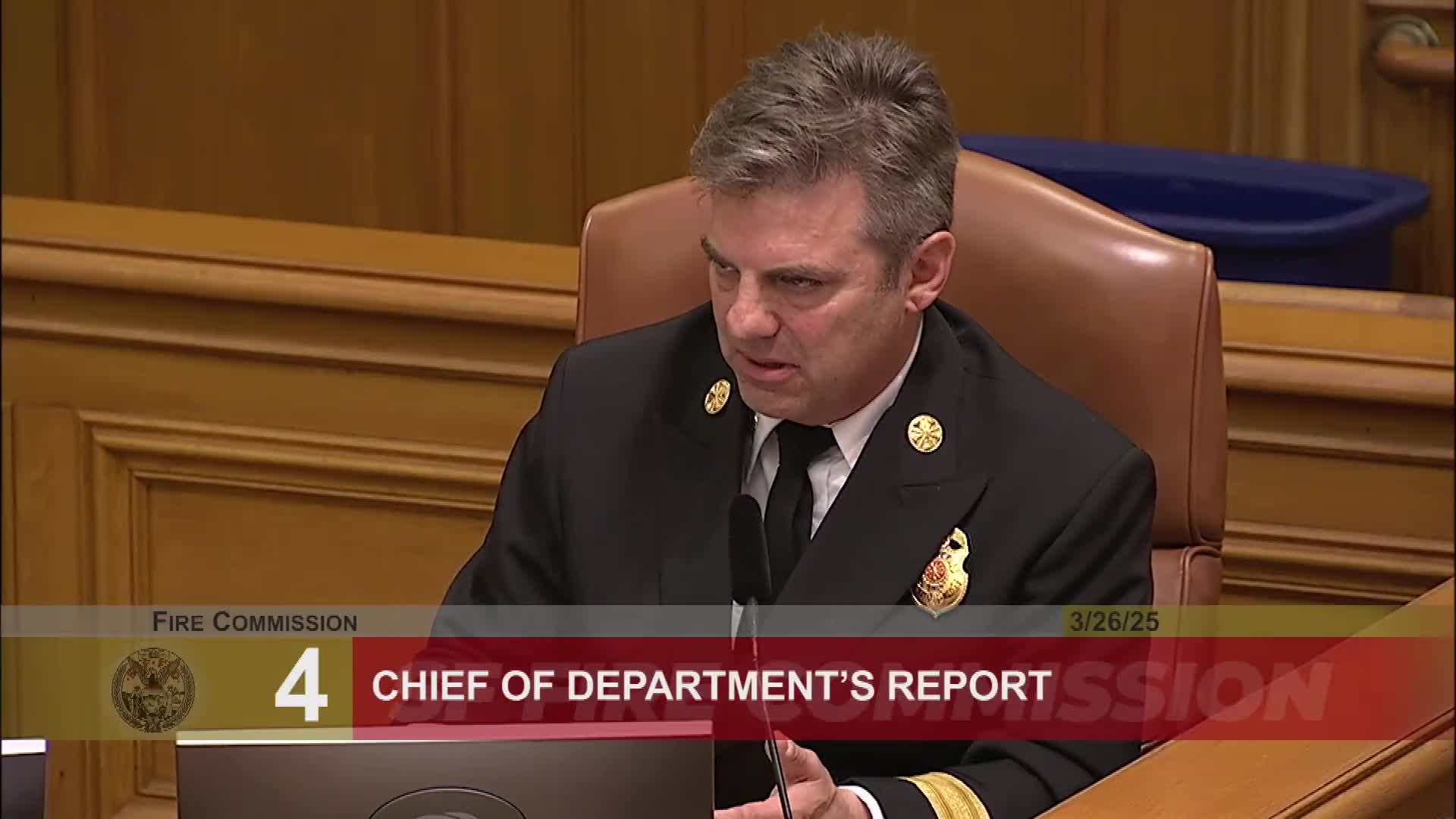
Chief Dean Crispin reported March 26 on new department policies including rotating unassigned members every six months, a new maximum work-hours policy, street-team restructuring and ongoing health and environmental studies; commissioners acknowledged the measures and asked for follow-up details.
Chief Dean Crispin reported on March 26 that the San Francisco Fire Department has adopted internal personnel and safety policies and is pursuing several operational initiatives.
Crispin described two personnel policies included in the packet. On rotating unassigned members he said, “What we've decided is, for fairness, we're going to rotate them every 6 months.” He said the change is intended to ensure equitable opportunities for members who have not been assigned to specific companies.
On fatigue and safety, Crispin said the department instituted memo CD3-2502, “a maximum work hours policy,” after reviewing cases in which members had worked long runs of shifts. He said the policy grew out of health reviews and data compiled by Chief Alba and was implemented to reduce health risks for members.
Crispin also briefed commissioners on the street teams reconfiguration. He said the city consolidated nine street teams into one to improve case coordination across departments and neighborhoods and to produce by-name lists for people needing services. He said the aim is better cross-department communication and more consistent care for people with complex needs.
Health and safety work was described by Deputy Chief Sayumi Bridal and Battalion Chief Alba during the administration report. The department is conducting a nutrition study, a fuel pump study using environmental sensors, and additional sampling on a study referred to in the materials as the “ceforophane study” (samples pending analysis). Chief Bridal said the fuel pump study accumulated a month of data and that additional months of monitoring will follow.
Crispin and staff also summarized recent operational exercises. He credited Chief Brown for organizing an active-attacker drill at Oracle Park that involved rescue task forces and multiple agencies. “We were able to form rescue task forces,” Crispin said, “so we're trying to fine tune our policies so that we make sure that if there is an active attacker, we're able to treat the patients, but also enter safely with the assistance of PD.”
Chiefs recognized the department’s recent community engagement and ceremonial events and noted the funeral for Assistant Chief Art Kenny, a long-serving member. Crispin closed by noting ongoing work on a five-year strategic plan addressing staffing, apparatus, fleet and facilities.
Why it matters: The personnel and health policies address firefighter safety and staffing fairness; street teams changes affect how the city coordinates outreach to people experiencing homelessness or behavioral health crises.
Follow-up: Commissioners asked for more data on the health studies and implementation updates on the maximum-hours policy at future meetings.