
San Antonio committee backs Major Thoroughfare Plan amendment to add South Texas Parkway; concern raised over notice and property impacts
Get AI-powered insights, summaries, and transcripts
Subscribe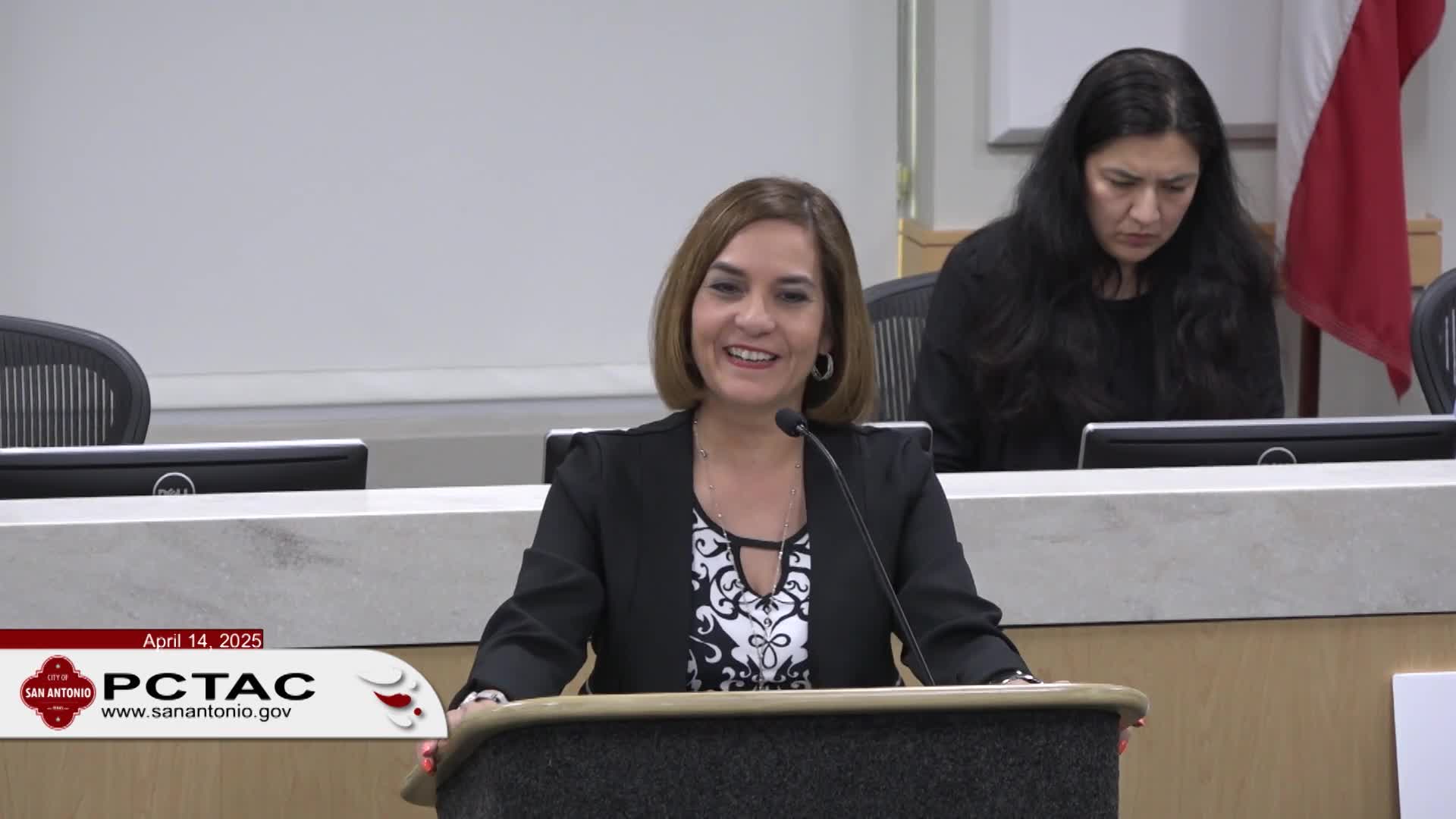
Summary
The Planning Commission Technical Advisory Committee voted to recommend approval of a city-initiated amendment to the Major Thoroughfare Plan that would create a new South Texas Parkway corridor linking I-35 and I-37 and reclassify portions of Kelly Parkway to Malerman Road.
The Planning Commission Technical Advisory Committee voted to recommend approval of a city-initiated amendment to the Major Thoroughfare Plan that would create a new South Texas Parkway corridor linking I-35 and I-37 and reclassify and realign sections of Kelly Parkway to Malerman Road.
Kat Hernandez, director of the city's transportation department, presented the proposal and said, "I'm bringing forward to you, an amendment to our major thoroughfare plan" to add a corridor and reclassify existing segments to provide east–west connectivity in the southern sector of the city. Hernandez said the change is intended to support recent growth around University Health System, Texas A&M and the South Star development and to reduce freight traffic using neighborhood streets.
The amendment would add a conceptual freeway-class corridor (a freeway classification in the Unified Development Code provides a right-of-way range of roughly 250 to 500 feet) between I-35 and I-37. Staff said the corridor would likely be built at about 300 feet. The proposal also would reduce the Kelly Parkway–Malerman Road segment from a super-arterial (about 250 feet) to a secondary arterial (about 86 feet) and shift that alignment to follow the existing Malerman Road out to Pleasanton Road. Hernandez said the central portion of the proposed corridor is a new conceptual alignment intended to close an existing gap on the city’s Major Thoroughfare Plan.
Hernandez described the project timeline: staff held three community meetings the previous week (west-side property owners, east-side property owners and a meeting on the conceptual center alignment), and planned to take the item to Planning Commission on April 23 and to City Council on May 8. She said the city is seeking state funding and that stakeholders including University Health System, Texas A&M, Toyota, JCB, South Star and regional organizations had participated in the stakeholder process.
Committee members and speakers raised several recurring concerns. Questions focused on public outreach and notice, potential impacts to private property and future compensation, floodplain and environmental effects, and interactions with Toyota’s site and test track.
Renee Neria, a former president of the South Side Alliance for Economic Development who spoke during public comment, said the project was an idea her group advanced decades ago and offered support: "I think it's gonna be a real blessing for the South Side." Committee members pressed staff to provide clearer, parcel-level outreach. One committee speaker, Bianca (committee member), asked the city to "go above and beyond with public engagement" because owners may not understand that a plan amendment can limit future development before funding or construction begins.
Staff provided several clarifying details during the meeting: the city notified 250 property owners who were identified as impacted (roughly a hundred properties on each of the west and east sections, and about 40 properties—22 owners—in the central conceptual segment). Staff reported about 50 people attended the three outreach meetings. Hernandez and other staff emphasized that the amendment is conceptual and does not itself acquire land; dedication or acquisition would occur later during platting, feasibility studies and any right-of-way acquisition phase. Staff said the city explores negotiated acquisition first and uses eminent domain only as a last resort.
Environmental and operational concerns were raised. A committee member asked whether the alignment affects the Mitchell Lake Audubon Center; staff responded it does not. Members also flagged proximity to Leon Creek and asked about coordination with agencies such as the San Antonio River Authority; staff said the River Authority is part of technical reviews and that the city has been coordinating with utility and stormwater operators. Committee members discussed Toyota’s facilities and a test track on the northern side of the plant; staff said moving the alignment north would affect Toyota’s test track and that the city had discussed refinements with Toyota but that changes could be costly.
Staff summarized travel-demand analysis from regional models: the MPO 2050 model shows substantial growth in the area (staff cited roughly 20,000 new homes and several thousand new employees projected) and staff said the corridor could carry on the order of 60,000–70,000 average daily trips in future conditions; staff also described an aggregate trips figure from the MPO analysis used in planning. Staff and speakers said the corridor is intended to reduce truck traffic through neighborhoods and to improve freight access to inland-port corridors.
The committee voted on a motion to recommend approval of the amendment with two explicit additions requested during discussion: that staff continue and expand outreach to property owners and community members and that the presentation shown at the meeting be included in the meeting minutes. Miss Maldonado moved the motion; Miss Fairmont seconded. A roll-call vote showed 19 in favor and 1 opposed (Miss Karen Dyker). The motion passed.
The committee’s recommendation advances the amendment to Planning Commission on April 23 and, if recommended, to City Council on May 8; staff said the next steps include feasibility and engineering work and securing funding, with detailed property-level analyses and acquisition work to follow only after funding and project definition. Staff noted that similar parkway projects have taken many years to advance from plan to construction and that right-of-way acquisition typically represents a major portion of cost and schedule.
Questions that remain on the record include the scope and format of expanded outreach, specific property-level impacts once feasibility work is complete, the final right-of-way width chosen for each segment during design, and the ultimate funding/ownership arrangement for construction and long‑term maintenance (city, county and/or TxDOT participation was discussed but not decided).