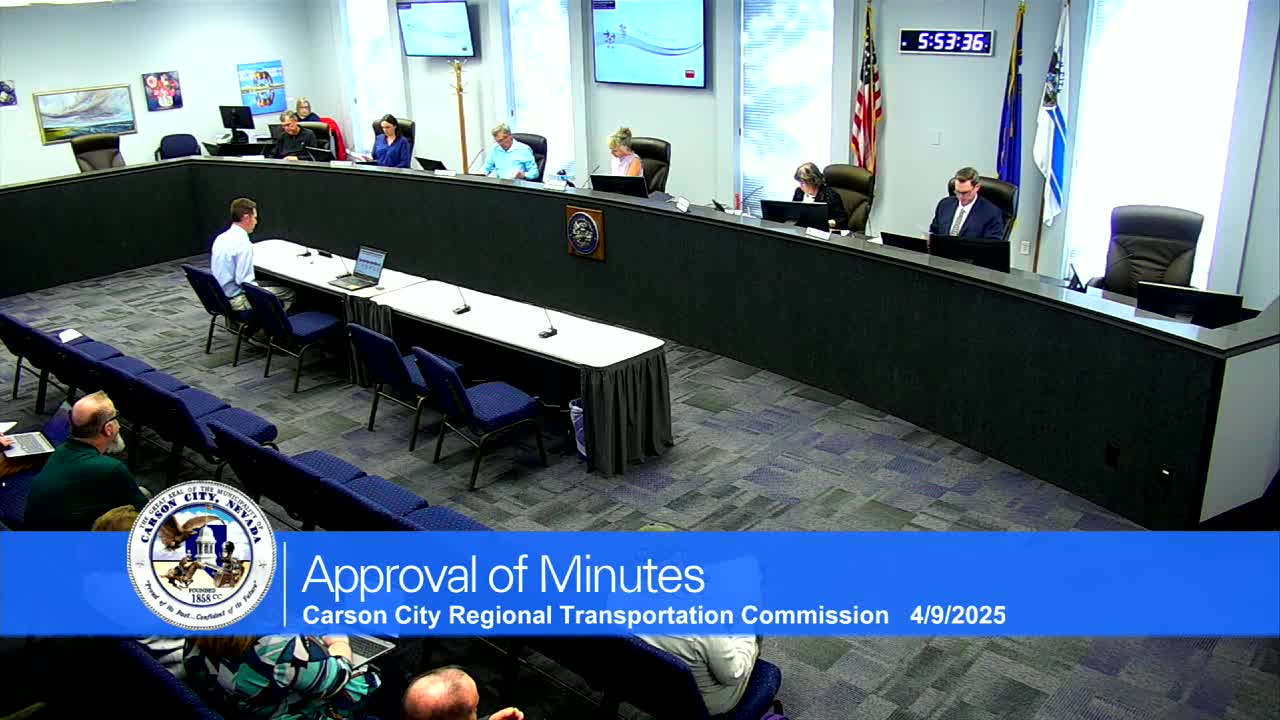
Carson City RTC unanimously recommends FY26 transportation, transit and street budgets; supplementals left for later
Loading...
Summary
The Carson City Regional Transportation Commission voted unanimously to recommend the Board of Supervisors approve the fiscal year 2026 budgets for regional transportation, transit and street maintenance funds, while deferring approval of two supplemental staffing requests amid concerns about limited street-fund capacity.
At its meeting, the Carson City Regional Transportation Commission unanimously voted to recommend that the Carson City Board of Supervisors approve the fiscal year 2026 budgets and capital requests for the regional transportation, transit and street maintenance funds.
The recommendation covers three funds: the transit fund (Fund 225), the regional transportation fund (Fund 250) and the street operations fund (Fund 256). Commissioners and staff emphasized that the transit budget maintains current service levels and that significant expansion would require additional local matching revenue. Commissioners also debated two supplemental staffing requests — a shared compliance officer and additional right-of-way maintenance funding — and agreed those supplementals would not be recommended as part of this motion.
Why it matters: The decision sets the commission's formal budget recommendation to the Board of Supervisors and frames near-term priorities for pavement projects, grant matches and capital purchases. Commissioners repeatedly warned that without new revenue or transfers, the city’s pavement condition index (PCI) will continue to decline and only limited miles of critical roadway work can be funded.
Transit: Transportation Manager Chris Martinovich said the transit (225) budget contains no requested expansions for FY26 and is structured around a mix of federal grants and eligible local-match sources, including state grants, advertising revenue and an operating transfer. Martinovich noted the fund programs vehicle replacements — about $586,000 is listed for vehicle purchases in FY26 tied to replacing two larger “pusher” buses (vehicles 43 and 44) with slightly shorter models — and the fund maps account for differing federal match rates. "This budget maintains the current transit operations," Martinovich said. He also said staff are keeping up with federal grant execution and matching requirements to avoid losing apportionments.
Regional transportation (Fund 250) and debt service: The commission reviewed Fund 250's revenue mix, which includes county-option fuel tax receipts and a capital sanitation franchise fee tied to the Waste Management contract. Staff explained a $50,000 placeholder for the Ash Canyon reconstruction project as the RTC's committed local contribution to a larger federal lands access grant package that includes more than $5 million from federal sources plus local park and stormwater funds. The commission heard that debt service on existing bonds is currently consuming capacity but that scheduled bond payoffs will free local dollars in coming years; staff estimated roughly $1 million becomes available in FY29 and another roughly $500,000 in FY30 as bonds expire, allowing more capital spending later.
Street operations (Fund 256) and supplementals: Commissioners probed Fund 256 line items, including the city’s small year-end "street repairs" balance (an example figure shown was $22,000 as a year-end placeholder). Staff described two supplemental requests in the streets account: (1) a shared compliance officer (the cost allocation proposed as 50% landfill, 20% streets, 15% water, 15% wastewater) intended to reduce time public-works crews spend responding to signage, illegal dumping and other right-of-way complaints; and (2) a $190,000 request for right-of-way landscaping/weed-abatement work. Deputy Public Works Director Rick Cooley said the compliance officer would allow crews to remain focused on maintenance rather than repeatedly responding to enforcement-type complaints. Several commissioners expressed support for the concept but opposed charging a strained street fund for a new FTE. "I don't wanna take 20% from the street division," one commissioner said, noting that the street fund ending balance is limited and payroll and basic operations must be preserved.
Public comment and budget questions: Carson City resident Mark Costa asked why some revenue and expenditure categories show dramatic year-to-year swings in the packet, noting a roughly 90% decline shown in intergovernmental revenues and an 86% decline in capital outlay in certain tables; he also asked why debt service appears as about $1.6 million and why a $3 million line for district repairs is far short of a $21 million shortfall he recalled. Staff explained that intergovernmental figures change when grants are received and augmented; large federal grants appear only when awarded and executed. Finance staff and commissioners stressed the difference between available fund balances for matching grants and actual recurring local revenue.
Project status and prioritization: Staff walked through the project-status report and several near-term projects expected to advertise or begin construction in the next months, including East William Street reconstruction (bids received and award expected at the Board of Supervisors meeting), multiuse path work, and several ARPA-funded neighborhood rehabilitation segments. Staff noted that some districts show lower PCI scores temporarily because projects are in design but not yet constructed; that can cause year-to-year dips that are expected to improve as projects are delivered.
Vote at a glance: - Motion: "Recommend that the Board of Supervisors approve the fiscal year 2026 budgets and capital requests for the regional transportation, transit and street maintenance funds." Mover: Member Maloney. Second: not specified in the transcript. Outcome: recommendation approved unanimously. Yes: Chair (unspecified by name), Vice Chair Shetty, Member Dotson, Member Novak, Member Maloney.
What’s next: The RTC will forward the recommendation to the Carson City Board of Supervisors for final adoption. Commissioners asked staff to bring further materials to an upcoming prioritization meeting (in June) showing fund-level five-year projections, how bond payoffs change capacity in FY29–FY30, and options for splitting district-level allocations between regional and local roads. Staff also indicated they will present a project-prioritization discussion and continue seeking grant matches for projects when possible.
Quotes (select): "This budget maintains the current transit operations," Chris Martinovich, Transportation Manager. "I looked quickly through some of the forms and I had a bunch of questions... particularly you look at the intergovernmental resources... showing a decline of, my gosh, I think that's like 90%." Mark Costa, Carson City resident. "When we look at District 3... I threw in a line item to get some feedback... Is that something we want to do now?" Chris Martinovich, Transportation Manager.
Ending: Commissioners approved the RTC’s recommendation by unanimous vote and left open further discussion on the two supplemental staffing requests and district-level prioritization; the Board of Supervisors will consider formal adoption of the FY26 budgets and capital requests at a subsequent meeting.