Get Full Government Meeting Transcripts, Videos, & Alerts Forever!
Get email alerts on the Climate Resilience topic
No spam. Unsubscribe anytime.
Planning Commission urges county-specific analysis before new sea-level regulations, debates 'best management practices' wording
Summary
Commissioners argued for local data and stakeholder review before adopting sea-level regulations and discussed whether the comp plan should add broader definitions for best management practices and environmental science.
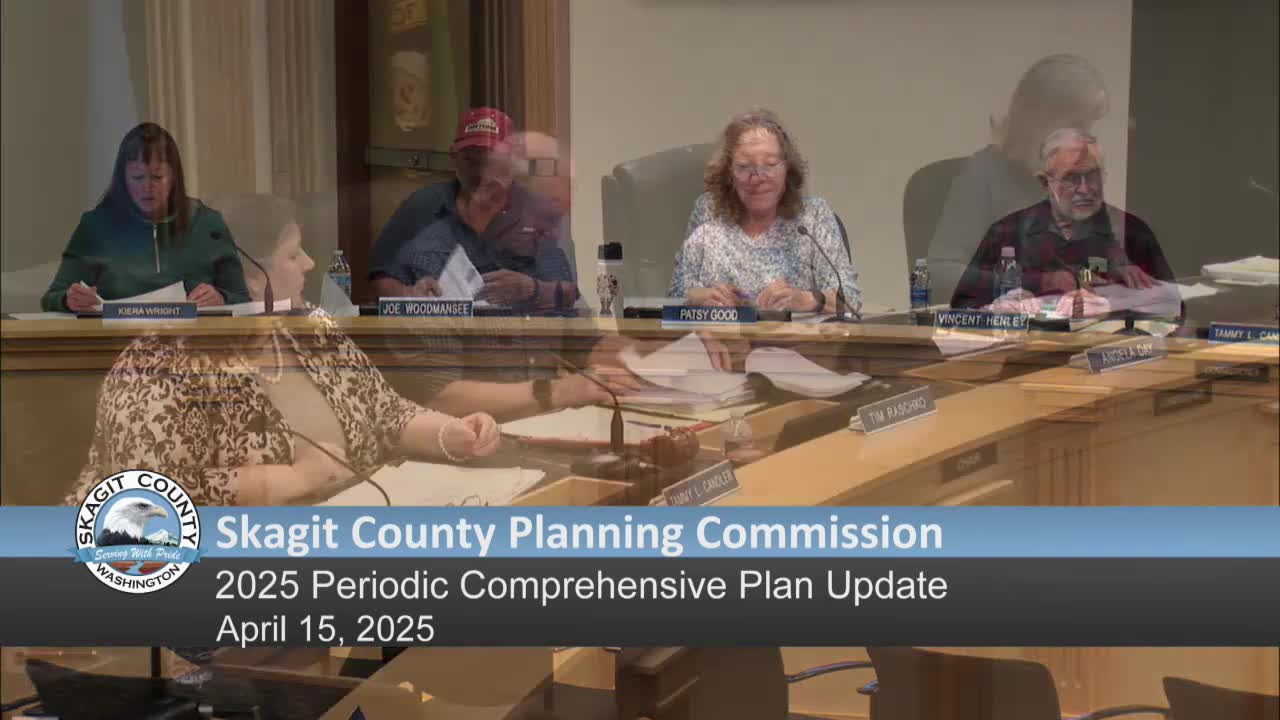
The Skagit County Planning Commission debated on April 15 whether the comprehensive plan should direct the county to develop new regulations to address sea-level rise before the county undertakes detailed, local scientific analysis and stakeholder engagement. After extended discussion, commissioners agreed to recommend adding conditional language to coastal and resilience policy text requiring in-depth analysis and stakeholder input before developing prescriptive regulations.
Commissioner Day raised concerns that policies calling for regulations on elevation and setbacks read like "cart before the horse" when the county lacks a local monitoring program for sea-level impacts. "We talk about sea level rise but we don't currently in our county have any monitoring or ability to really look at what the science is on that or what that looks like for us," she said, and asked that the commission add language that ties regulatory action to county-specific analysis.
Planning staff said available statewide mapping currently relies largely on FEMA datasets and statewide tools, and that the county’s critical areas ordinance update (coming to the commission next week) will include the best-available science used for that regulation. Staff member Robbie told the commission that "best management practices and best available science are both defined in, in county code" and pointed to definitions already in Title 14; Clay and other staff noted that the critical areas ordinance and development regulations will include more detailed technical material.
Commissioners expressed different concerns: some wanted a broader, "environmental science" preamble that would encourage review of multiple scientific disciplines (geology, hydrology, meteorology) when the county evaluates environmental issues; others cautioned that the widely used term BMP (best management practices) often is tied to stormwater and specific Department of Ecology guidance. Staff suggested that many BMP and BAS definitions are already codified in Title 14 and that the forthcoming critical areas ordinance package will provide an occasion to revisit definitions and technical bases.
After discussion the commission agreed to recommend modifying the relevant sea-level policy (policy 12j-1.1/12j-1.7 was referenced in the discussion) to include conditional language such as "if appropriate after in-depth analysis and stakeholder engagement" before directing staff to develop regulations that would require elevation or setback standards based on sea-level projections. Commissioners and staff emphasized that this approach would place assessment and stakeholder processes in the implementation plan so that methodology and local vulnerability mapping can be completed before prescriptive regulations are adopted.
Ending
Staff told the commission the draft critical areas ordinance (including the technical basis and best-available science references) will be presented at the next meeting and will be the vehicle for more detailed, implementable definitions and vulnerability analysis. The commission asked staff to incorporate the conditional language into the recorded motion forwarded to the Board of County Commissioners.