Get Full Government Meeting Transcripts, Videos, & Alerts Forever!
Get email alerts on the Judicial Procedure topic
No spam. Unsubscribe anytime.
Committee advances bill sending facial constitutional challenges to Court of Appeals; judges warn of logistical and fiscal impacts
Summary
House Bill 1832 would move initial jurisdiction for facial constitutional challenges to the Arkansas Court of Appeals. Supporters say it reduces forum-shopping; Court of Appeals officials warned of possible caseload, evidence-taking and reporter costs.
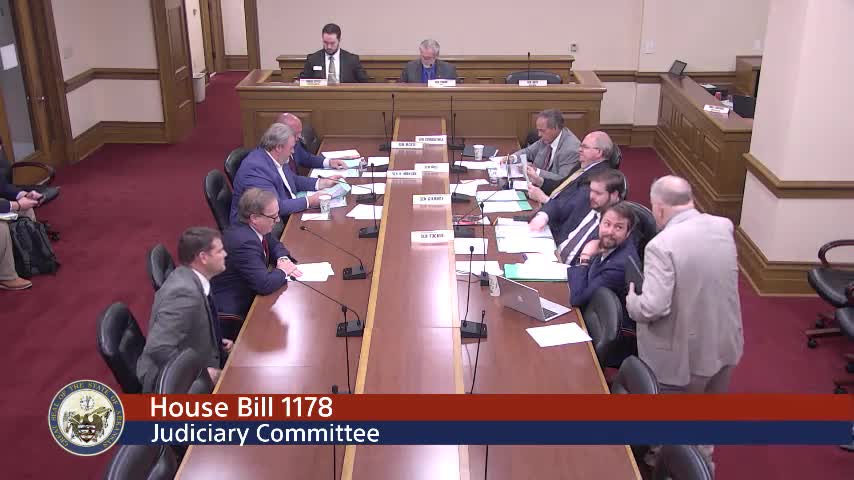
The Senate Judiciary Committee approved House Bill 1832, which would transfer initial jurisdiction for facial constitutional challenges to the Arkansas Court of Appeals rather than circuit courts.
Representative Matthew Shepherd, the bill's presenter, said the change is narrow and limited to "facial" challenges — cases that seek to invalidate a law in all its applications. He told the committee, "This bill is only covering challenges in which a claimant is seeking to invalidate an act or rule, of the general assembly." Shepherd said the intent was to have such cases heard initially by judges elected from across the state rather than by a single circuit court.
Mark Clappenbach, chief judge of the Arkansas Court of Appeals, testified with Anne Solomon, the court's chief staff attorney. Clappenbach said the court's concern is not the fairness of judges but the uncertainty about caseload and the court's existing structure: "we're not here today to, to support or or not support the bill. We're just concerned about depending on how it's done, what how it'll affect our caseload in the Court of Appeals." Solomon added that the court does not normally take evidence, lacks routine courtroom infrastructure such as court reporters and trial support staff, and that the Administrative Office of the Courts does not track statistics that would show how many constitutional challenges the attorney general declines to intervene in.
During questioning, committee members pressed on procedural details the bill leaves to the Supreme Court's rulemaking and on whether shifting these cases could create a form of forum selection. Representative Shepherd said the change rests on Amendment 80, Section 10 of the state constitution and argued the plan would reduce forum-shopping by centralizing venue for facial challenges in a statewide court.
Committee discussion included fiscal concerns: court officials said DFA's fiscal note did not reflect potential costs the Court of Appeals might incur for court reporters, masters or additional staff. Representative Shepherd acknowledged the success of the plan depends on rules the Supreme Court would adopt and on procedures the Court of Appeals would establish. The committee approved the bill by voice vote.