Get Full Government Meeting Transcripts, Videos, & Alerts Forever!
Get email alerts on the Housing Finance topic
No spam. Unsubscribe anytime.
Supervisor Safaie pitches targeted transfer‑tax reduction to unlock union‑built affordable housing projects
Summary
Supervisor Safaie introduced an ordinance to reduce real property transfer tax rates to 3% for certain high‑value property transfers that meet on‑site affordable unit, union labor and union pension investment criteria; he said the change could unblock stalled construction projects.
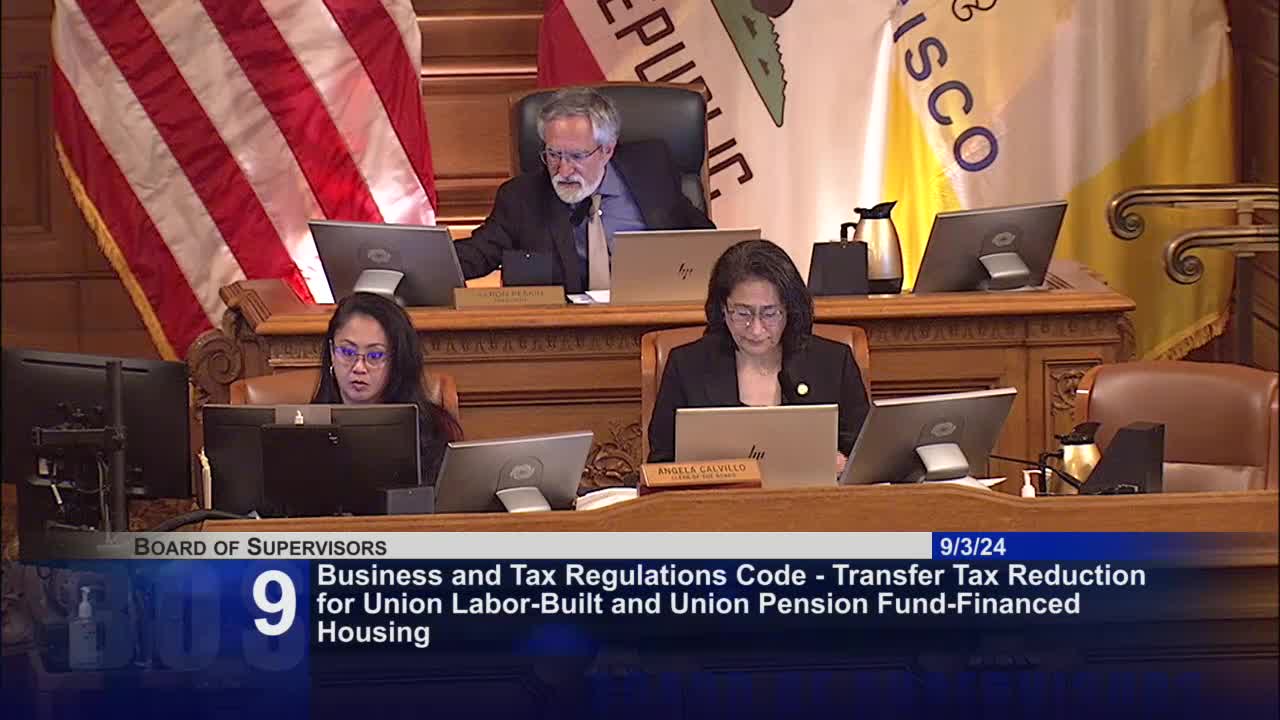
Supervisor Safaie introduced an ordinance on Sept. 3 to amend the city's Business and Tax Regulations Code to reduce certain real property transfer tax rates to 3% for qualifying transfers that meet specified affordable‑housing, union‑labor and pension‑investment criteria.
The proposed code change would reduce the transfer tax from 5.5% to 3% for transfers with consideration of at least $10 million but less than $25 million, and from 6% to 3% for transfers at or above $25 million, provided the transferred property includes at least 12% rent‑restricted units constructed using union labor and had at least $25 million in debt or equity investment from a union pension fund at the time of transfer. The ordinance was passed on first reading.
Why it matters: Supervisor Safaie said the ordinance is a “targeted way to finance some of the construction that's in the pipeline” and argued it could help unlock stalled, fully‑permitted projects by improving access to financing while ensuring on‑site affordable housing and union labor requirements.
Details and sponsor remarks: Supervisor Safaie told colleagues that San Francisco has “over 40,000 fully permitted projects in the pipeline that just are not moving” and that financing barriers are a major reason. He argued the transfer‑tax reduction would “literally unlock some of the projects that have been waiting. So we'll get we'll put good union members to work. We'll build affordable housing on‑site.” He invited other supervisors to co‑sponsor the legislation; Supervisor Chan and Supervisor Melgar were listed by Safaie as early cosponsors.
Next steps and scope: The ordinance passed on first reading; further committee hearings and final readings will be required before the tax change becomes permanent. The measure applies only to transfers that meet the specified affordable‑unit and union‑investment criteria described in the ordinance language read into the record.
Ending: The board advanced the ordinance on first reading; the sponsor said he hopes the targeted reduction will help the city meet housing production goals by incentivizing projects that include on‑site affordable units and union labor.