Get Full Government Meeting Transcripts, Videos, & Alerts Forever!
Get email alerts on the Public Safety Policing Accountability topic
No spam. Unsubscribe anytime.
San Francisco protesters demand charges and release of video after Walgreens security guard kills Black trans man
Summary
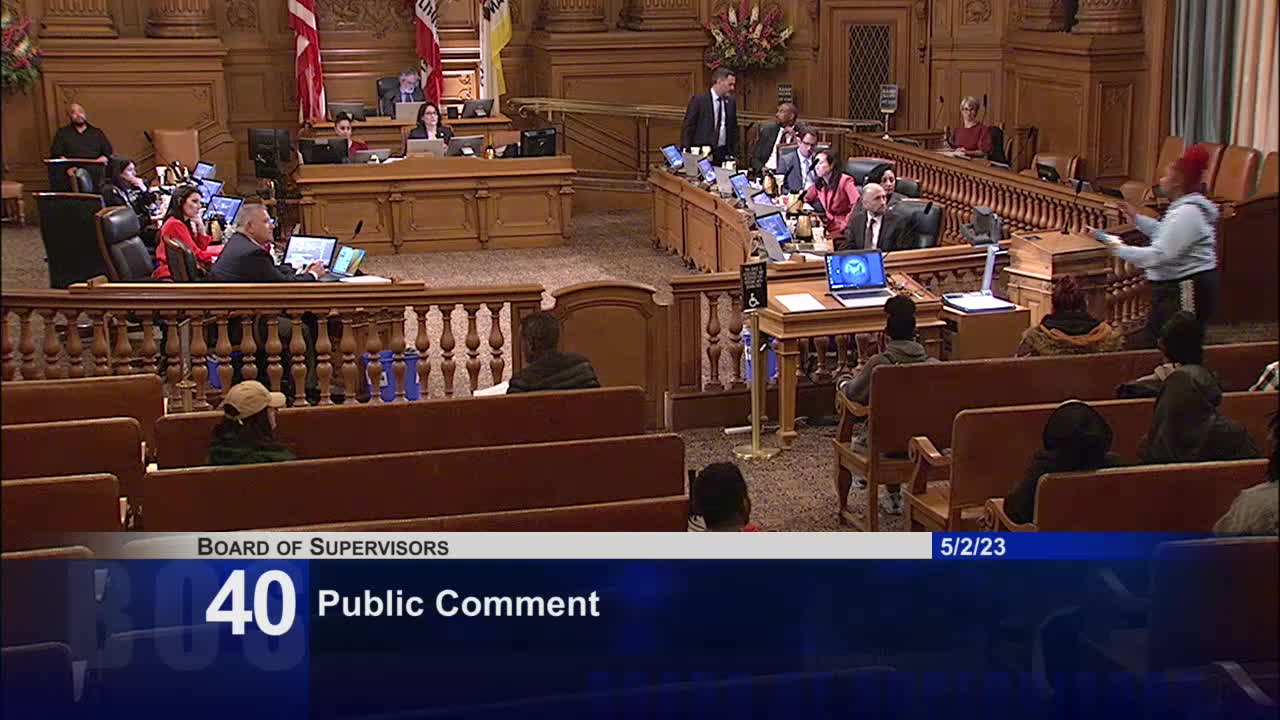
Hundreds of public commenters and community groups addressed the San Francisco Board of Supervisors on May 2 after a Walgreens security guard shot and killed Banko Brown; speakers demanded the district attorney revisit charging decisions and called for bans on armed private security and more housing and services for vulnerable residents.
Hundreds of residents, advocacy groups and family members addressed the San Francisco Board of Supervisors on May 2 following the April 27 killing of Banko Brown by an armed security guard outside a Walgreens at Fourth and Market Street, calling for the district attorney to reconsider charging decisions and for immediate policy changes to prevent future deaths.
The public outcry centered on calls for the release of store surveillance video, accountability for Walgreens and its contracted security, and broader demands for housing and services for Black and transgender residents. Several speakers tied Brown’s death to systemic racism and to city funding priorities that they said over-invest in policing and under-invest in housing and social services.
Board President Peskin, responding after public comment, said he was "deeply concerned, based on my conversations with law enforcement, by the district attorney's decision not to charge at least manslaughter," and said he planned to pursue formal action asking the district attorney to “reconsider and re-examine that decision.” Supervisor Walton told the chamber during members' remarks: "you do not have the right to execute someone just because you have a gun and you do not have the right." Supervisor Ronan offered condolences and said she and colleagues were listening.
Community organizations and people who knew Brown described him as a community organizer and urged concrete steps: release of the Walgreens tape, prosecution or independent review of the shooting, a ban on armed private security in retail settings, and greater investment in housing and behavioral-health services. Julia Arroyo, co-executive director of the Young Women's Freedom Center, who worked with Brown, urged the district attorney to make the footage public: "Please, the D. A. Jenkins to release the video, the tapes." Other speakers, including organizers, family members and community advocates, led chants and repeated Brown’s name throughout the two-hour public-comment block.
Multiple speakers linked their calls to broader policy decisions. Several criticized the district attorney, Brooke Jenkins, for declining to bring charges; others criticized recent increases in police overtime funding and urged reallocating resources to services. Protesters and community members staged demonstrations outside the Walgreens and pushed the board to hold a public hearing and demand transparency from Walgreens and the district attorney's office.
Members of the public pressed for specific measures including a city ban on armed private security in retail stores, expedited release of evidence in the case, and more rapid placement of people experiencing homelessness into housing. Members of the board announced steps they intended to pursue: President Peskin said he would submit an in memoriam for Brown and seek formal board action requesting the DA reexamine the case; several supervisors asked the district attorney to release video evidence publicly.
The meeting record shows extensive public participation on this incident and multiple supervisors acknowledged community grief and the need for accountability. The board did not take a formal vote during the public-comment period on criminal charges; subsequent formal actions on the DA's decision were proposed for future meetings.