Get Full Government Meeting Transcripts, Videos, & Alerts Forever!
Get email alerts on the Land Use topic
No spam. Unsubscribe anytime.
Board affirms Planning Department's community-plan exemption for 1088 Howard Street after hearing; appellants raised air, noise and sewer concerns
Summary
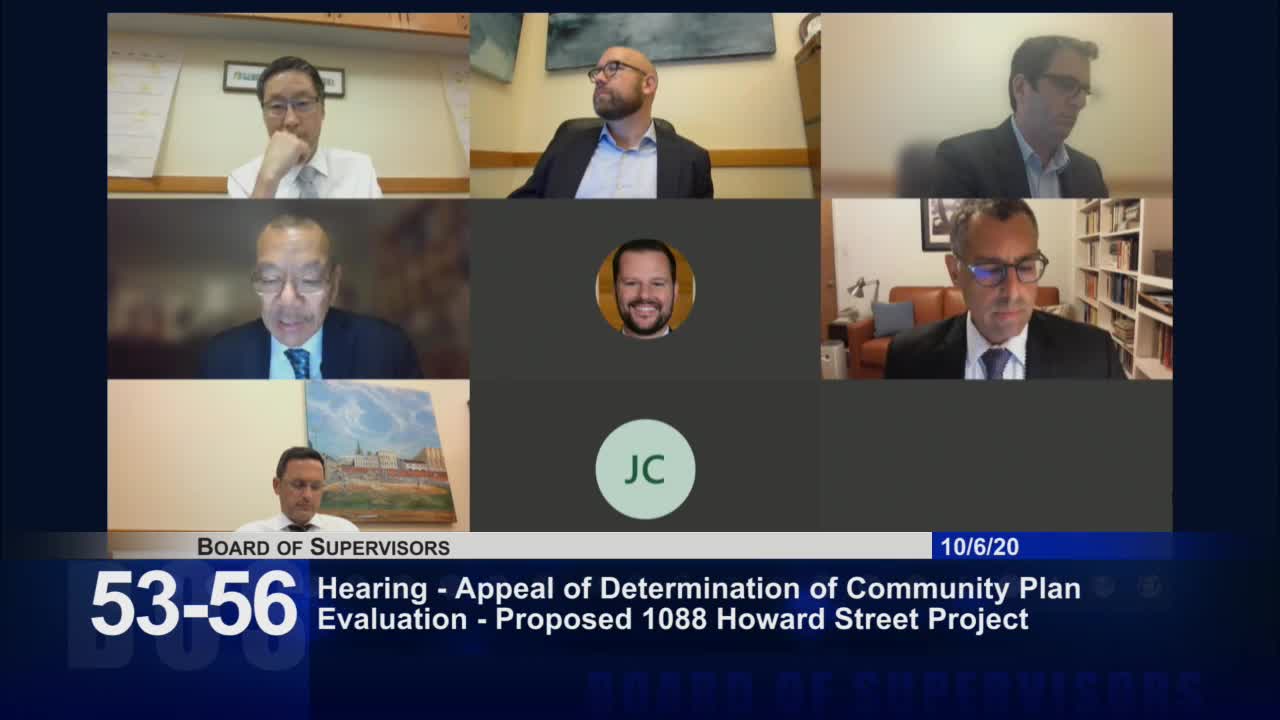
The Board of Supervisors affirmed the Planning Department's community plan evaluation for a proposed seven-story mixed-use project at 1088 Howard Street after a contested hearing in which neighboring condominium residents raised construction noise, wildfire-related air-quality and sewer-backup concerns.
Lede: The Board of Supervisors reviewed an appeal of the Planning Department's community plan evaluation (CPE) for a proposed seven-story mixed-use project at 1088 Howard Street (agenda items 53–56). Neighbors living in an adjacent high‑density condominium raised construction noise, air quality (including wildfire smoke and the COVID era's more-homebound residents), and local sewer-backup concerns. Planning staff and project experts countered the project is consistent with the Eastern Neighborhoods program EIR and that mitigation and city rules reduce construction impacts to less-than-significant levels.
Nut graf: Appellants contended the PEIR did not contemplate the current pandemic and extended wildfire smoke episodes, and they argued the specific adjacency and building geometry combined with an older condominium configuration create a unique exposure pathway for contaminants and noise. Planning staff said the program EIR anticipated residents present during construction and that the project-specific CPE included technical studies and required mitigation (noise attenuation measures, low-emission construction equipment, and registration of receiving facilities) that render impacts less than significant.
Key elements from the hearing: - Appellants' case: Board testimony from multiple condo residents said units are very small (average ~300 sq ft), have limited windows facing the project site, and would experience reduced airflow and additional heat during construction and after build-out. They expressed particular concern about aerosolizing legacy contaminants in shallow soils and about sewer backups in heavy rain events. The appellants requested a full CEQA review. - Planning Department: Staff presented the CPE and supporting studies for air quality, greenhouse gases, soils, noise and utilities. Staff explained the PEIR conservatively assumed residents would be present during construction and that mitigation measures (tiered low-emission construction equipment and site‑specific noise attenuation plans) would reduce impacts to a less-than-significant level. - Sponsor presentations: The project sponsor described the development (24 two‑bedroom units, three on-site affordable units; no parking; 71-foot height in an MU district), the technical soil assessment (project geologist said detected lead levels were consistent with broader citywide 1906-earthquake-related deposits and not from recent site operations), and the planned mitigation measures (site-specific noise controls; clean equipment).
Board action: After presentations and public comment, the Board voted to affirm the Planning Department's CPE (item 54) and table related action items (55–56) that would have reversed the CPE. The roll call recorded 10–0 (one supervisor briefly absent from the roll call sequence before being recorded) in favor of affirming the Department's determination.
Why it matters: The case illustrates how programmatic environmental review interacts with project-level studies: where a program EIR sets conservative assumptions and mitigation, subsequent project CPEs often rely on those measures unless appellants present substantial evidence of new, project-specific impacts. Neighbors raised concerns about compound exposures (construction plus wildfire smoke plus more time at home during the pandemic) that the Planning Department and project team said the program-level analysis and project-level mitigations already covered.
Ending: The Board's vote affirms the Planning Department's process and required mitigations for 1088 Howard Street; parties may still pursue other legal or administrative remedies off the dais. The cited mitigation and monitoring measures (equipment emissions limits; site-specific noise attenuation to be approved by DBI; registration of receiving facilities) remain central to the project's permit path.