Get Full Government Meeting Transcripts, Videos, & Alerts Forever!
Get email alerts on the Housing And Homelessness topic
No spam. Unsubscribe anytime.
Mayor Breed urges housing-first approach, highlights 1939 Market site and new shelter goals
Summary
Mayor London Breed told the Board of Supervisors the city must expand shelter and housing options, including sobering centers and safe‑injection sites, and highlighted work to acquire 1939 Market Street for affordable senior housing.
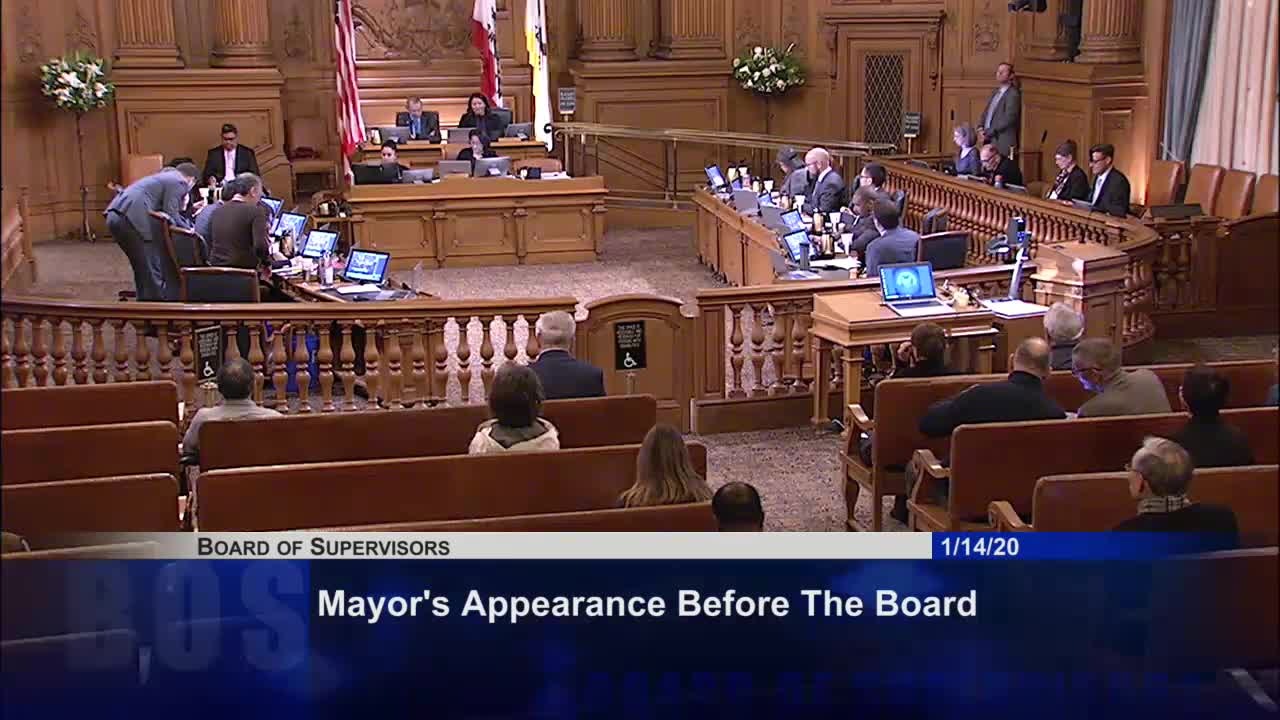
Mayor London Breed told the San Francisco Board of Supervisors on Jan. 14 that the city must expand shelter capacity and housing to address homelessness, and she highlighted a city effort to identify 1939 Market Street as a site for affordable housing for seniors.
Breed said outreach crews who met people on the Embarcadero that morning placed three people in navigation centers but encountered many who declined help. "Addressing homelessness, we know, is a real challenge in our city," she said, adding that the city aims to open 1,000 new shelter beds this year and is working on additional options for people who refuse existing services.
The mayor framed housing as the longer‑term solution, and listed other strategies including sobering centers and safe injection sites. She also cited a proposal for 1939 Market Street in Supervisor Mandelmann’s district, saying the site could house about 80 seniors permanently. Breed thanked supervisors for partnership on several housing efforts and noted the city faces an estimated $500 million budget gap.
Why it matters: City leaders emphasized a mix of immediate shelter capacity, outreach and long‑term housing to reduce street homelessness. The mayor framed both local and state policy shifts as necessary to serve people who decline help and to expand housing at speed and scale.
Details and context
Breed said earlier outreach that day led to three placements in a navigation center on the Embarcadero but that dozens refused services. She described one woman who appeared hungry and in distress and who declined services. "We have to make sure that there are places for people to go," Breed said, and added that options for people who reject shelter will require policy changes at the city and state level.
On housing, the mayor applauded work on multiple developments and cited a new opportunity at 1939 Market Street in Supervisor Mandelmann’s district that could produce permanent affordable units for seniors. She also referenced a major announcement that she said would yield 2,600 units (reported alongside Supervisor Walton) and noted the city’s prior successes with a housing bond but warned of a significant budget shortfall.
What officials said
- Mayor London Breed, speaking to the full board, said the city must pursue shelter expansion, sobering centers and safe‑injection sites and emphasized that "housing is gonna be critical" to addressing the crisis. - Supervisor Mandelmann (remarks acknowledged by the mayor) was thanked for partnering on the 1939 Market effort. - Supervisor Ronan was thanked for leadership on a school‑based shelter that the mayor said has helped families exit homelessness.
What the record shows
These remarks were delivered during the mayor’s scheduled 2 p.m. appearance before the board; they were primarily a policy overview and status update. The transcript records no formal vote tied to the mayor’s remarks. The board did not adopt any new citywide homelessness ordinance at this meeting; several housing and finance resolutions on the agenda (see separate "Votes at a glance" article) moved forward through the consent calendar or public hearings.
Looking ahead
The mayor said further discussion and policy work — including potential state‑level reforms — will be required to expand options for people who decline services. Several supervisors expressed support during the meeting for increased shelter capacity, community‑based housing and local planning tools to accelerate affordable units.