Get Full Government Meeting Transcripts, Videos, & Alerts Forever!
Get email alerts on the Water Policy topic
No spam. Unsubscribe anytime.
Board backs new rules to require water recycling in large new buildings and city policy to expand recycled water use
Summary
Supervisors passed on first reading an ordinance that will require certain large new developments to use on-site nonpotable water systems, mandate water-budget analyses for sizable projects, and set city policy to phase in recycled water for public irrigation and cleaning.
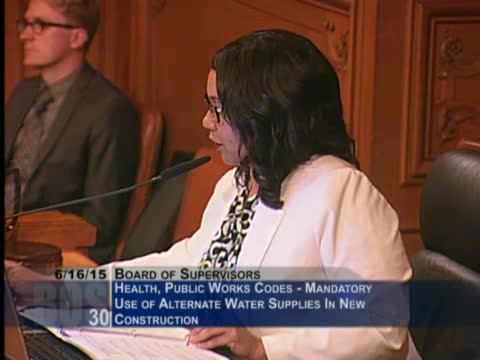
The Board of Supervisors on July 16 unanimously approved on first reading an ordinance that requires large new developments in San Francisco to include on-site water reuse systems or participate in district-scale nonpotable systems, and sets a city policy to expand recycled water use in public spaces.
Supervisor Scott Wiener, the measure's lead sponsor, said the ordinance is intended to address California's prolonged drought and to conserve potable water by requiring available alternate water sources for large buildings. The ordinance requires new buildings of 250,000 square feet or more to install and operate on-site water-reuse systems; developments of 40,000 square feet or more must complete a water-budget analysis to evaluate the feasibility of reuse systems.
Wiener said the policy initially focuses on developments in the city's reclaimed "purple pipe" zone but extends citywide over a two-tier schedule to give some projects already permitted time to comply. He described possible approaches including on-site systems or shared district systems serving several buildings. The measure also directs city departments to move toward using recycled water for park irrigation and cleaning public spaces within five years, and it urges the Public Utilities Commission to consider fee reductions that reflect reduced sewer impacts where reuse systems are installed.
Supporters noted potential water savings: Wiener and staff cited examples where mixed-use projects could offset 100 percent of nonpotable demand and estimated a large residential building could reduce potable use by millions of gallons per year. The Board adopted a minor cleanup amendment distributed before the vote and approved the ordinance as amended without objection.
Ending The ordinance passed unanimously on first reading and will return for further readings. Supervisor Wiener and staff said follow-up work will include PUC fee studies and possible future steps to encourage or require reuse in existing buildings within the purple-pipe zone.