Get Full Government Meeting Transcripts, Videos, & Alerts Forever!
Get email alerts on the Land Use Ceqa Appeal topic
No spam. Unsubscribe anytime.
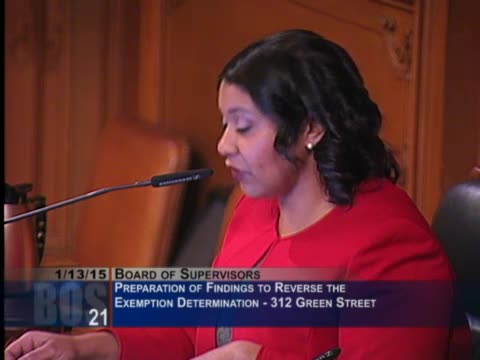
Board affirms planning department's categorical exemption for 312 Green Street after neighbors' appeal
Summary
The Board of Supervisors denied an appeal and unanimously affirmed the Planning Department's determination that a proposed vertical addition at 312 Green Street (Telegraph Hill) is categorically exempt from CEQA.
The San Francisco Board of Supervisors on Jan. 13 affirmed the Planning Department's categorical exemption under CEQA for a proposed vertical addition at 312 Green Street (Telegraph Hill), denying an appeal from neighboring property owners.
The project sponsor proposes adding two stories to an existing two-story single-family house, install a roof deck, widen a garage door and perform seismic and accessibility upgrades. Neighbors, represented by Ryan Patterson and by structural and geotechnical experts, argued the work amounted to de facto demolition that triggers full environmental review due to "unusual circumstances," including potential geotechnical impacts from sandstone outcrops and concerns about view, shade and solar-panel impacts.
Why it matters: The decision upholds the Planning Department's determination that the project falls within CEQA class 1 (additions to existing structures) and that the appellants did not present substantial evidence showing a fair argument that the project could cause a significant environmental impact. The ruling allows the project to proceed under the Planning Commission's prior approvals, subject to building department requirements.
What was argued: Appellants' experts described structural and geotechnical concerns, saying the project scope involves extensive replacement of framing and foundations and that sandstone bedrock at the site might require heavy excavation methods. Appellant Jack Oswald also said the addition would substantially shade rooftop solar panels on a neighboring property and asked the board to delay action and require mediation. The project sponsor and architect, Bruno Cantor, said the scope had been reduced in response to neighbor input, that the project complies with zoning and the Planning Commission had unanimously approved the discretionary review, and that structural concerns are DBI matters.
Board action: Supervisor Mark Farrell seconded a motion by Supervisor John (District 15) Christensen to affirm the Planning Department's categorical exemption. The roll call vote to deny the appeal and uphold the exemption was unanimous.
Details to note: - Planning staff said the building does not qualify as a historic resource, citing alterations (stucco replacement, window changes) that reduced integrity from the reconstruction period after the 1906 earthquake. - The project had earlier received discretionary review and the Planning Commission voted 6-0 to approve the project; a rear-yard variance decision by the zoning administrator is under separate appeal and scheduled for a later hearing before the Board of Appeals. - Planning staff cited compliance checks against Planning Code section 3.17 and the City building code in concluding the work qualifies as an exemption.
Next steps: With the Board's affirmation the project returns to the usual building-permit and DBI processes. The Board urged neighbors to seek continued dialogue; Supervisor Christensen expressed regret at the acrimony between neighbors and encouraged future reconciliation.
Ending: The Board unanimously resolved the appeal and affirmed the categorical exemption, allowing the sponsor to proceed under existing approvals and DBI oversight.