Get Full Government Meeting Transcripts, Videos, & Alerts Forever!
Get email alerts on the Community Development topic
No spam. Unsubscribe anytime.
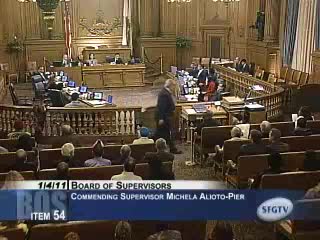
Board approves Civic Center community benefit district after amended plan wins ballot support
Summary
The San Francisco Board of Supervisors adopted a resolution establishing the Civic Center Community Benefit District after ballots showed strong weighted support for an amended management plan that excluded residential parcels at Opera Plaza.
The San Francisco Board of Supervisors on Jan. 4 adopted a resolution establishing the Civic Center Community Benefit District (CBD) after election returns showed strong weighted support for an amended management plan that removed Opera Plaza residential parcels.
The board voted 6-5 on the implementing resolution after hearing public testimony and receiving the Department of Elections report that 89.89% of weighted ballots supported the amended plan and 10.11% opposed it. An earlier version of the plan, which had included Opera Plaza residential units at 601 Van Ness, drew 86.50% weighted support and 13.50% opposition; the steering committee had proposed the amendment after discussions with Opera Plaza residents.
The management district plan calls for services above and beyond those the city provides, including cleaning, safety ambassadors, street-level beautification and advocacy for the Civic Center and adjacent Market Street corridor. City staff and the district consultant told the board the ballot turnout among affected property owners was unusually high for a district of this size, with most large private property owners participating in the vote.
"On the amended plan the returned weighted ballots voting for equal 89.89% and returned weighted ballots voting against equal 10.11%," the clerk read when announcing the tabulation. Lisa Pagan of the city—s Office of Economic and Workforce Development summarized the amended plan for the board and staff, saying the change removed the Opera Plaza residences from assessments and that the steering committee had recalculated the budget accordingly.
Supporters said the CBD will help knit together Civic Center—s civic, cultural and transit assets and improve safety and cleanliness for visitors to City Hall, the War Memorial and surrounding institutions. "We have made great efforts in the last two months to get the vote in," said Jim Hass, coordinator of the Civic Center stakeholders group, noting that several large property owners had voted in favor.
Opponents, including representatives of the Coalition on Homelessness and local free-speech advocates, warned that private-funded ambassadors and enforcement tied to a business-improvement structure can lead to exclusion of people who rely on public space. "It is wrong to place any aspect of civic center spaces and streets to any aspect of control over those places and streets to a private group," said Peter Warfield of the Library Users Association during the public hearing.
With the vote, the board adopted the amended management plan and directed staff to proceed with implementation steps described in the engineer—s report and management plan, including execution of the assessment levy for the district and transition to the CBD—s managing entity.
City staff said the district board will next work to finalize contracts for services, establish oversight arrangements and begin budgeting for the first fiscal year of operations. Opponents signaled they will monitor enforcement protocols and free-speech impacts as the new district becomes operational.
The board—s action followed a multi-year process of stakeholder meetings and a public ballot of property owners in and around Civic Center. The CBD will start providing services once administrative steps and contracts are in place.