Get Full Government Meeting Transcripts, Videos, & Alerts Forever!
Get email alerts on the Homelessness Response topic
No spam. Unsubscribe anytime.
City auditor: Denton’s homelessness response needs clearer encampment procedures, coordinated outreach and stronger shelter case management
Summary
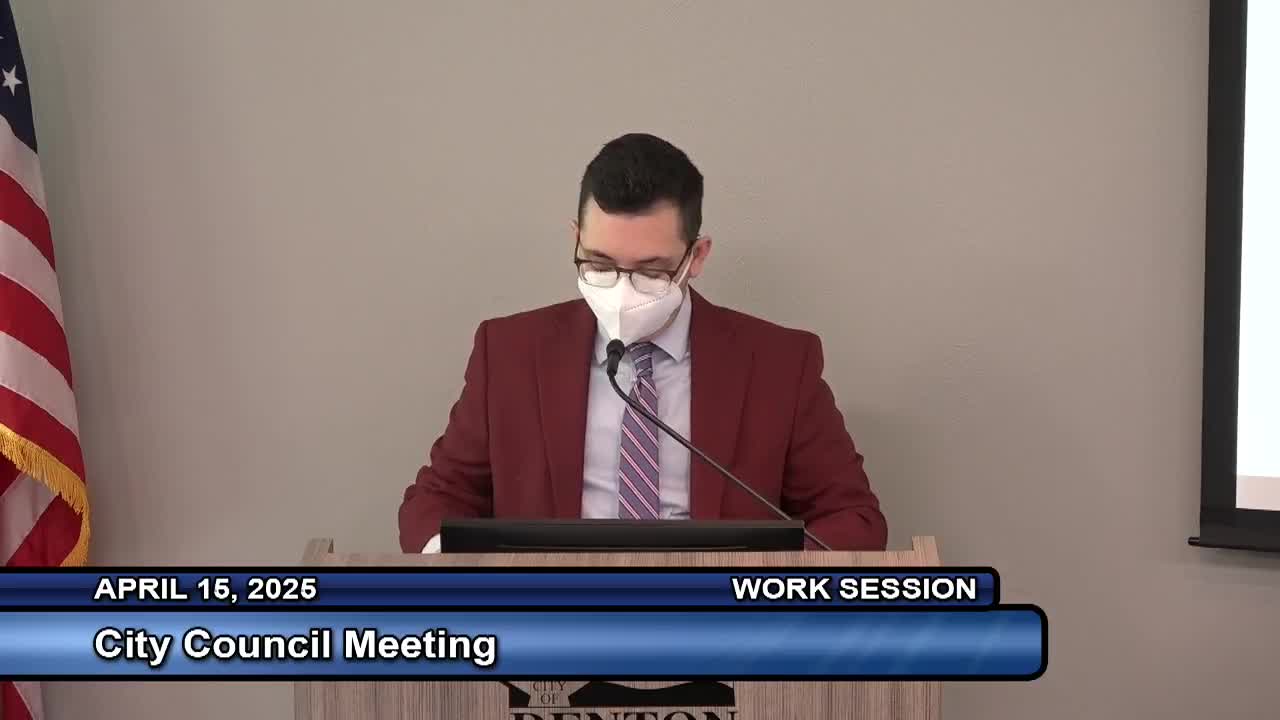
A city audit and an extended council work session on April 15 highlighted gaps in Denton’s response to unsheltered homelessness and led to direction from council for staff to develop concrete next steps.
A city audit and an extended council work session on April 15 highlighted gaps in Denton’s response to unsheltered homelessness and led to direction from council for staff to develop concrete next steps.
The audit, presented by the city auditor, summarized service gaps, enforcement impacts and shelter operations after the city’s 2024 Point-in-Time count showed 424 people experiencing homelessness in the city. The auditor said about 45% of people counted were unsheltered and that the city enforces state camping statutes while having “not enacted local laws that may impact people experiencing homelessness” beyond a few targeted local ordinances.
Why this matters: The review found uneven monitoring of encampments, limited documentation of responses, low collection of fines tied to enforcement, and shelter practices that do not reliably produce housing placements. Council members said better coordination is needed to balance public-safety concerns, property-owner impacts and the city’s capacity to help people exit homelessness.
Key audit findings and numbers - 2024 Point-in-Time (PIT) count for the City of Denton: 424 people experiencing homelessness. - About 45% of people were unsheltered, the audit reported. - The shelter contract requires 120 emergency shelter beds and 32 enhanced shelter beds; auditors found the “enhanced shelter” format had changed in practice and that about 25% of overnight guests lacked a completed coordinated entry assessment. - The audit said 88% of overnight shelter guests were exited back into homelessness after a shelter stay during the audit period; only about 11% of overnight guests had a housing placement plan. - The auditor reported 19 recommendations: “15 of which the department agreed, 3 were partially agreed, and 1 was disagreed,” the auditor said.
Audit recommendations and staff response The audit urged clearer, documented encampment tracking and response policies; multilingual notice and storage options for personal property; a coordinated approach that limits law‑enforcement as the lead responder; and clearer contract and case‑management expectations at the Denton Community Shelter (operated by a nonprofit under contract).
Jesse Kent, director of Community Services, told council staff will centralize encampment reporting and tracking within his department, improve coordination with nonprofit outreach providers, and explore ways to assist private property owners facing repeated cleanup costs. Kent summarized the operational changes staff plans to pursue and asked council for policy direction on several items.
Shelter operations and case management The audit said the shelter’s intake and housing-prioritization practices left many guests without a housing plan or case management. Auditors and staff cited limited case‑management capacity as a major constraint: HUD best-practice ratios (about 1 case manager per 10–20 clients) informed the audit’s recommendations.
Wendy McGee, executive director of the Denton Community Shelter (Our Daily Bread), said the shelter has been cooperating with city staff and that its current resources mean it cannot provide intensive case management for all guests. McGee said the shelter has placed hundreds of people in housing since opening and supported workforce programs but acknowledged the need to better target case-management resources.
Council direction and next steps Councilmembers debated a range of operational choices: formalizing a seven‑day cleanup timeline for public‑property encampments where feasible; consolidating civilian mental‑health clinicians in Community Services rather than under police operations; and changing the shelter contract to link overnight capacity to available case-management resources, create a waitlist and adopt a length‑of‑stay framework tied to housing‑plan progress. Assistant Director Kent said staff will try to implement encampment tracking, refined cleanup procedures and technical assistance for private-property owners.
Mayor Gerard Hudspeth said he “counted a majority in favor of moving forward” with the recommendations, and staff will return with implementation details, timelines and estimated resource impacts. Kent told council staff will present progress reports and follow up regularly; auditors said they will perform a formal follow-up review in fiscal 2027 unless council directs earlier action.
Public comments and concerns Multiple residents and people with lived experience addressed council during public comment. Speakers urged faster, more humane action, called for more low‑barrier services that actually lead to stable housing, and described instances of harm they attributed to current practices. Shelter and outreach providers also urged clear operational steps and said they were willing to expand coordination, identify new funding and support transitional approaches.
What council asked staff to return with Council requested that staff: - Provide specific implementation timelines and estimated budget impacts for proposed changes (case‑management staffing, storage solutions, encampment cleanup support for private owners). - Produce better historical data on encampments, repeat locations and repeated contacts with the same individuals. - Explore funding options for outreach once federal grants end in 2026. - Draft proposed contract amendments for the Denton Community Shelter tying overnight capacity to case‑management availability and a wait‑list/prioritization policy.
Quotes “We issued 19 recommendations, 15 of which the department agreed, 3 were partially agreed, and 1 was disagreed,” the city auditor said. “Based on these responses, we believe the identified risks will be appropriately addressed and plan to perform a formal follow‑up review, in fiscal year 2027 unless council would like to direct us to perform one sooner.” — City auditor (Madison)
“The city should adopt a more collaborative, proactive approach to addressing encampments in the city,” Jesse Kent said when summarizing staff recommendations.
Wendy McGee of Our Daily Bread said: “We have been working hand in hand with the city and city staff. We have shared every single data workbook that we have, they have been privy to every single policy that we have adopted. We have been an open book.”
Ending Staff will return with specific contract language, a timeline and cost estimates. The council’s next steps will determine whether changes to the shelter contract, encampment cleanup timelines and outreach staffing are implemented before the next formal audit follow‑up.