Get Full Government Meeting Transcripts, Videos, & Alerts Forever!
Get email alerts on the Economic Development topic
No spam. Unsubscribe anytime.
Council tables $100,000 DeSoto Development Corporation amendment for ‘Healthy DeSoto’ plan after broad council questions
Summary
The DeSoto City Council voted unanimously to table a proposed $100,000 amendment to the DeSoto Development Corporation (DDC) budget to pay professional fees for a six‑month ‘Healthy DeSoto’ planning effort. Council members asked for more detail, community engagement and to hear from the DDC ad hoc committee before approving the expenditure.
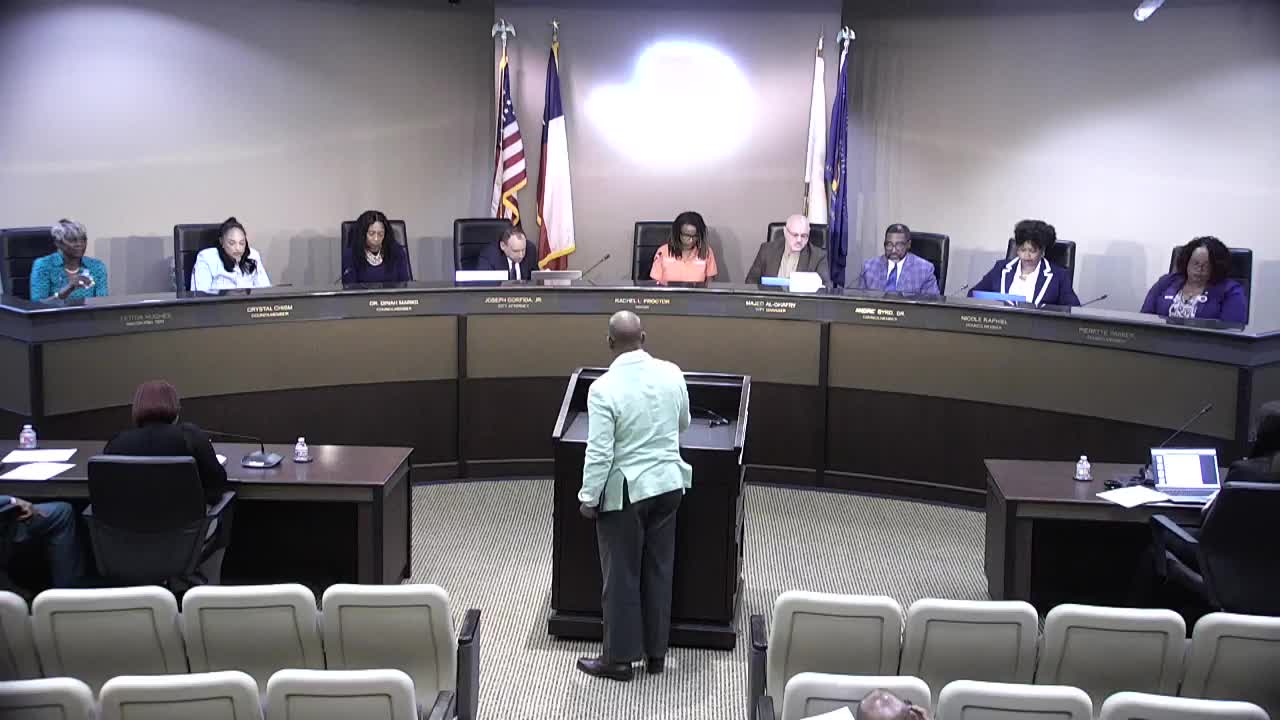
The DeSoto City Council on April 15 voted unanimously to table a proposed amendment to the DeSoto Development Corporation budget that would reallocate $100,000 from unallocated funds to professional services for development of a ‘‘Healthy DeSoto’’ plan.
Matt Carlson, director of the DeSoto Development Corporation, told council the six‑month effort would produce a data‑driven, outcome‑based framework for planning health‑related assets, including possibilities such as a BioLife Science Innovation Campus, a Hampton Road medical village, and sports‑medicine training facilities. Carlson said the DDC board authorized spending $100,000 from unallocated budget funds to start the work.
‘‘We don't know what we don't know,’’ Carlson told council, summarizing why the DDC wants professional assistance to define needs and options before pursuing development. He said the work would include a charrette, stakeholder interviews, research into comparable projects, and identification of potential partners. Carlson said the board had worked with a subcommittee that included Dr. Mikayla Herndon, Dr. Ahmad Garrett Price and Akila Wallace to assemble a group of professionals to advise the process.
Council members across the dais raised a similar set of concerns: the urgency of spending the money now, the scope and measurable outcomes of the six‑month engagement, whether Dallas County public‑health data and existing local partnerships had been tapped, how success would be measured, and how community voices would be included. Council member Perrette Parker asked whether the $100,000 covered only six months and what would follow at the end of the fiscal year; Matt Carlson said the effort is intended as an exploratory, fact‑finding phase and that the city will use the findings to decide on next steps.
Council member Crystal Chisholm and others asked that the DDC bring representatives of the ad hoc subcommittee and its proposed experts to a work session so council members could ask detailed questions before authorizing the expenditure. Council member Andre Byrd proposed tabling the item and inviting the committee; the motion to table was seconded by Chisholm and passed unanimously.
Before tabling the item, councilman Bird retracted an earlier motion to approve; after the retraction the council voted to table. Staff and the DDC said unallocated funds would remain in the DDC fund balance until council takes final action; no funds will be transferred while the item is tabled.
During discussion Carlson emphasized that the DDC and city have long‑standing strategic interest in improving health outcomes and making land‑use decisions that promote healthy living. He said the professionals identified by the DDC include former health‑system executives, investors, academics and clinicians who will help the city translate goals—such as ‘‘longer, more fulfilling lifespan’’ and an environment that supports healthy living—into specific development recommendations.
Council members asked the DDC to provide more specifics about the proposed consultants, the scope of services, how deliverables would be measured, and whether existing data sources such as Dallas County public‑health records and prior local grant work would be used. Several council members also asked for clear community engagement, including town‑hall style input, and for the DDC to explain how the plan would tie to city‑owned parcels such as the roughly 80‑acre site discussed in prior sessions.
The motion to table passed unanimously; staff said the council will schedule a work session with the DDC ad hoc committee and return the item to a future meeting after council members have had the requested briefing.