Get Full Government Meeting Transcripts, Videos, & Alerts Forever!
Get email alerts on the Municipal Bonds Debt Capacity topic
No spam. Unsubscribe anytime.
Murphy financial adviser outlines debt capacity, May 2028 bond-election scenarios
Summary
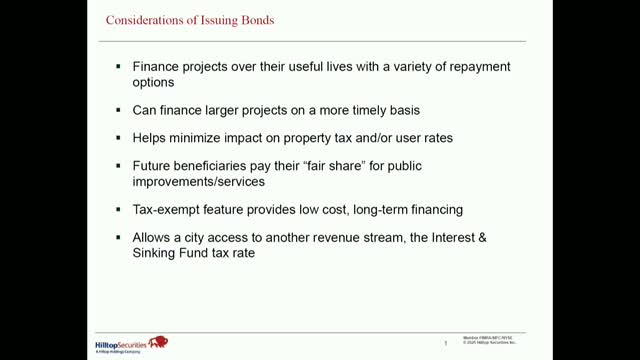
Jason Hughes, senior managing director at Hilltop Securities and the city's financial adviser, told the Murphy mayor and council that preliminary analysis shows the city could support a May 2028 general obligation bond election under several tax-rate scenarios and that staff had included a proposed $6,500,000 certificates of obligation sale in the near-term budget analysis.
Jason Hughes, senior managing director at Hilltop Securities and the city's financial adviser, told the Murphy mayor and council that preliminary analysis shows the city could support a May 2028 general obligation bond election under several tax-rate scenarios and that staff had included a proposed $6,500,000 certificates of obligation (CO) sale in the near-term budget analysis.
"So this is really meant, obviously, as a work session for you," Hughes said, framing the presentation as informational while he walked through types of municipal debt, outstanding obligations and assumptions used in capacity modeling. He noted, "20 year debt right now is probably around the 4.25%." Hughes also identified the city's current I&S (interest and sinking) tax rate at about 9.13' (nine-point-one-three cents).
Why it matters: Council and staff are evaluating financing options for projects that include street work (including McMillan Road) and utility needs. The presentation set out the mechanics and legal constraints of common Texas municipal debt tools — general obligation (G.O.) bonds, certificates of obligation, tax notes and water/sewer revenue bonds — and how changes at the state legislature could affect those options.
Hughes explained the differences among common debt instruments and their practical uses. G.O. bonds typically require a voter election and can finance large, quality-of-life projects; certificates of obligation do not require an election but start with a notice of intent and may be petitioned by registered voters to trigger an election; tax notes are short-term (maximum seven-year maturity) and commonly used for smaller or emergency projects; and water/sewer revenue bonds are secured by utility revenues and generally carry higher costs because of reserve-fund requirements.
Hughes warned that legislative changes are possible and under discussion in Austin, including proposals to restrict CO use, limit bond-election dates, or raise approval thresholds for G.O. bonds. He also described S&P's approach to ratings, noting that S&P had previously assigned Murphy a AA+ rating and that S&P's methodology considers debt plus overlapping obligations and contingent liabilities when assessing credit.
On outstanding debt, Hughes said Murphy has about $32.3 million in outstanding principal across eight issues and that the city has historically used COs to fund utility projects and tax notes for other needs. The capacity analysis Hughes presented used conservative assumptions: 20-year maturities for G.O. bonds, an assumed 5% interest rate for future issues, and existing I&S tax rate held at 9.13' for base scenarios.
Under those assumptions and including a $6.5 million CO issuance assumed late this year, Hughes presented three scenarios for combined 2028/2030 bond issuances: a no-I&S-rate-increase scenario with approximately $22.2 million of capacity; a one-cent (1') eventual increase scenario that structured larger issuance in 2028; and a two-cent (2') scenario that increased capacity further (Hughes reported the highest scenario at roughly $31.5 million under the stated assumptions). Hughes emphasized these numbers are preliminary and based on the stated timing, growth and interest assumptions.
Hughes provided an example of taxpayer impact: with an average Murphy home value he used of about $620,000, one penny on the I&S rate would equal about $62 per year (approximately $5.17 per month) for that home, a figure he said is useful for public communication about tax-rate changes.
Staff direction and next steps: City staff said they will include the potential CO sale in the upcoming budget process and present specific projects for council consideration; the CO timing would need to align with tax-rate-setting and notice-of-intent publication requirements. Hughes flagged schedule constraints: to have CO debt service reflected in the tax rate, the COs must be sold before the date the tax rate is set, and the notice of intent for COs must be published at least 46 days before sale, which would push the notice into mid-July for a mid-September sale.
Council discussion included timing for a bond committee and clarification that a single bond election can authorize issuance of multiple series sold over multiple years (for example, series A and series B under the same voter authorization), with staff noting the city can choose the timing of actual sales after voter approval. One council member indicated a preference to stand up a bond committee in 2027.
No formal vote was taken during the presentation; the session was conducted as an informational work session and staff said no approvals were required at that meeting. Staff plans to return with budget materials and project lists, including the proposed CO, before the start of fiscal year 2026.