Get Full Government Meeting Transcripts, Videos, & Alerts Forever!
Get email alerts on the Homelessness Shelter Assessment topic
No spam. Unsubscribe anytime.
Multnomah County reviews shelter assessment as budget pressures force policy choices
Summary
County commissioners reviewed a staff-compiled shelter assessment that details differences in shelter types, costs and outcomes and flagged possible policy shifts as budget shortfalls loom. Commissioners asked staff to prioritize data-driven choices about which programs to retain, scale, or change ahead of next year’s budget decisions.
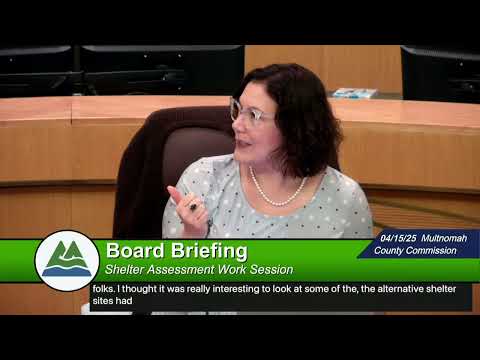
Multnomah County commissioners used an afternoon work session to review a new shelter assessment that compares shelter types, operational costs and placement outcomes and to discuss policy options as county and city homelessness budgets face deficits.
Commissioner Singleton, who requested the assessments, told colleagues the review was intended to inform upcoming budget choices and asked the board to focus on clarifying data rather than policy debate during the session. “I don't believe that the type of housing support 1 should get should depend on which shelter they happen to enter,” Singleton said, framing a central question for the review: should the county decouple housing placement work from specific shelters to make access more equitable?
The assessment compiled by county and city staff compares motel-based shelters, alternative/small-site shelters (including micro-villages and culturally specific villages) and congregate shelters. Staff and city partners described systematic differences in outcomes and costs: motel and alternative sites showed higher placement rates into housing or treatment and generally longer lengths of stay, while congregate shelters showed shorter stays and higher turnover that staff said makes housing placement work more difficult.
Anna Plumb, deputy director of the Homelessness Services Department, emphasized the importance of aligning service levels to client needs across shelter types. “If we want shelters to be a place where folks then stabilize and move to housing, having service provision at those shelters that matches the needs of the folks is really important,” Plumb said. She and other staff noted the shelter system developed over time as a patchwork with uneven services.
Antoinette, representing the Joint Office of Homeless Services, clarified cost reporting in the staff materials, saying the per-unit, per-night figures are “mainly operational costs, but there's maybe just a tad bit of folks that may have some rent assistance, but the bulk is operational cost.” City and county staff also warned that methodology differences—city counts by bed, county counts by unit—produce different totals (the county noted a count of about 144 units when using the county’s counting method).
City staff highlighted additional system factors. Skyler Birkner, director at Portland Solutions, and Scarlett Rocker (also identified with Portland Solutions) pointed to a marked drop in rent assistance as a primary reason for falling placement rates. Birkner also flagged retention problems: some people placed into housing subsequently lose that housing and return to shelter because of insufficient post‑placement supports.
Brandy Westerman, humanitarian operations director for the City of Portland, said smaller alternative shelters and culturally specific villages often show higher positive exits and longer, more stable stays; two culturally specific villages in her portfolio were established with an expected stay of about two years. Staff and commissioners discussed gender- and identity-specific access: the Salvation Army’s women-identifying shelter was cited as nearly full each night and as evidence of demand for more gender- or identity-specific shelter options. County staff noted ongoing interest in an LGBTQIA2S+ shelter program and urged better data on disability status and service needs.
Commissioners also pressed on the system’s ability to move people to permanent housing and the limited supply of affordable units. Staff described partnerships with the Portland Housing Bureau (PHB), saying the county provided about $18,000,000 in partnership funding that supported roughly 400 affordable units with rent supports. Commissioners asked whether long-term rental assistance to market-rate units is the right tool for people who will need sustained, possibly lifetime, subsidy; staff replied that many evidence-based housing-first models require different, often larger, investments and cross-system coordination.
Throughout the session commissioners noted trade-offs: shelter operations account for a substantial share of homelessness funding (staff said roughly 38% of the Homeless Services Department budget goes to shelter), and the board will face decisions about where to cut and where to preserve services. Commissioners and staff agreed to continue follow-up work, including a planned work session on outreach, navigation and in‑reach to examine mobile and cross-site placement strategies. The assessment will also inform potential updates to intergovernmental agreements with the City of Portland and budget deliberations ahead of next year's allocations.
The board did not take formal action at the session; commissioners directed further study and interagency coordination and signaled difficult budget choices ahead.