Get Full Government Meeting Transcripts, Videos, & Alerts Forever!
Get email alerts on the Council Votes 2025 04 15 topic
No spam. Unsubscribe anytime.
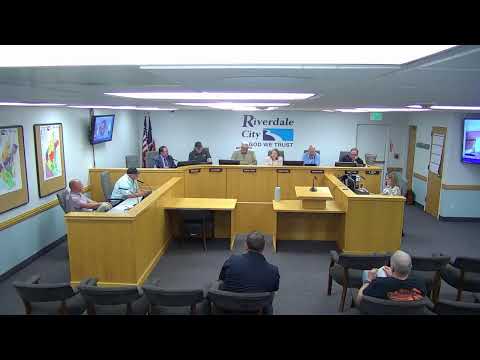
Riverdale council approves seasonal-sales code change and four city measures in unanimous votes
Summary
At its April 15 meeting the Riverdale City Council approved an ordinance to broaden temporary seasonal-sales rules, awarded a waterline construction bid, authorized a nonexclusive park-use agreement and adopted a policy for special-needs participants. All measures passed unanimously after discussion.
Riverdale City Council on April 15 approved an amendment to the city code on temporary seasonal sales and three other items — a waterline construction contract, a nonexclusive city-property agreement with a volunteer cycling group and a policy for accommodating special‑needs participants in city programs. All four measures passed unanimously.
The most detailed discussion centered on Ordinance 992, which revises Riverdale City Code 10-9-10-19-9 to clarify and expand the circumstances under which temporary structures for seasonal sales are allowed. Planning staff presented the draft change and Kenny McFarland, petitioner for McFarland Farms, answered questions about how the revision would affect farm stands. The ordinance will allow seasonal sales of fresh fruits and vegetables (including sales of some items purchased from other growers) in the C-3 commercial zone as well as in A-1 agricultural zones on the producer's property, subject to a temporary-use permit and site standards. The council adopted the planning commission's recommended limits: a maximum duration of 20 weeks per year, standard hours of 8 a.m. to 9 p.m., a self-contained structure not to exceed 200 square feet, and limits on proximity (no more than one per site and 500 feet spacing along a roadway). The council also directed that vendors who are not state-exempt agricultural producers must present a state sales-tax certificate at application; the city will honor state sales-tax exemptions for producers and eligible nursery Christmas-tree sellers.
Votes at a glance
- Ordinance 992 (amend Riverdale City Code 10-9-10-19-9, temporary structures/seasonal sales): Motion to approve made by Councilor Arnold; second recorded. Council approved the ordinance unanimously. Key provisions: permits seasonal sales of fresh fruits and vegetables in C-3 and A-1 (on-premise) zones; 20-week maximum duration; 8 a.m.-9 p.m. standard hours; 200 sq. ft. maximum footprint; director-level permit with appeal to the planning commission; private-property-only and prohibition on certain goods such as flowers, rugs, jewelry. Planning commission recommended approval. McFarland Farms supported the change as allowing local produce vending.
- Resolution 2025-11 (award bid for 2025 waterline improvement project): Council approved awarding the bid to Slippery Rock Constructors. The agenda item initially noted an amount "not to exceed $907,000.85," and staff reported multiple bids; during the meeting the motion to award specified an amount not to exceed $616,291.85 and the council approved that motion unanimously. Staff said the apparent range of bids at opening was wide and that staff reviewed the winning bid for accuracy.
- Nonexclusive use of city property agreement (Bonneville Bike Club): The council approved a nonexclusive-use agreement allowing the volunteer bike group to use and maintain a portion of city parkland discussed at earlier meetings. Staff emphasized the agreement is nonexclusive because the land remains public property and the city retains control; the group will maintain the area under the terms of the agreement. Motion carried unanimously.
- Resolution 2025-12 (policy regarding special-needs participants in city programs): The council adopted a written policy to guide city recreation and program staff on reasonable accommodations, confidentiality, training and case-by-case review when participants require assistance. Staff said the policy codifies practices already used and clarifies procedures, including privacy protections and how to evaluate undue burden. Councilors asked about HIPAA/FERPA and were told the policy relies on existing privacy laws and the city's own privacy practices; accommodations would be considered on a case-by-case basis.
Why it matters
The code amendment aims to make it clearer when temporary farm-stand and seasonal vendors may operate on private property, while preserving the city's ability to regulate structure size, location and safety. The waterline contract moves a capital infrastructure project into construction, while the park-use agreement and the special-needs policy document the city's approach to volunteer stewardship and inclusive recreation services.
Details and context
During the ordinance discussion staff emphasized that the existing code (amended in 2013) was unclear about what qualifies as seasonal sales and limited produce sales to A-1 properties where the product is produced on site. The revised language is intended to allow modest, regulated vending in commercial corridors while limiting items that city leaders said could compete with established retailers.
On the waterline project, public-works staff told councilors they were pleased to see competition at bid opening and said the apparent wide spread among bids was discussed with the low bidder, who indicated confidence in the bid. Councilors asked questions about traffic control and stormwater management during construction.
On the park-use agreement, staff said insurance and public‑property concerns drove the choice to make the agreement nonexclusive; the volunteer group will maintain the area but the property remains public and city-controlled.
On the special-needs policy, staff said the policy is intended to give future staff written guidance and ensure consistent, legally informed accommodation decisions; councilors emphasized that any accommodation must be "reasonable" and not impose an undue burden on city operations.
Next steps
Ordinance 992 is effective per the city's codified process. The waterline contractor is expected to proceed per the awarded contract; staff will return with project oversight updates. The nonexclusive use agreement and special-needs policy are effective as adopted and will be implemented by the appropriate departments.
Ending note
Councilors and staff noted the ordinance change was partially intended to soften the loss of the local farmers market for residents by allowing limited local produce vending, and members expressed interest in helping long-term partners such as local food vendors find suitable C-3 locations under the new rules.