Get Full Government Meeting Transcripts, Videos, & Alerts Forever!
Get email alerts on the Ranked Choice Voting topic
No spam. Unsubscribe anytime.
Santa Clara County committee receives ranked‑choice voting report; forwards item to full board after Sept. 30
Summary
The Finance and Government Operations Committee received an informational report from the Registrar of Voters on implementing ranked‑choice voting (RCV), heard more than 50 minutes of public comment both for and against RCV, and voted to forward the report to the full Board of Supervisors for further consideration after Sept. 30, 2025.
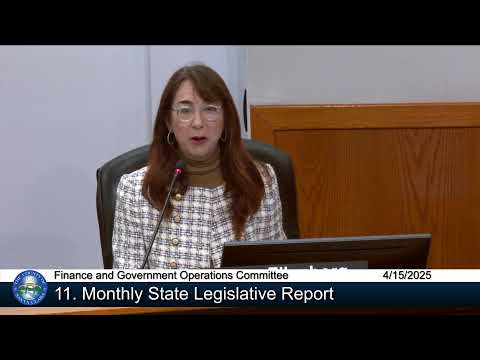
The Finance and Government Operations Committee on April 15 received a neutral informational report from the Registrar of Voters on what it would take to implement ranked‑choice voting (RCV) for county offices and voted to forward the report to the full Board of Supervisors for consideration sometime after Sept. 30, 2025.
The report focused on implementation logistics rather than a policy recommendation. Acting Registrar of Voters Matt Morales presented a timeline that administration described as targeting implementation in 2028 if the board ultimately decides to adopt RCV. Morales said the report breaks estimated costs into fixed, variable and discretionary items and that administration’s “common takeaway” was that a comprehensive voter‑education program would be critical to reduce voter error and confusion.
Why it matters: adoption of RCV would change how county elections are conducted, affect election costs and outreach, and requires multiple policy decisions and additional planning time for voter education. Committee members and members of the public described high stakes for communities that the county serves and urged careful pacing and resourcing before any adoption.
Details from the presentation and public comment
Morales told the committee the report “attempts to remain neutral on RCV as a policy question, and instead focuses on providing an informational report on what it would take for the county to successfully implement ranked choice voting should the board decide to go in that direction.” The report included a sample implementation timeline (labelled “table 1”) and preliminary cost estimates (labelled “table 2”). Morales emphasized that a robust voter‑education program is “critical to ensuring the success of the implementation.”
Public comment at the committee hearing ran more than two hours and included speakers from local advocacy groups, neighborhood residents, and representatives of outside organizations. Opponents raised concerns about ballot‑exhaustion, higher ballot error or rejection rates observed in other jurisdictions using RCV, disproportionate impacts on seniors and voters of color, and the cost of a large voter‑education program. Supporters said RCV can increase representation for women and candidates of color, reduce negative campaigning, and reduce the need for low‑turnout primary elections.
Committee discussion and action
Committee members emphasized the number of outstanding policy questions that would need to be answered before the county could implement RCV and agreed the county would require time and resources for large‑scale education and outreach. Vice Chairperson Ellenberg moved to receive the report and forward it to the full Board of Supervisors for consideration sometime after Sept. 30, 2025; Chairperson Betty Young seconded. The motion carried with both supervisors voting yes.
What the vote does (and does not) do
The committee vote did not adopt RCV or change the county’s election rules. It directed that the informational report be forwarded to the full Board of Supervisors after Sept. 30, 2025, and requested additional detail for the full‑board discussion (including examples of how other California counties handled policy questions tied to RCV). Administration and county counsel told the committee they will prepare additional policy detail to be included when the item goes to the full board.
Next steps
Administration said the ROV would need roughly a year to 18 months prior to any adoption for thorough voter education and outreach. The sample timeline in the report contemplates a November 2028 implementation if the board directs staff to proceed and resources are allocated. Committee members and staff also asked that any future full‑board packet include comparisons to other California jurisdictions that have implemented RCV and details on the set of follow‑up policy questions that would need resolution.
Ending note
Committee members repeatedly framed the decision as significant and requiring additional public outreach and fiscal clarity; the committee’s action was procedural — to move the report to the full board for further deliberation after Sept. 30, 2025.