Get Full Government Meeting Transcripts, Videos, & Alerts Forever!
Get email alerts on the Economic Development topic
No spam. Unsubscribe anytime.
Economic development staff seek Housing and Transit Reinvestment Zone to spur Cairns mixed‑use projects
Summary
Economic development staff presented a Housing and Transit Reinvestment Zone (HTRZ) proposal and updates on multiple Cairns‑area projects on April 15, telling the council an approved HTRZ could provide tax‑increment incentives to help close financing gaps for mixed‑use development.
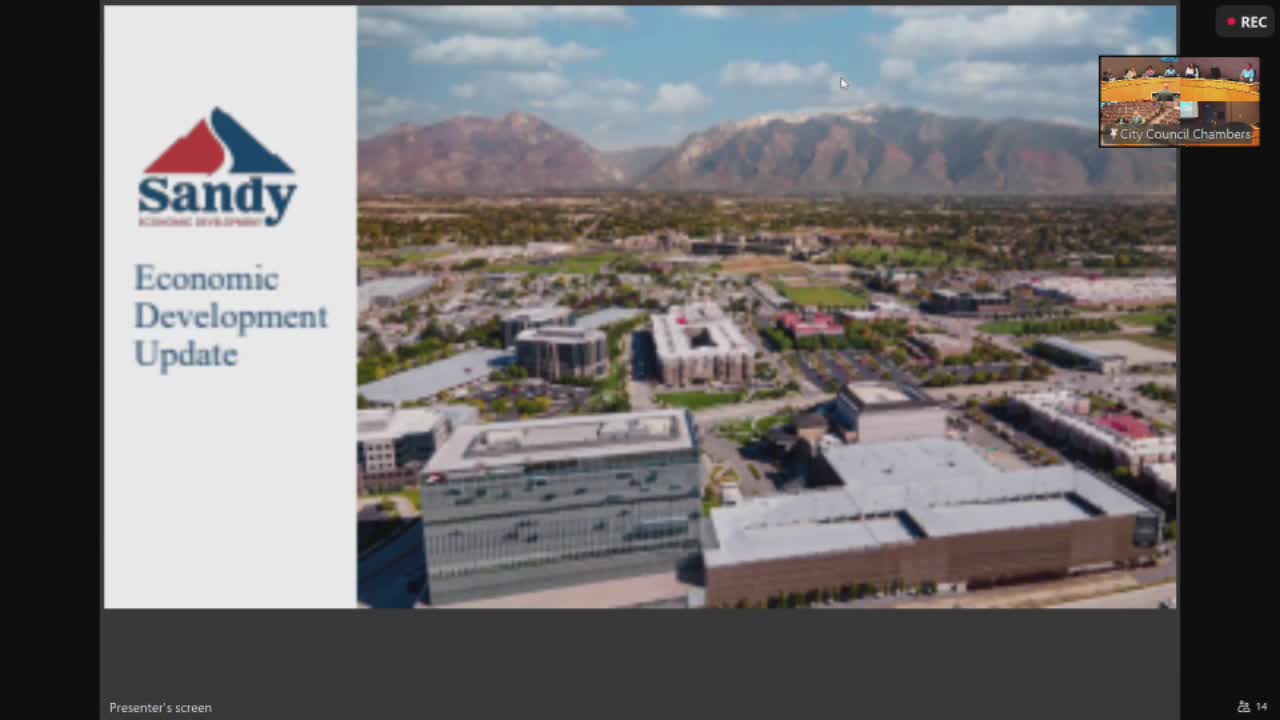
Economic Development Director Casey Dunlavy and Senior staff Rob Sant briefed the Sandy City Council on April 15 on development activity in the Cairns area and on a proposed Housing and Transit Reinvestment Zone (HTRZ) intended to accelerate several stalled or ready‑to‑build projects.
Dunlavy said work over the last several years has prepared developers to return to the market and that the HTRZ — a state tool designed to encourage density and affordable housing near transit stations — could help close financing gaps. "If we get approval on this HTRZ, I believe we'll see the potential of three major projects in our Cairns area, potentially this year," Dunlavy said.
Rob Sant reviewed the HTRZ rules and the city’s proposal. He said the state requires mixed‑use, multifamily development with an average density target (the statute expects high residential density near transit). Sant explained the process: the city will submit a proposal to the governor’s Office of Economic Opportunity (GOEO), an independent gap analysis is done (90 days), and a state committee reviews applications in late summer. If the committee approves an HTRZ, Sant said the city would enter an interlocal agreement with its RDA to administer tax increment; approved projects can receive 80% of incremental tax revenues per phase for a 25‑year period (Sant noted longer phase windows may extend overall program life up to statute limits).
Sant described the Sandy proposal as focused on roughly 25–26 acres in the Cairns area, targeting about 1,500 housing units in the proposal footprint and an average density staff described as roughly 58 units per acre. He summarized statutory affordability requirements that changed since earlier versions of the HTRZ statute: 12% of residential units in an HTRZ must be affordable (Sant said 9 percentage points must be at 80% area median income and 3 percentage points at 60% AMI).
Staff tied the HTRZ to multiple local projects:
- Wasatch Shadows / Compass (Gardner Boyer): Dunlavy said the mixed‑use project east of the fire station is under review and that Gardner Boyer is pursuing a 100% owner‑occupied affordable component for a roughly triangular 1.1‑acre parcel. Dunlavy said the RDA could bridge the gap between appraised land value and the developer’s cost to enable a fully owner‑occupied affordable housing phase under a public‑private partnership.
- Sandy‑area mixed‑use near the Hilton Garden Inn (project developer referenced as working through Kerns design standards): staff said the developer has secured financing components and would be a candidate participant if the HTRZ is approved.
- Centennial Village (DB Urban): Dunlavy said the developer has a memorandum of understanding and is negotiating a purchase‑sale and development agreement; the proposal relies on tax increment financing (TIF) tools, including a previously discussed $3,000,000 TIF payment intended to support the project’s financing.
- Summit / Ron Radden hotel and convention project: Dunlavy said the project still faces a wetlands easement recorded in perpetuity that prohibits development until it is cleared or released; the property changed hands from the prior mall owner to a new owner (SEG) which has required additional easement negotiations. Dunlavy said the developer’s contract requires him to clear easements and perform by November under the current agreement or renegotiation would be necessary. He also discussed an awarded SIB loan (approximately $6,000,000) and said staff have taken steps to minimize the city’s upfront exposure by conditioning payments on permit/permit‑pull milestones; staff said the remaining SIB loan terms and eventual use of proceeds will depend on whether the developer performs and whether the site is ultimately developed.
- Utah Hockey Club practice facility and Fire Station 31 topping‑out: Dunlavy and others noted the hockey practice facility will open for team use in September and for public use in January, while the new Fire Station 31 has reached its topping‑out milestone and is on track for later‑year completion.
Sant and Dunlavy emphasized the pedestrian bridge to the Frontrunner station as a critical connection for the HTRZ proposal. Public Works Director Ryan Compe told council the bridge was originally envisioned as a transit bridge (2015 circulator study), but South Jordan vacated a right‑of‑way that previously offered a long, gentle landing for vehicles. Compe said that change, combined with required vertical clearance over the freeway and rail, makes a vehicle transit bridge (rubber‑tire bus or streetcar) more difficult and expensive, though not absolutely impossible; the transit option would likely require acquiring additional right‑of‑way and higher grades that complicate vehicle geometry. Compe said a pedestrian/cyclist bridge still provides the first‑mile/last‑mile connection that staff and the state committee will want to see.
Council discussion covered parcel selection for the HTRZ (staff limited the footprint to properties with known residential potential to preserve density numbers), whether the mall parcel should be included, and next steps to meet with state committee members to advocate for the application. Sant suggested council members may be asked to make targeted outreach to committee representatives during the review period.
Why this matters: Staff say an approved HTRZ would provide a state‑backed funding mechanism (tax‑increment sharing) to help close developer financing gaps for high‑density, mixed‑use projects near the transit station. That funding — combined with RDA tools and developer contributions — could unlock several long‑planned projects in the Cairns area.