Get Full Government Meeting Transcripts, Videos, & Alerts Forever!
Get email alerts on the State Legislation topic
No spam. Unsubscribe anytime.
Deputy city attorney briefs Sandy council on dozens of 2025 state bills, many effective May 7
Summary
Deputy Attorney Kim Bell summarized 2025 state legislation affecting housing, zoning, law enforcement, transit and short-term rentals and told the Sandy City Council most bills become effective May 7.
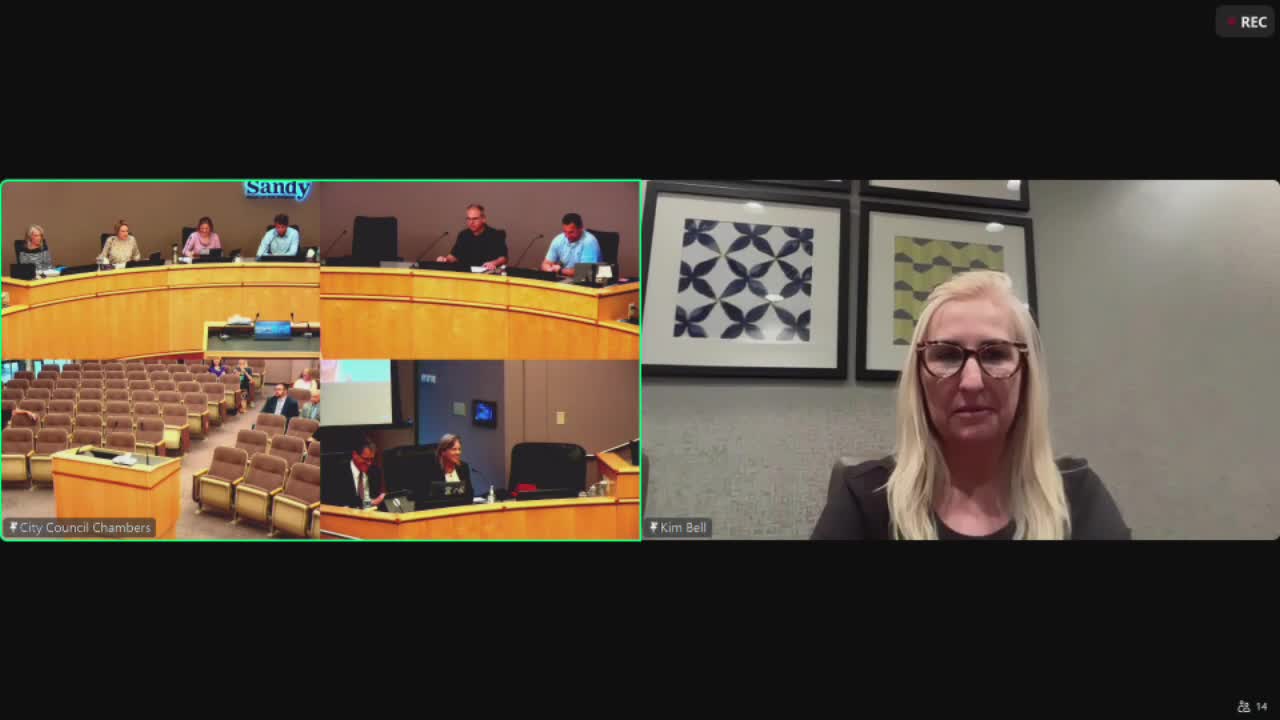
Deputy City Attorney Kim Bell delivered the Sandy City Council a final legislative briefing on April 15, 2025, summarizing dozens of bills from the 45-day session that she said will affect local control, housing affordability, zoning and public safety.
"Unless otherwise specified, the bills do become effective May 7," Bell told the council, listing major measures and briefly describing their likely local effects.
Bell highlighted measures on housing and land use, including HB 37 (housing amendments) which she said authorizes cities to allow additional housing density tied to owner-occupancy and affordability incentives, and HB 368 (local land use amendments), a broad bill flowing from the state land-use task force that touches on annexation, development standards, special districts and bonding. On homelessness and sheltering, Bell identified HB 329 (winter overflow and homeless services) and HB 505 (unsanctioned camping) as bills that add requirements and, in some cases, new oversight bodies or penalties tied to mitigation funding.
On public-safety and schools, Bell summarized HB 40 (school safety amendments) requiring coordination between local law enforcement and school security officials, and HB 465 (law enforcement agency amendments), which she said allows the state Department of Public Safety to enter interagency agreements with city police departments and includes a penalty provision that could affect road funding if certain requirements are not met. Bell told the council the city’s police department already practices many of the measures in HB 465.
Other bills Bell summarized included HB 81 (prohibiting addition of fluoride to public water systems while easing pharmacy access to fluoride pills), HB 198 (rules for relocation of billboards affected by highway construction), HB 256 (short-term rental zoning evidence and takedown recommendations), HB 300 (changes to mail‑ballot rules and ID requirements beginning in 2029), HB 456 (transient room tax amendments creating an outdoor recreation mitigation grant program), and the transportation omnibus SB 195 requiring cities to amend general plans to identify priority transportation connections and station-area planning.
Bell also summarized two senate measures tied to housing and transit incentives: SB 23 (First Homeowner Investment Zone provisions) and SB 26 (amendments to the Housing and Transit Reinvestment Zone statute). She described SB 23 as changing how some owner‑occupied affordable housing is defined in eligible areas and SB 26 as altering HTRZ provisions and additional funding mechanisms available for cities that have convention centers.
Council members did not ask follow-up questions during the briefing. Bell said she and staff will provide additional detail to departments as they unpack large bills such as HB 368.
Why this matters: several of the bills Bell flagged include deadlines, new local planning or reporting requirements, or changes that could affect the city’s zoning and incentive tools. Bell repeatedly noted timing: many of the session’s bills take effect May 7 unless the legislation specifies otherwise.