Get Full Government Meeting Transcripts, Videos, & Alerts Forever!
Get email alerts on the Criminal Justice Budget topic
No spam. Unsubscribe anytime.
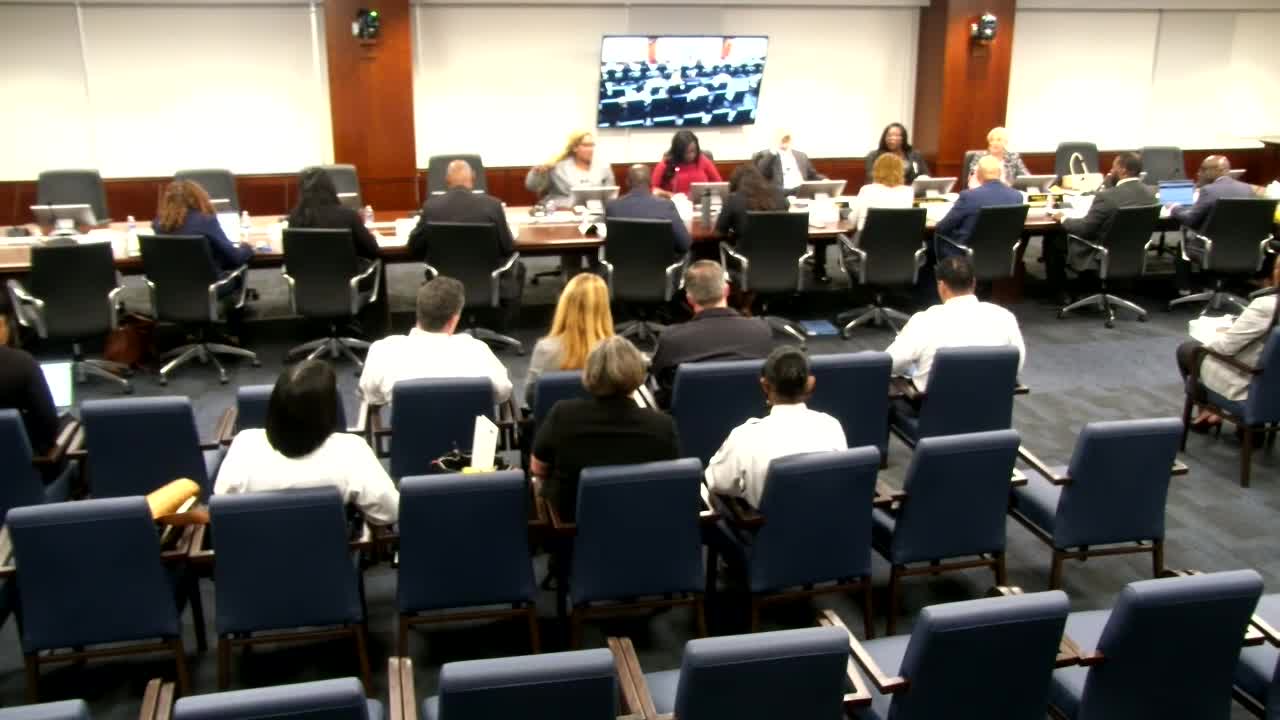
Prince George’s County HHSVS committee reviews State’s Attorney’s $30.8M FY26 proposal, highlights staffing and digital evidence costs
Summary
State’s Attorney Aisha N. Braveboy told the council committee the FY26 proposed budget is about $30.8 million and prioritized fully funding a newly adopted salary schedule, hiring support staff and paying for growing digital evidence storage tied to NICE Justice software.
Prince George’s County officials on Monday reviewed the proposed fiscal year 2026 budget for the Office of the State’s Attorney, which county staff described as approximately $30,800,000.
The proposed budget preserves a recently adopted salary schedule for assistant state’s attorneys and requests additional operating funds to hire and retain legal assistants, victim‑witness coordinators and administrative staff, State’s Attorney Aisha N. Braveboy told the Health, Human Services, and Public Safety (HHSVS) committee.
Braveboy said the new salary schedule — approved earlier this year — is “historic” for the county because it lets the office be more competitive with neighboring jurisdictions and federal positions. “It allows us to be more competitive, allows us to attract and retain, and also, as I like to say, reclaim those who were once in our office who now are in a position to wanna come back,” Braveboy said.
The office asked the committee to fully fund the salary schedule and requested more support staff to ease the workload on prosecutors. Principal Deputy Jason Abbott told the committee assistant state attorneys currently shoulder much of the digital discovery work and that legal assistants and expanded victim‑witness staffing would allow attorneys to focus on trials and motions. Abbott said the conviction and sentencing integrity unit has only two staff and would need additional positions if Maryland’s so‑called “second look” legislation becomes law and triggers a larger caseload of petitions.
Budget staff told the committee the office’s FY26 proposal “represents an increase” from FY25. David Williams, a county budget analyst, noted the fiscal package includes general fund and grant components and flagged IT initiatives and storage as cost drivers.
Braveboy also described a $500,000 earmark secured with federal lawmakers’ support that funded the purchase of NICE Justice, a digital evidence management system. She told council members the transition to fully digital discovery is creating large long‑term storage costs for both the state’s attorney’s office and the police department and said the county will need to consider how to finance and house that capacity going forward.
The office requested continued funding for four long‑running temporary positions that currently are filled through a county temporary‑staff contract; Braveboy said those four positions cost about $253,050 per year and function as legal assistants and administrative aides. The office also submitted a larger ranked list of additional complement requests that total a larger amount if fully funded, she said.
Committee members pressed on priorities. Vice Chair Wanika Fisher and others said victim‑witness staffing appeared to be the next highest need after full funding of the salary schedule. In response, Deborah Anderson (budget director, State’s Attorney’s Office) told the committee the office has eight permanent victim‑witness coordinators and about eight grant‑funded coordinators; one federal grant noted in the discussion was the Violence Against Women Act (VAWA) grant.
David Williams and county budget staff said the administration had prioritized public safety in the proposed county budget and moved to implement much of the salary schedule within fiscal constraints.
The office’s specific staffing and operating requests presented to the committee included (per the office): full funding of a newly adopted ASA salary schedule, several additional legal assistant and victim‑witness coordinator positions, funding to continue temporary staff used year‑to‑year, and additional storage and IT funding tied to NICE Justice.
Braveboy and her deputies emphasized they will continue to pursue grant funding for specific programs such as reentry and emerging adult initiatives; Braveboy cited grants used to support emerging adult programming and noted a second annual conference on women and girls in the justice system scheduled for May 14.
The committee did not take a recorded vote on the office’s request during this session. The state’s attorney’s presentation and the budget analyst’s slides will be part of the ongoing budget review process.
Ending: The HHSVS committee moved on to other agency budget presentations after roughly an hour of discussion with the state’s attorney’s team; committee members signaled support for the salary schedule and asked staff to return with more precise cost items and options for addressing the digital evidence storage issue.