Get Full Government Meeting Transcripts, Videos, & Alerts Forever!
Get email alerts on the Elections topic
No spam. Unsubscribe anytime.
Santa Clara County committee receives ranked-choice voting report, will send to full board after Sept. 30
Summary
The Finance & Government Operations Committee received an informational report from the Registrar of Voters on ranked‑choice voting implementation and voted to forward the report to the full Board of Supervisors for consideration after Sept. 30, 2025, citing remaining policy questions and county fiscal uncertainty.
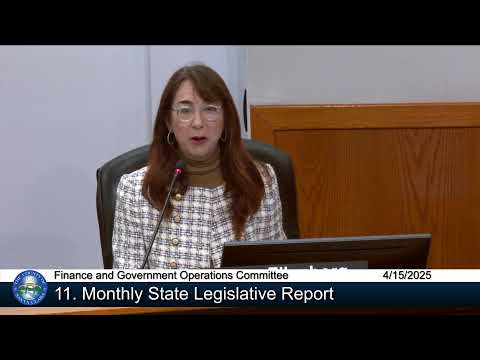
The Santa Clara County Finance & Government Operations Committee on April 15 received an informational report from the acting Registrar of Voters on what it would take to implement ranked‑choice voting (RCV) for county offices and voted to forward the item to the full Board of Supervisors for consideration after Sept. 30, 2025.
The presentation, delivered by Matt Morales, acting registrar of voters, summarized a proposed implementation timeline aimed at a November 2028 rollout, preliminary cost estimates that separate fixed, variable and discretionary (voter‑education) costs, and a list of policy questions administration said the board would need to resolve before implementation. Morales said the report “attempts to remain neutral on RCV as a policy question, and instead focuses on providing an informational report on what it would take for the county to successfully implement ranked choice voting.”
Committee members and the public debated technical and policy issues at length during a more than two‑hour public comment period that drew dozens of speakers for and against RCV. Supporters told the committee RCV can increase representation for women and candidates of color, reduce negative campaigning and eliminate low‑turnout primaries. Opponents raised concerns about ballot exhaustion, higher ballot‑error and rejection rates in some jurisdictions, and the potential for voter confusion and reduced public confidence.
The nut of the committee’s discussion was procedural and practical: whether the board should exercise the discretion granted under Measure F (1998) and county charter provisions to change the county’s election method, and if so, how much additional study and lead time would be required. County staff and counsel told the committee that RCV implementation would involve multiple follow‑on policy decisions (for example, whether to eliminate a separate primary, how to handle recounts, and specific voting system configurations) and substantial voter‑education work.
Vice Chairperson Ellenberg proposed a motion, which the committee approved, to receive the report and forward it to the full Board of Supervisors for consideration after Sept. 30, 2025, so the board would have updated information about county fiscal conditions and additional time to review outstanding policy questions. Chairperson Betty Young voted in favor; Vice Chairperson Ellenberg moved and Chair Young seconded the motion. The committee recorded the vote with both members saying “Yes,” and the motion carried.
The report included a recommendation from the Registrar that, if the board chose to proceed, a robust voter‑education campaign would be critical. Morales’ team estimated that an effective outreach program would be a substantial portion of the discretionary costs, noting that jurisdictions that adopted RCV reported education and outreach as key to minimizing voter error. Committee members asked staff to compile additional comparative information about how California counties that use RCV handled the policy questions laid out in the report and to include that material when the matter goes to the full board.
The committee’s action does not adopt RCV or change any rules; it advances the informational report and asks the full board to weigh the policy threshold and follow‑up choices later this year. The committee also asked administration to include a list of California counties that have implemented RCV and how they addressed the policy decisions identified in the report when the item returns to the board.