Get Full Government Meeting Transcripts, Videos, & Alerts Forever!
Get email alerts on the Jail District Budget topic
No spam. Unsubscribe anytime.
Cochise County supervisors review jail district budget, salary requests and plan for separate mental-health facility
Summary
The Cochise County Board of Supervisors discussed the jail district budget at a work session, with staff outlining salary requests, staffing proposals and efforts to offload nonviolent mental‑health cases from the jail.
The Cochise County Board of Supervisors discussed the jail district budget at a work session, with staff outlining salary requests, staffing proposals and efforts to offload nonviolent mental-health cases from the jail.
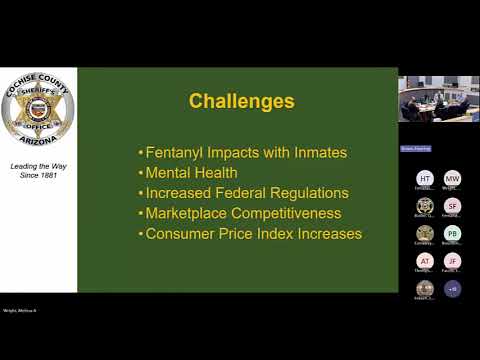
Supervisor Gilman said she had asked jail staff to present their budget needs and described steps the jail is taking to reduce contraband and manage a growing population of inmates with substance‑use and mental‑health needs. "We're currently changing our policy on mail, where we're gonna photocopy all the mail and give the photocopy to the inmates," Gilman said, noting the change is intended to reduce introduction of fentanyl and other synthetic drugs concealed in mailed paper and bindings.
The discussion foregrounded three budget themes: pay and staffing, detention health funding, and planning for alternatives to incarceration for people with mental‑health or substance‑use problems. The issue matters because supervisors said high detention costs (including out‑of‑county competency evaluations and hospital placements), rising market pay for corrections staff, and new federal rules affecting jail revenue together risk pushing more costs onto the county.
On pay, staff presented a set of proposed increases targeted at detention and corrections personnel. The budget request lists a $2,400 fixed increase for detention officers and $1,200 increases for corporal sergeants, lieutenants, medical staff and administrative staff. Staff said the combined salary increase across these lines would total $213,938. Supervisors discussed that the county also plans a countywide market adjustment (estimated roughly 1.6 percent pending the market study) with deputies and detention officers receiving additional increases above that baseline.
To reduce overtime costs, the jail asked to fund 30 part‑time positions and requested $40,000 to staff them; the positions had been funded previously at only $12,000, staff said. Staff explained part‑time officers do not carry employer retirement and benefit expenses (ERE) and are paid hourly, so using part‑time officers for some shifts is cheaper than paying overtime to full‑time staff.
Detention health services requested an overall $23,000 increase, Megan, a detention health services representative, told the board. "Detention health services is requesting a total of $23,000 increase across the board," she said. She said the ask breaks down to $5,000 for operating supplies, $5,000 for contracted nursing staff to cover vacancy and hiring shortages, and $13,000 for miscellaneous professional services to pay the medical director; the medical‑director cost would be split 50/50 with the county health department.
Supervisors also raised a $12,000 funding gap for a nurse‑practitioner position previously subsidized by inmate welfare fund commissions. Supervisor Gilman told the board that Federal Communications Commission action has largely removed commissions on inmate phone and video services, shrinking that revenue source. "The FCC recently came out with new regulations where we can't collect any [commission] on phone calls and video visitation," she said; the board was told commissary revenue alone cannot reliably replace the $12,000 previously drawn from the inmate welfare fund.
Board members repeatedly discussed long‑standing operational and capital questions for a new jail and for alternatives to housing people with mental‑health needs inside the jail. Several supervisors supported pursuing a mental‑health crisis facility in Douglas to accept nonviolent, noncriminal individuals who currently end up in the jail for lack of local alternatives. Gilman and other supervisors said such a facility could be eligible for Medicaid and other federal funding, and that a business case will be required to attract private vendors and justify a facility site.
Supervisors described the county's current expense for court‑ordered competency evaluations and inpatient placements as an important driver of cost. "Right now, we're paying Pima County, like, $36,000 whether they stay a day or whether they stay a year," Gilman said when describing the county's current out‑placement costs; she added that sending someone to the Arizona State Hospital can carry a cost of "a hundred thousand" in the county's accounting, quoting staff discussion of market prices for long‑term placements.
Board members asked county staff and planners to continue refining jail design and staffing plans before settling on a site, arguing the planning consultant's draft report presented a more expansive staffing plan than supervisors want to adopt. One supervisor said the county should define threshold (minimum) requirements and objective (preferred) requirements for a new facility and then select a site that fits the operational design rather than starting from site selection alone.
Facility and safety issues also arose: supervisors asked where upgrades such as fire alarms and water‑suppression systems in the existing jail would be budgeted. Staff said such capital repairs would be handled by the facilities budget in the general fund rather than the jail‑district supplemental request.
The board did not take formal action at the work session. Supervisors directed staff to provide additional detail on population counts related to mental‑health holds, to refine market analyses for pay adjustments, to provide more precise estimates for the costs captured in the supplemental request, and to set follow‑up meetings with planning and architecture staff as the Chin planning study continues.
No votes were recorded at the session; supervisors said the county attorney's budget would be discussed in the afternoon meeting at 1 p.m.