Get Full Government Meeting Transcripts, Videos, & Alerts Forever!
Get email alerts on the Sheriff Budget topic
No spam. Unsubscribe anytime.
Cochise County sheriff urges pay increases to retain deputies as border funding and dispatch costs shape budget talks
Summary
In an April 15 work session, the Cochise County Sheriff outlined a budget request prioritizing pay increases to address recruitment and retention, discussed border-related grant funding and a subscription model for regional dispatch, and identified fleet and contract areas for potential savings.
Cochise County Sheriff presented the full sheriff's office budget at a Board of Supervisors work session April 15, asking the board to prioritize pay increases to help recruit and retain deputies while outlining how state and federal border funding and dispatch subscription costs affect the department's finances.
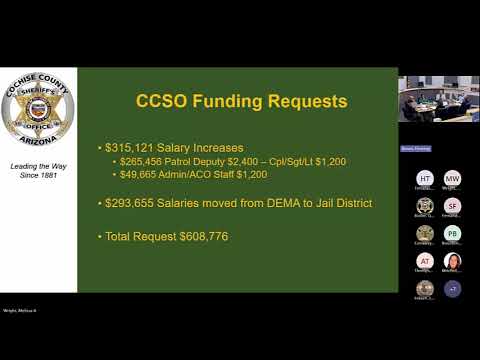
The sheriff told the board that recruitment and retention are the department's top budget drivers and proposed raising starting deputy pay to about $60,000 and starting detention-officer pay to about $50,000 while applying flat one-time increases to current staff. He said the package would include a flat $2,400 adjustment for deputies, $1,200 for corporals and sergeants and $1,200 for some administrative positions and described the move as intended to make Cochise County competitive with federal and state employers.
The sheriff framed the request as a response to what he called “marketplace competitiveness,” citing Border Patrol and state law-enforcement raises he said are drawing deputies away. “Recruitment retention is huge to what we do,” he said. He added that it costs about $100,000 to recruit and train a deputy who then leaves, which increases recurring staffing costs.
Why it matters: supervisors and staff said the county has a limited tax base and competing fiscal priorities — from roads to public health — and must balance higher pay against other service needs. The sheriff acknowledged that Cochise County’s smaller population and property base constrain revenue, telling the board, “we have a very shallow tax base,” and urging careful prioritization.
The sheriff described a mix of funding sources supporting patrol and border operations. He said less than 1% of his funding currently comes from federal sources, and that the state remains the primary partner. He said the county receives about $2 million a year in a state local-border-support allocation and reported learning of additional state funding discussions (he said the state had discussed allocations of $15 million and that legislative proposals could grow that figure). He also said the department recently received a roughly $700,000 state grant for equipment.
The board discussed whether reductions in cross-border activity or future policy shifts could reduce grant funding and require more general-fund support. The sheriff said he does not expect to return to the board for general-fund increases immediately and described efforts to sustain operations through grants and partnerships: “we're gonna sustain what we have because the money is being allocated for us.” He also cautioned that a political reversal that reopens the border could require rebuilding capacity.
Dispatch and contracts: board members and the sheriff discussed the county’s joint dispatch center (referred to as CECOM). The sheriff praised Tammy Jones, the center’s leader, for improving operations and said CECOM is moving to a subscription-based model that the sheriff described as still subsidized while it phases toward covering costs. Board members and staff noted joint dispatch subscription fees in the sheriff’s budget in the range of about $938,000 to $982,000 and that the fee model is under revision.
Fleet and other savings: the sheriff and staff identified fleet charges and some contracted services as potential areas for cost savings. The sheriff said federal grant-funded (G r a m a /grant) vehicles had reduced immediate county replacement costs and that the department expects to return roughly $500,000 in fleet savings by year-end. The sheriff told the board he and the new fleet director are reviewing outdated assumptions and potential efficiencies.
Staffing distribution and operations: the sheriff outlined his office’s structure (patrol and detention bureaus, plus support and volunteer teams) and said about 75% of sworn staff work patrol and 25% in special operations. He described efforts to assign deputies to three county regions to support response times, and noted recruitment challenges in some rural regions such as Wilcox and Benson. On housing and economic development, the sheriff and supervisors agreed that limited housing and a shallow tax base make recruiting and retaining employees harder.
Follow-up and next steps: supervisors asked for more detailed budget breakouts and for individual follow-up meetings with sheriff’s office staff to review contracts, fleet, and joint dispatch charges. The sheriff and staff agreed to provide detailed line-item information and meet separately with supervisors under open-meeting constraints.
No formal motions or votes were taken during the discussion; the board adjourned the sheriff’s budget discussion at the end of the session and planned a separate jail district budget meeting to follow.
Ending: The work session closed with the board scheduling further, individual budget reviews and a separate jail district budget session; supervisors said they will analyze salary proposals, contract consolidation opportunities and the dispatch subscription model before making formal budget decisions.