Get Full Government Meeting Transcripts, Videos, & Alerts Forever!
Get email alerts on the County Budget Adrs topic
No spam. Unsubscribe anytime.
Cochise County attorney details border‑crime surge, requests new ADRS legal‑secretary position
Summary
County Attorney Lori Zuko told the Board of Supervisors a post‑2021 surge in border‑related felony cases and new electronic reporting mandates have strained staff; she requested funding for one ADRS legal‑secretary 2 to meet reporting and CJIS requirements.
County Attorney Lori Zuko told the Cochise County Board of Supervisors at an Oct. work session that a surge in border‑related felony cases since 2021 and a state mandate to electronically report case dispositions have strained the county attorney’s office and prompted a request for one additional ADRS legal‑secretary 2 position.
Zuko said the office started separately tracking “border crime cases” in PBK in 2022 and that filings and the workload spiked after a replacement human‑smuggling statute was enacted in September 2022. “We did get some DEMA money…we were not able to hire someone for the 110. Nobody would come down here to do that for that salary,” Zuko said, referring to an unfunded attempt to hire a dedicated border‑crime prosecutor and subsequent temporary staffing funded by the sheriff’s grant.
The county attorney’s office asked supervisors to fund a legal‑secretary 2 to perform Arizona Disposition Reporting System (ADRS) work that the office says is required by state rules and that must be accurate to maintain criminal‑history integrity and CJIS access. Dallas Bullington, the office’s technology project manager and lead paralegal, described ADRS as “the defendant’s criminal history” and said the office received a 2020 ADRS grant to adopt PBK to meet electronic reporting requirements. Bullington briefed supervisors on technical limits of the electronic interface and said the interface is only partially effective: “That interface is only 40% effective.”
Why it matters: Accurate ADRS reporting affects firearm purchases, employment background checks and other decisions that rely on up‑to‑date dispositions. Zuko told supervisors that failing to comply with the ADRS reporting rules could lead to loss of CJIS access and other consequences specified by the department and the Supreme Court rules. Bullington added that ADRS entries that remain in limbo — for example, arrest entries with no final disposition — can unfairly affect a person until a court order removes them.
Key staffing and budget details cited in the presentation: - The felony unit currently has seven full‑time felony attorneys; paralegals decreased from seven to five. Zuko said some attorneys left last year for higher‑paying jobs and the office left one felony attorney position unfunded to help fill an open civil position. - The county secured an ADRS grant around 2020 worth about $150,000 to acquire PBK, the case‑management system used for electronic reporting (speaker: Bullington). - The office seeks a legal‑secretary 2 with an estimated salary range of about $38,000–$40,000 plus EREs to perform ADRS data entry and manual updates the interface cannot send (speaker: Bullington). - Zuko said the office will use Criminal Justice Enhancement (CJIP/CJF) funds to cover some attorney salary gaps and noted several grants — HIDA, DEMA and others — that fund portions of unit work but are not permanent.
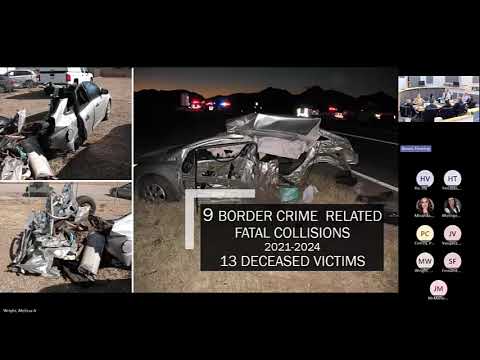
Zuko and Bullington described operational consequences of the border‑crime caseload: multi‑defendant investigations requiring phone downloads and search warrants, a backlog of furthered 48‑hour cases that later return for charging, and significant trial costs for homicide cases tied to human‑smuggling events. Zuko provided a historical summary of nine fatal collisions that produced 13 deceased victims and described several high‑cost trials and sentences imposed in those cases.
Board action: The presentation was delivered as part of a budget work session; supervisors did not take formal action on the request at that meeting. The county attorney’s office characterized this as a funding request under consideration rather than an approved appropriation.
Ending: Bullington and Zuko asked the board to consider the ADRS position as part of the county‑attorney budget process so the office can meet reporting mandates and reduce manual work for paralegals and attorneys. The supervisors scheduled their next budget work session with the county recorder.