Get Full Government Meeting Transcripts, Videos, & Alerts Forever!
Get email alerts on the Impact Fees Transportation Ems topic
No spam. Unsubscribe anytime.
Ocala staff urge caution on county’s proposed higher transportation and EMS impact fees, request clearer benefit boundaries
Summary
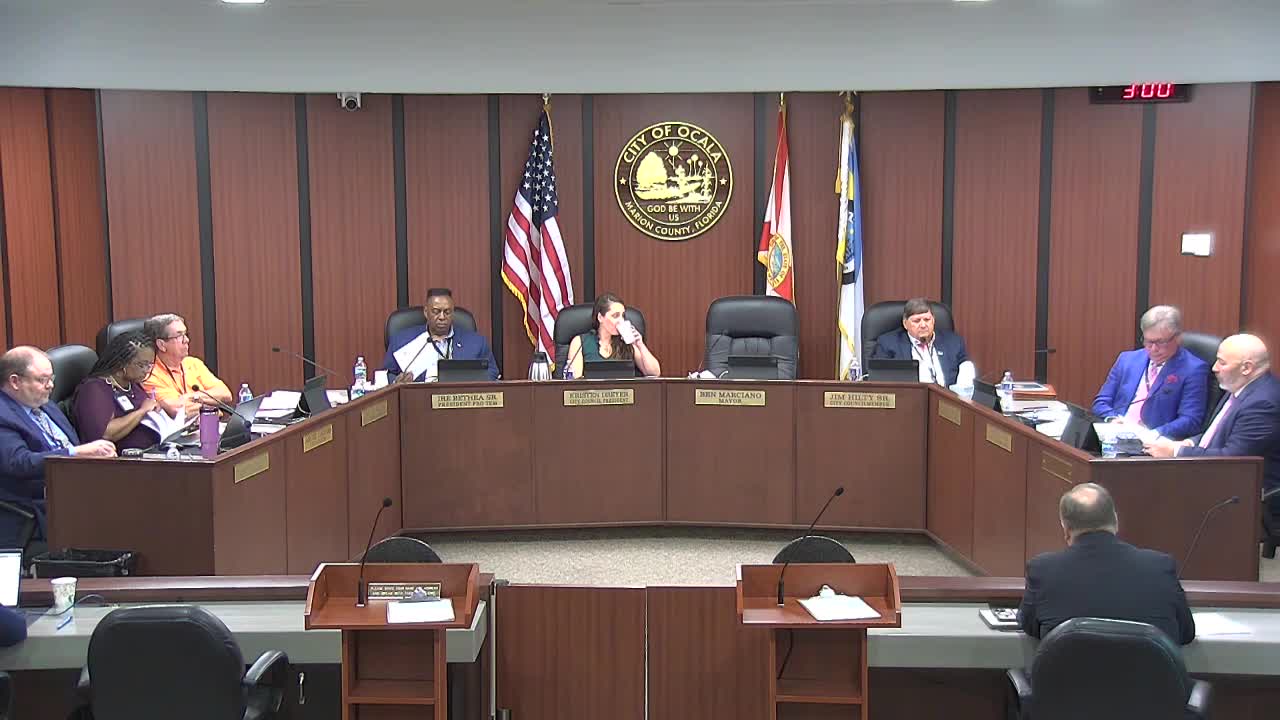
City staff and council discussed proposed county transportation and EMS impact fee increases, raising concerns about rational nexus, benefit districts, the city’s daytime population and whether collected fees will fund projects benefiting Ocala.
City officials and council members discussed proposed Marion County increases to transportation impact fees and a proposed EMS impact fee, raising questions about how fee revenue would be allocated and whether the county’s proposed district structure would meet the legal tests that allow impact fees to be imposed.
The city manager summarized the county’s schedule: a May 6 workshop to discuss “extraordinary circumstances” and a May 23 adoption hearing, with any adopted increases taking effect 90 days later. Staff noted historical collection amounts and contrasted those with the county’s proposed 2025 fee schedule. Between February 2003 and February 2010 the city collected roughly $25.2 million in transportation impact fees; after the 2017 reinstatement through December 2024 the city collected about $6.17 million. The city said the 2015 study used a $6,978.94 baseline for a 1,500–2,500 square‑foot home; the current fee is about $1,397 and the county’s proposed 2025 fee would be about $5,318 for a dwelling in that size range.
City staff raised several concerns: (1) the county’s East/West district split has produced unequal revenue outcomes (staff cited roughly $31 million from the West district and $19 million from the East in the historical accounting), (2) the county’s current proposals may not provide a “rational nexus” showing that fees collected from new development will be proportionate and spent on facilities that directly benefit the fee payers, and (3) the city lacks clear visibility into where previously collected fees were spent and whether future collections will fund city‑adjacent projects that provide direct benefit to Ocala residents.
On EMS, staff said the county’s proposed 2025 EMS fee would be $125.23 per functional residence, which translates to about $222 for a 1,500–2,500 square‑foot dwelling. City officials noted that EMS services receive multiple revenue sources (insurance reimbursements, county revenues, etc.) and said a countywide fee should meet the same rational‑nexus tests. Several council members urged that, if the county uses the city’s acknowledged daytime population in fee calculations, the city should receive a proportionate share of penny sales tax revenue tied to that daytime population or the fee structure should be phased in.
The city manager said staff will schedule one‑on‑one meetings with council members and continue discussions with the county before the May 23 hearing. Staff suggested the city could pursue a mobility fee alternative or seek an Ocala‑specific benefit district if a more defensible legal nexus and spending plan cannot be achieved under the county’s proposed approach. No formal council vote was taken; staff will report back after one‑on‑ones and additional county materials are available.