Get Full Government Meeting Transcripts, Videos, & Alerts Forever!
Get email alerts on the Parks And Recreation topic
No spam. Unsubscribe anytime.
Pompano Beach CRA details McNabb House botanical-gardens plan; debate surfaces over TIF financing and oversight
Summary
City redevelopment staff and private consultants presented a design, operations and financing plan for the McNabb House and Botanical Gardens project on April 15, emphasizing a mix of public open space and a revenue-generating restaurant and event center to support long-term maintenance.
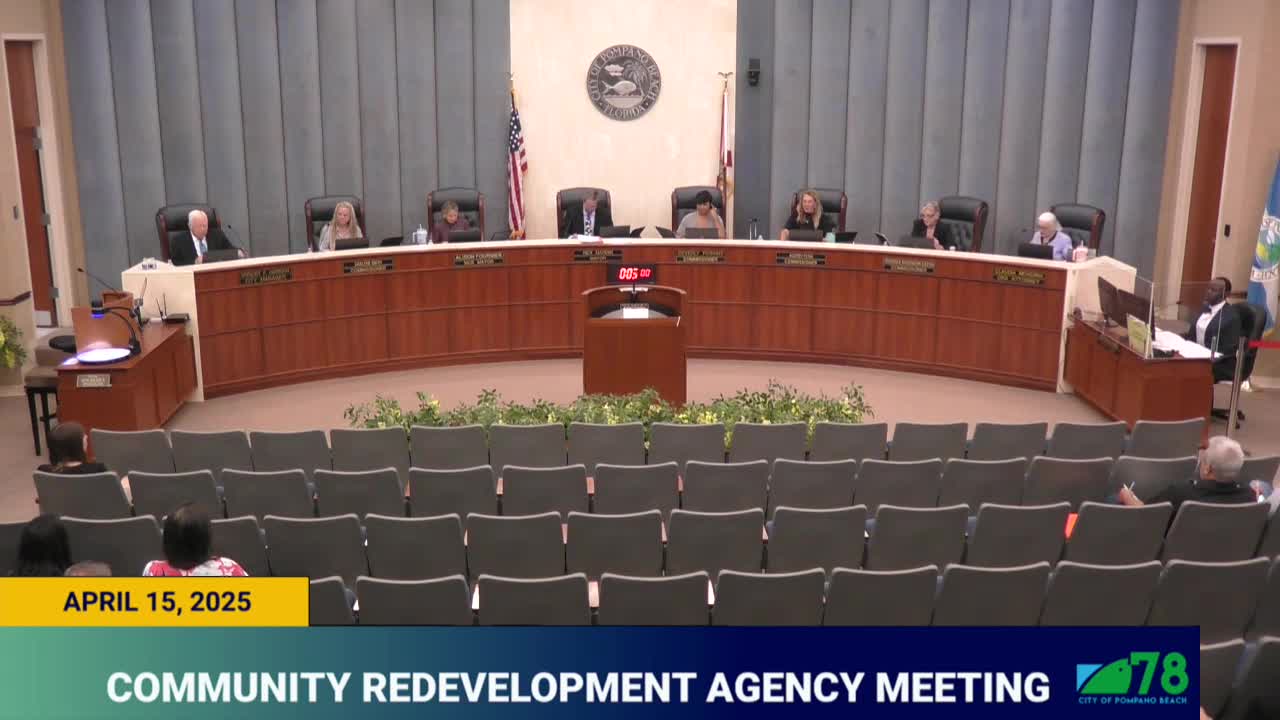
POMPANO BEACH, Fla. — City redevelopment staff and private consultants presented detailed plans on April 15 for the McNabb House and Botanical Gardens, a proposal to relocate and restore the historic McNabb House within a roughly 3-acre botanical garden in the East Community Redevelopment Area (East CRA). CRA project manager Sarah Mulder said the project aims to pair public open space with a revenue-generating restaurant and event pavilion to sustain ongoing maintenance.
The presentation included a conceptual master plan, a proposed operations model and financing approach. “This bond does not rely on raising taxes to fund debt service,” Sarah Mulder, CRA project manager, said in the presentation, describing tax-increment financing (TIF) bond repayment from future taxes generated inside the East CRA boundary.
The plan presented by consultants called for preserving about 75% of the site as public green space, moving the McNabb House to the park’s north edge and adding a restaurant, event pavilion, classrooms, a garden store and playgrounds. Randy Hollingworth, one of the project designers, walked commissioners through a five-senses garden layout centered on an existing large ficus tree and said circulation would allow the public to use garden paths even during private events.
Sterling Hospitality, the hospitality consultant on the project, provided a conservative pro forma showing potential annual revenue from food, beverage and events. Tommy DiGiorgio, the Sterling consultant, said his firm’s conservative projection was roughly $7 million in annual revenue with a projected operator earnings margin near 19 percent and estimated that about $490,000 in percentage rent could flow to the CRA under a lease arrangement.
Biederman Redevelopment Ventures (BRV), the place-making consultant, outlined programming and revenue mixes intended to supplement restaurant revenue, from free community programming to paid special exhibits, a garden store and sponsorships. “Our vision for the Gardens is that it’s open to the public, self sufficient,” Kayla Hughes of BRV said, describing a staged approach to operations and a goal of achieving greater self-sufficiency by year three.
Mulder and staff also gave a project finance and schedule update: staff reported $2.4 million spent to date on the project (including the cost of moving the house and design fees), about $1.3 million currently encumbered, and recommended studying a tax-increment (TIF) bond to fund construction. The design-development phase and development-review committee work are complete; staff expects Appearance Committee review and an updated opinion of probable cost in June, site-plan review finalized in October 2025, construction documents by May 2026 and an estimated 18-month construction window once bids are awarded.
Commissioners and members of the public asked detailed questions about TIF mechanics, who bears a tax burden if the CRA sunsets, operations funding and property-title issues. Vice Mayor Fournier pressed staff to clarify that TIF revenues are taxes collected on the increment in property valuations within the CRA boundaries; CRA executive director and city manager Harrison confirmed that the increment is taxed and used inside the district. Commissioner Fournier also raised cost and debt concerns, saying the proposed bond and extended CRA horizon include significant interest expense.
Several public commenters raised governance and ethics concerns tied to consultants and property ownership. Matthew Walsh, a local business owner, told the board he has prepared an ethics complaint and asked whether staff and consultants disclosed property purchases in CRA zones. RMA principals Kim Breesemeister and Chris Brown, who were in the audience, responded later in the meeting that RMA’s purchases predated the McNabb relocation and that the firm had obtained legal advice and made required disclosures when it acquired properties.
City attorney Claudia McKenna and the city manager both urged that questions about public records and legal matters be raised with staff or legal counsel so they can be answered directly. McKenna said she is available to meet privately about records or legal questions, but added she will respond publicly when false statements about staff or legal matters appear in the public record.
What the meeting did not do: there was no final vote or formal CRA action to authorize construction funding, no bond issuance authorization, and no final operator selection. Staff noted an RFP for an operator will be issued as planning continues and that an operations and maintenance plan will be delivered in June for further commission review.
Background and immediate next steps: the CRA acquired portions of the park property in 2021; staff says the McNabb family originally donated the house to the historical society and that the CRA later assumed the preservation project. The CRA-funded portion of the project has a long timeline; staff said it will return with detailed cost estimates and an operations plan for a June review and expects to return to the commission as the site-plan and permitting processes advance.
Concerns raised at the meeting — about TIF tradeoffs, debt-service costs and transparency around consultant relationships and property ownership — remained unresolved at adjournment. Staff confirmed records exist and that several family members provided quitclaim deeds for portions of the property; one family member reported reluctance to sign and staff said the city attorney would follow up.
The presentation and the public debate emphasized that the project blends a preservation and park mission with revenue-focused elements intended to reduce future taxpayer maintenance obligations, but commissioners and residents pressed staff for clearer financial trade-offs and governance safeguards before the board proceeds further.