Get Full Government Meeting Transcripts, Videos, & Alerts Forever!
Get email alerts on the Accessory Dwelling Units topic
No spam. Unsubscribe anytime.
Committee approves accessory dwelling unit rules allowing internal, attached and detached ADUs with owner-occupancy limits
Summary
The Zoning & Development Committee approved a substitute ordinance defining and permitting accessory dwelling units (ADUs) in single‑ and two‑family areas under a set of design and limited‑use standards. Sponsors included a requirement that owner‑occupants, not investor owners, must initiate many ADUs; building-code compliance remains mandatory.
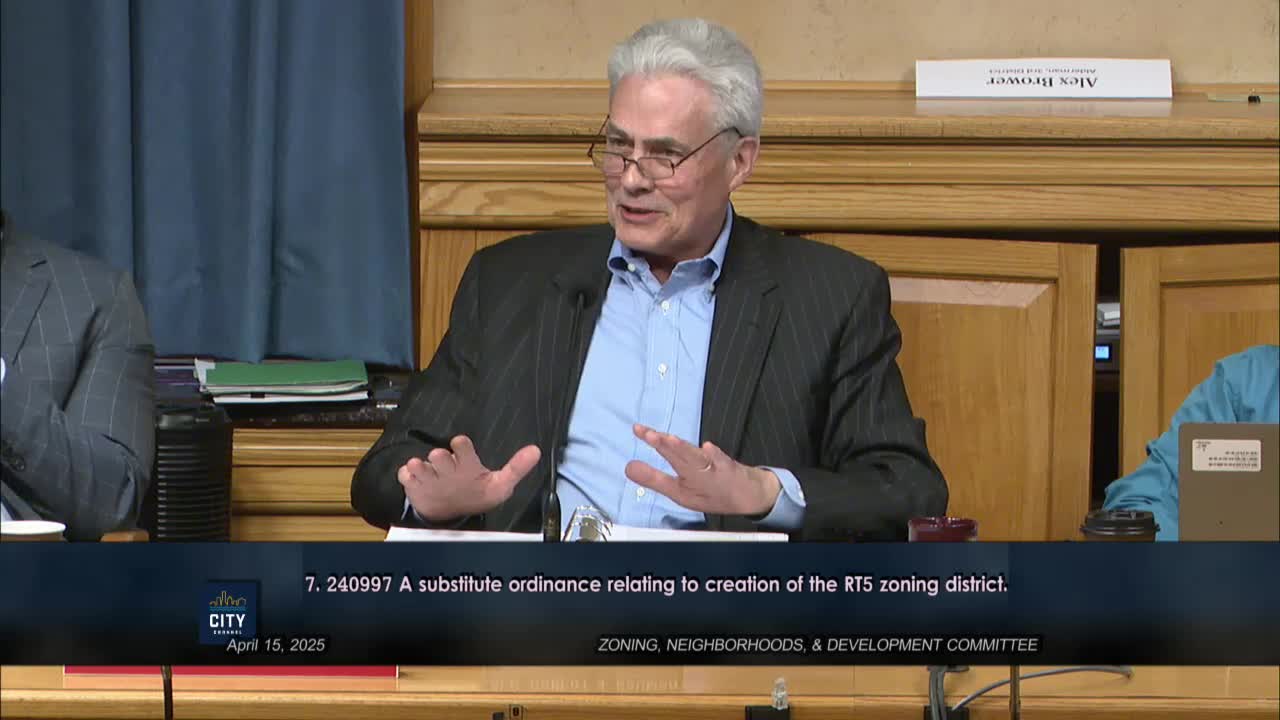
The Zoning & Development Committee approved a substitute ordinance to add definitions, design standards and limited-use rules for accessory dwelling units (ADUs) in Milwaukee’s zoning code.
The ordinance creates three ADU types — internal (within the existing primary structure), attached (an addition attached to the primary structure) and detached (a separate accessory building such as a carriage house) — and sets location, size and design limits. Department of City Development staff and Department of Neighborhood Services staff briefed the committee on building-code and life-safety implications for internal and third-floor conversions; Neighborhood Services staff warned a conversion that increases the building’s classification could trigger commercial-building-code standards, sprinkling and additional egress requirements.
To address neighborhood concerns about investor-driven conversions, sponsors included a limited-use standard that would permit many ADUs only where the application is filed by the owner-occupant of the primary dwelling. Sam Leichling (DCD) described the approach as aligned with national best practices and noted the substitute incorporates technical changes requested by the Zoning Code Technical Committee. DCD also said the Plan Commission had unanimously recommended approval with one abstention.
“An accessory dwelling unit … is a room or a set of rooms that has its own living facilities,” Leichling said during the presentation, explaining that an ADU creates a new dwelling unit and therefore triggers building-code requirements.
The committee adopted the substitute ordinance after members discussed possible narrower alternatives (for example, allowing only detached ADUs or limiting internal ADUs to single‑family lots). Sponsors and advocates said the expansion would increase intergenerational housing options and small-scale housing supply; building‑code, driveway-access and alley-use issues would be handled at permitting and design review.
Hearing no objections, the committee ordered the file for passage.