Get Full Government Meeting Transcripts, Videos, & Alerts Forever!
Get email alerts on the Zoning Reform topic
No spam. Unsubscribe anytime.
Council adopts 'RT5' zoning text to allow a pathway for 5–8 unit buildings; sponsors and opponents press for stronger neighborhood engagement
Summary
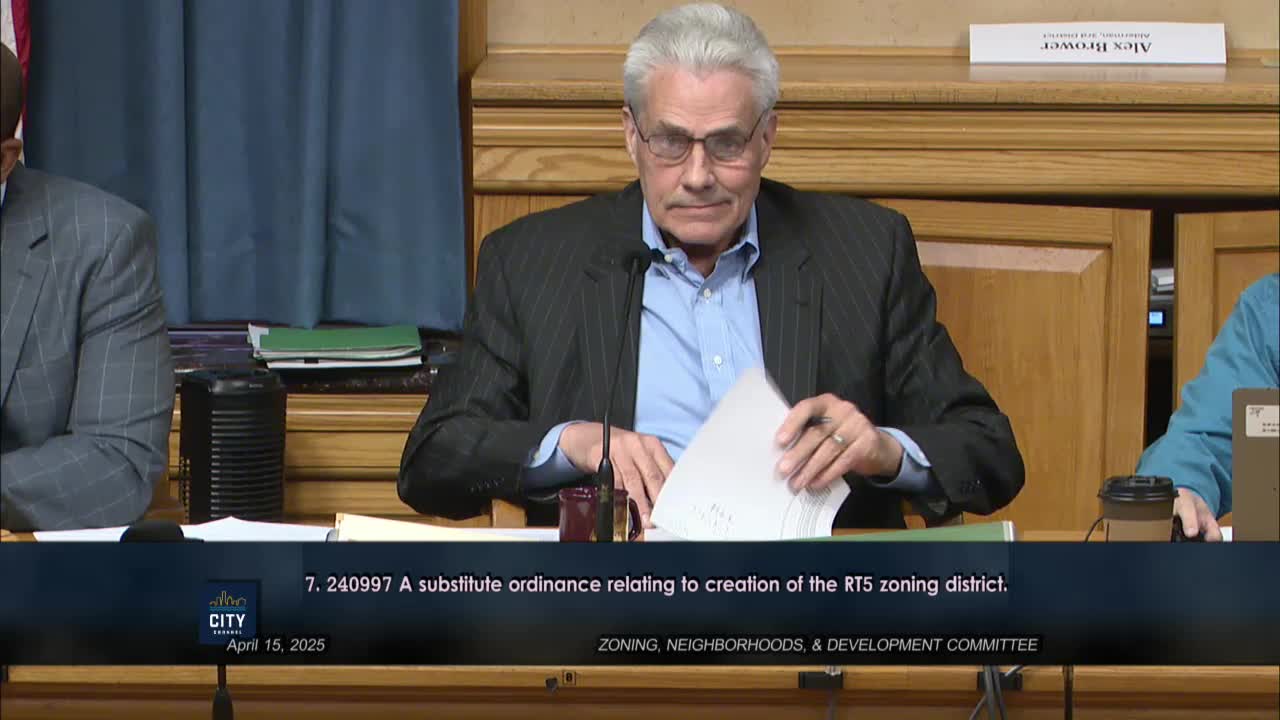
The Zoning & Development Committee adopted a substitute ordinance creating a new RT5 zoning district — a text change that would allow up to eight-unit small multifamily buildings if property owners later seek a rezoning—while members debated codifying neighborhood engagement requirements for subsequent map amendments.
The Zoning & Development Committee voted to adopt a substitute ordinance creating a new residential zoning category called “RT5,” a text amendment to the zoning code that would allow — if later applied to a property through a separate rezoning map amendment — small multifamily buildings of up to eight units where the RT4 district currently limits development to a maximum of four units.
Sam Leichling of the Department of City Development summarized the ordinance as a text change that would not automatically change the zoning of any property. “Adoption of the ordinance and creating a new zoning district would not apply this district to any properties in the city,” Leichling told the committee. He said any application to rezone a parcel to RT5 would still require neighborhood review, aldermanic input, public hearings and a vote of the Common Council.
Sponsor Alderman Michael Perez said the zoning district was designed to give the council a lawful, site-specific tool for allowing “missing‑middle” or small multifamily buildings in locations where the council and neighbors found them appropriate. “I represent a district that is almost entirely RT4,” Perez said. “The RT5 was born out of conversations … of how to be creative to figure out where and when a multi-unit building above four makes sense.”
Opponents at the committee and several neighborhood speakers urged stronger, codified neighborhood engagement before any rezoning could be initiated. Critics said that without explicit procedural requirements, residents could be left without meaningful influence once a map amendment was filed. Committee members and sponsors responded by saying that the map amendment process already requires public hearings and that the ordinance purposefully creates a “floating” tool to enable site-by-site decisions.
Department of City Development staff noted the item had been reviewed by the Zoning Code Technical Committee and the City Plan Commission; the item was revised to address ZCTC comments and DCD recommended approval. After extended debate about whether the council should add explicit neighborhood-consultation requirements to the code section that governs zoning map amendments (Milwaukee Code § 295.307), Alderman DeAndre Jackson moved adoption. The committee recorded the ordinance as adopted; the matter proceeded to the council with the committee’s approval.