Get Full Government Meeting Transcripts, Videos, & Alerts Forever!
Get email alerts on the Housing Conditions topic
No spam. Unsubscribe anytime.
Community survey finds 22% of homes in Reclaiming Our Neighborhoods areas need major exterior repairs; coalition urges enforcement and homeowner aid
Summary
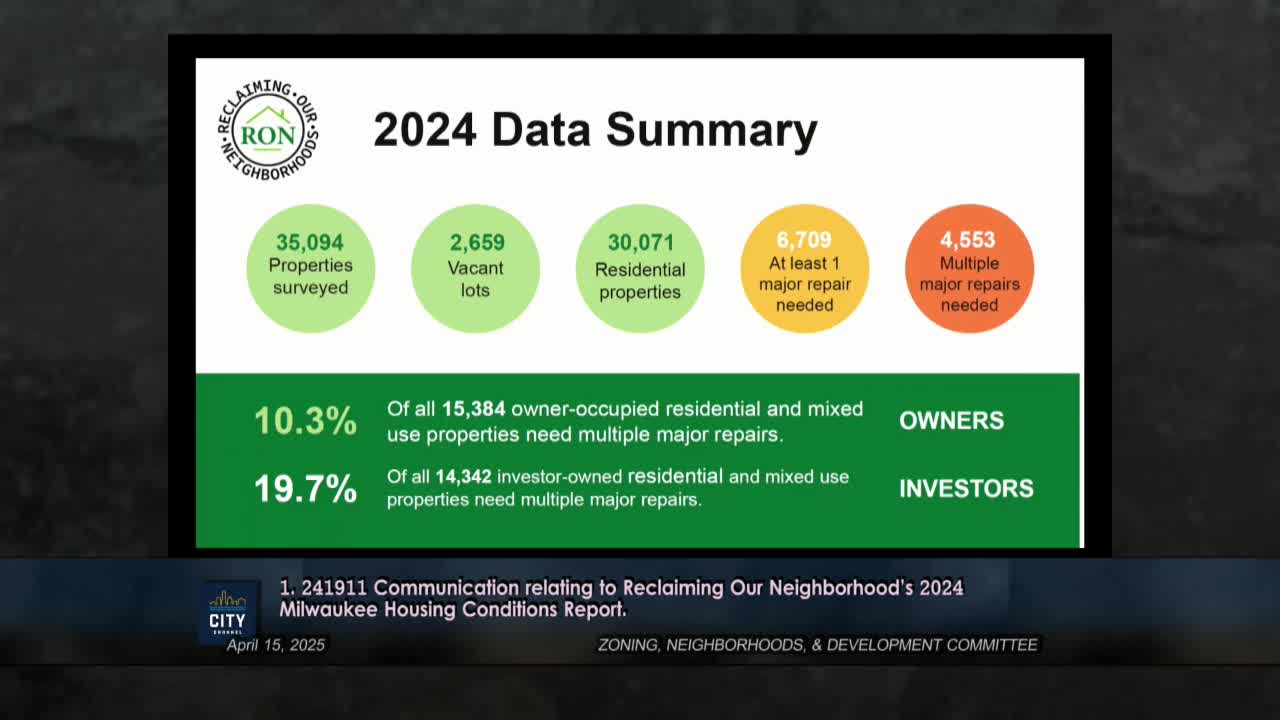
Reclaiming Our Neighborhoods (RON) presented its 2024 parcel-level housing conditions report to the Zoning & Development Committee, reporting that surveyors found major exterior repairs on about 22% of properties in 14 Milwaukee neighborhoods and urging expanded enforcement and homeowner assistance.
Reclaiming Our Neighborhoods (RON) presented its 2024 housing conditions report to the Milwaukee Common Council Zoning & Development Committee on April 29, detailing exterior-condition surveys of 14 neighborhoods and urging the city to expand enforcement and homeowner-assistance tools. The committee voted to receive and place the report on file.
The RON Coalition said volunteers surveyed parcels in neighborhoods including Amani, Sherman Park, Lindsay Heights and Washington Park and found that “a little over 22% of all residential and mixed use properties” required at least one major exterior repair. RON’s presenters told the committee investor-owned houses were more likely to need multiple repairs than owner-occupied homes and that investors own about 47.7% of RON-area units but account for 58.6% of the tax-delinquent properties. “They are owing the city of Milwaukee about $6,500,000 in unpaid taxes,” RON told the committee.
The report estimated exterior-repair costs averaging about $14,000 per property for identified work and said owner-occupied houses in the surveyed neighborhoods would need a minimum of roughly $35,000,000 to address identified repairs. RON also called attention to lead-risk indicators, reporting that roughly 14% of homes in the survey footprint were built before 1979 and showed deteriorated paint conditions that may indicate lead hazards.
“We are here to advocate for measures that we believe will have a positive impact on the quality of housing in our neighborhoods,” said Lindsay St. Arnobell, executive director of Near Westside Partners and a RON steering member. RON’s presenters said their data work was performed with technical assistance from Data You Can Use and that the coalition intends to continue person-to-person surveys, train more resident surveyors, and share anonymous parcel-level maps publicly.
RON recommended several policy responses, including enhanced enforcement targeted at investor-owned, tax-delinquent properties; prioritizing resources and grants for low- and moderate-income homeowners to complete exterior and lead-remediation work; and formalizing city partnerships to triage distressed properties and hold unresponsive landlords accountable. The coalition said its first round of outreach to investor owners generated stronger responses from local landlords and weaker responses from out-of-state or conglomerate owners.
Committee members asked RON how surveyors were trained and how properties would be referred to the Department of Neighborhood Services (DNS). RON described training developed in partnership with neighborhood improvement districts and said the coalition is sharing lists of nonresponsive owners with DNS for follow-up; staff emphasized RON’s role as a precursor that identifies issues and refers cases to city enforcement when owners do not engage voluntarily.
Alderman DeAndre Jackson moved to receive and place the report on file; the motion carried with no recorded objections. The coalition said its datasets and the full report are posted on DataYouCanUse.org and that residents with concerns should be referred to neighborhood partner meetings and RON outreach events.