Get Full Government Meeting Transcripts, Videos, & Alerts Forever!
Get email alerts on the Construction And Permits topic
No spam. Unsubscribe anytime.
San Antonio committee hears city, builders and utilities on construction coordination and permitting
Summary
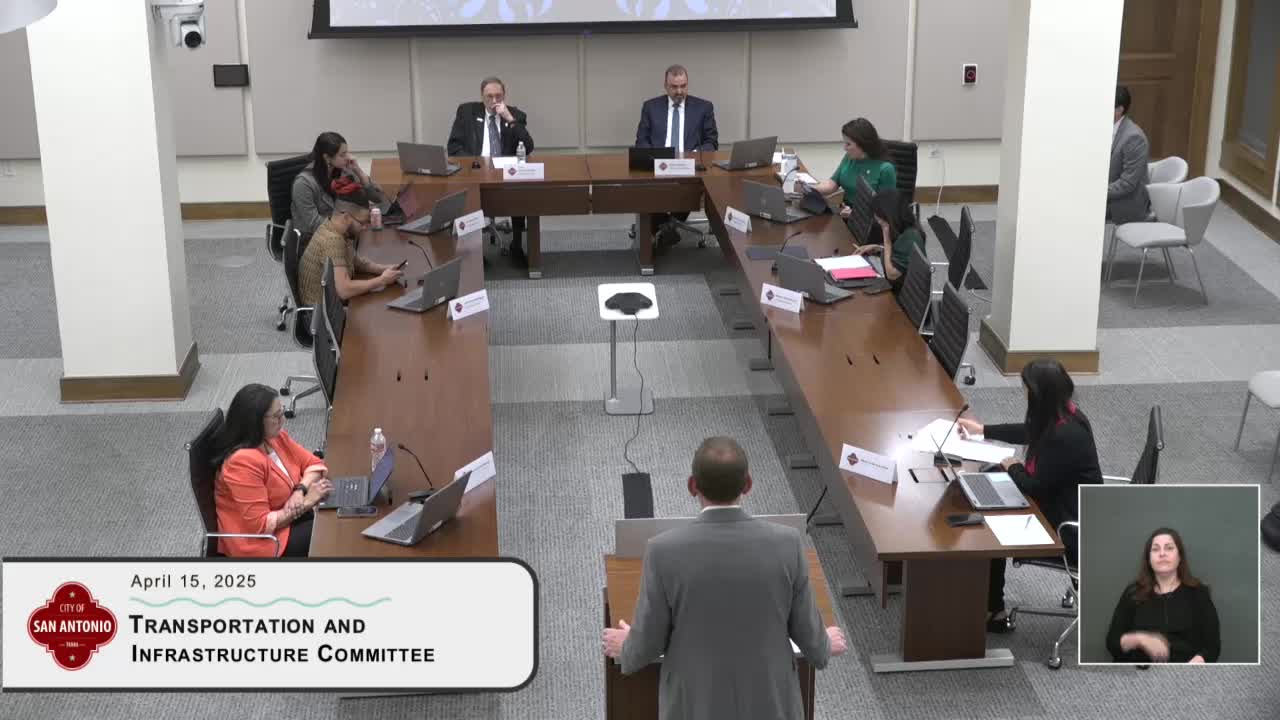
SAN ANTONIO — City staff, developers and contractors told the San Antonio City Council Transportation and Infrastructure Committee on April 15 that the city uses online permit dashboards, weekly coordination meetings and right-of-way permitting rules to manage growing volumes of private and public construction — but elected officials and industry representatives said residents and small developers still need clearer information and more support.
SAN ANTONIO — City staff, developers and contractors told the San Antonio City Council Transportation and Infrastructure Committee on April 15 that the city uses online permit dashboards, weekly coordination meetings and right-of-way permitting rules to manage growing volumes of private and public construction — but elected officials and industry representatives said residents and small developers still need clearer information and more support.
Development Services Department representative Mike Shannon described three public-facing tools his office uses: a building permit activity dashboard, preliminary application and plat mapping via the city GIS, and an online permitting portal that automates permit applications and issued permits into a public portal. “Information gets automated to this portal through our permitting database and really tells a story of not only what’s coming, but what’s happening, throughout our city,” Shannon said.
Why it matters: Downtown and other parts of San Antonio are seeing heavy construction from new hotels, conversions and infrastructure work. Committee members said residents and small-business owners report long disruptions and unclear timelines; committee leaders brought the item to explore whether better coordination, communication or policy changes could reduce impacts.
What city staff said - Right-of-way work is reviewed through Public Works and has distinct permit types for activities such as excavations, sidewalk closures and utility taps. Shannon said the city uses rules that limit the number of active permits on a city block and considers nighttime work and emergency exceptions. - Public Works staff said applicants are asked to provide notice 30 days in advance for non-emergency right-of-way work so staff can learn the scope, schedule and possible overnight or weekend work. “We require for anybody’s going to work on right away, as long as not emergency, to 30 days in advance,” Public Works staff member Razi said. - Development Services reported inspection throughput of roughly 1,000 inspections a day and said the department is meeting its target for scheduled inspections: “We’re at about 99.3% as scheduled right now. Our goal is 95%,” Shannon said. The department described efforts such as remote video reinspections for minor fixes (about 10% of reinspections) to speed turnaround. - The department recently migrated its cloud-based permitting/solar permitting system to a newer, cloud-hosted version; Shannon said the updated customer portal went live “a couple of weeks ago.”
Stakeholder perspectives - Stephanie Reyes, president and CEO of the Real Estate Council of San Antonio, said industry groups meet regularly with city staff and utility partners and aim to minimize disruption: “Thoughtful planning, proactive communication, and collaboration, coordination, are key to mitigating impacts,” Reyes said. - Michelle Davis, president of Associated Builders and Contractors South Texas, said her chapter represents “about 10,000 construction workers” in the region and emphasized education and site visits for council members to better understand construction processes. - Caleb Chance, senior vice president with Pig Dawson Engineers and leader of the Real Estate Council task force with the city, praised the level of coordination: the city’s Development Services and Public Works “by far are the best coordination that we have” compared with peers, he said.
Concerns raised to staff - Outdated web forms: A council member described a case in which a resident trying to request a block party received an invalid web form, producing frustration and extra calls to council offices. Shannon said staff monitor and update many online forms and will follow up on specific complaints. - Customer experience and small developers: Several council members and speakers pressed the city to simplify onboarding for first-time or small developers. Shannon noted the DSD “one-stop” consultation service where staff provide free 30–45 minute consultations and an affordable-housing team that handholds projects from start to finish. - Utility coordination and service outages: Council members asked about coordination with major internet providers. Shannon and other staff said the city shares project schedules with utilities including Google and AT&T and that coordination has improved; staff conceded response time to unexpected service impacts remains a concern. - Permit-review consistency: Council members said different plan reviewers can return inconsistent comments on the same drawings; the committee urged additional reviewer training and clearer guidance to applicants. - Storage and staging in the right of way: Staff said contractors may use a clearly authorized area for loading/unloading and that the city charges a per-square-foot fee for sidewalk or lane closures; contractors working on city projects may leave equipment in an assigned work zone overnight for efficiency while still required not to block driveways or emergency routes. - Illegal dumping and disposal access: A council member asked whether contractors are being turned away from city disposal sites; staff said they would follow up with Solid Waste for specifics and noted the department has expanded disposal options over time.
Context and follow-up: Committee members noted the large pipeline of bond and capital programs and questioned whether the city has sufficient resources and workforce to sustain the current construction pace. Public Works staff said a consultant’s interviews found adequate contractor capacity when projects are available, but added that coordination to preserve access for deliveries, mail and emergency response adds complexity to schedules.
The committee did not adopt new policy at the April 15 meeting but asked staff and stakeholders to continue dialogue on customer-facing tools, small-developer assistance and reviewer consistency. The item closed after roughly 90 minutes of presentation and committee Q&A.
Ending: Committee members asked staff to return with potential policy or process improvements and invited industry groups to continue working with DSD and Public Works on customer-facing materials and coordination strategies.