Get Full Government Meeting Transcripts, Videos, & Alerts Forever!
Get email alerts on the Fisheries Finance topic
No spam. Unsubscribe anytime.
Bill would provide one-time state-funded infusion to shore up Commercial Fisheries and Agriculture Bank; committee set aside for later
Summary
Senate Bill 156 would authorize a one-time infusion (purchase of nonvoting shares) from a sunsetted revolving fund to provide temporary low-rate financing at the Commercial Fisheries and Agriculture Bank (CFAB); committee heard sponsor and CFAB testimony and set the bill aside for future consideration.
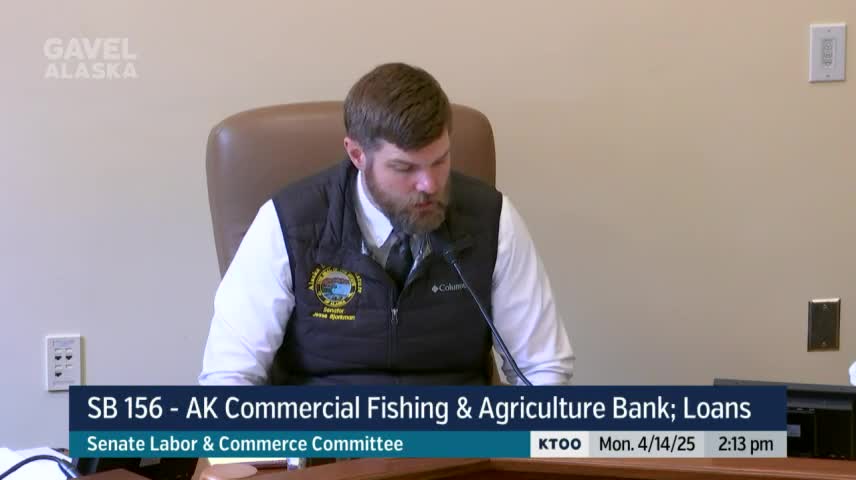
Senate Labor and Commerce on April 14 considered Senate Bill 156, a measure to provide a temporary, one-time financial infusion to the Commercial Fisheries and Agriculture Bank (CFAB) intended to keep the cooperative lender operating while the commercial fisheries revolving loan fund returns to its historic statutory rate formula.
Senator Jesse Kiel, sponsor of SB156 (carried at the request of the joint Fishforce task force), told the committee the bill would use remaining balances in a sunsetted revolving account (identified in testimony as the Capstone Avionics revolving loan fund) to purchase nonvoting shares in CFAB. The infusion would be tightly restricted: funds could be used only to make loans that in most respects match the commercial fisheries revolving loan fund (fixed terms, fixed interest rate) and only while the revolving loan fund’s temporary lower rate remains in effect (roughly a two-year window described by the sponsor). Any unused funds would be returned, and loans funded under the program would be repaid on a fixed schedule so the state would receive the funds back, the sponsor said.
"CFAB is a member-owned cooperative that provides financing for commercial fishing, agriculture, tourism, and natural resource businesses in Alaska," Doug Bloomer, chairman of CFAB's board, said in invited testimony. He described a "trifecta" of pressures on CFAB: declining fish returns and quotas in some areas, a challenging marketplace and processor changes, and the state’s temporary low-rate program that encouraged many borrowers to refinance with the state program. Bloomer said CFAB has more than 700 members and is seeing reduced new-loan volume and membership attrition; he testified that the bank could see membership declines of "20 to 25% annually" if the current lending gap continues.
Sponsor Senator Kiel emphasized that SB156 does not propose an ongoing subsidy or tapping the commercial fisheries revolving loan fund itself; rather, the bill uses an existing sunsetted fund balance (testimony indicated about $3.7 million remained) to provide bridge financing so CFAB can continue lending on limited-entry permits and other fisheries collateral that other lenders cannot accept. Kiel said the infusion is intended to "keep the doors open" rather than fully replace the scale of lending available through the state program.
Committee members pressed for the size of the available fund balance and whether the infusion would be sufficient if the state’s low-rate program were extended; Senator Kiel and CFAB representatives said the $3.7 million balance would likely not cover every refinancing scenario and estimated that fully matching the state program in scale could require roughly $9 million. The sponsor and CFAB described the bill as a narrowly tailored, time-limited measure to preserve CFAB's role in Alaska's fishing finance sector.
No final vote occurred on SB156; the committee set the bill aside for further consideration and will revisit the proposal as part of the Legislature's ongoing work on fisheries measures.