Get Full Government Meeting Transcripts, Videos, & Alerts Forever!
Get email alerts on the Firearms Privacy topic
No spam. Unsubscribe anytime.
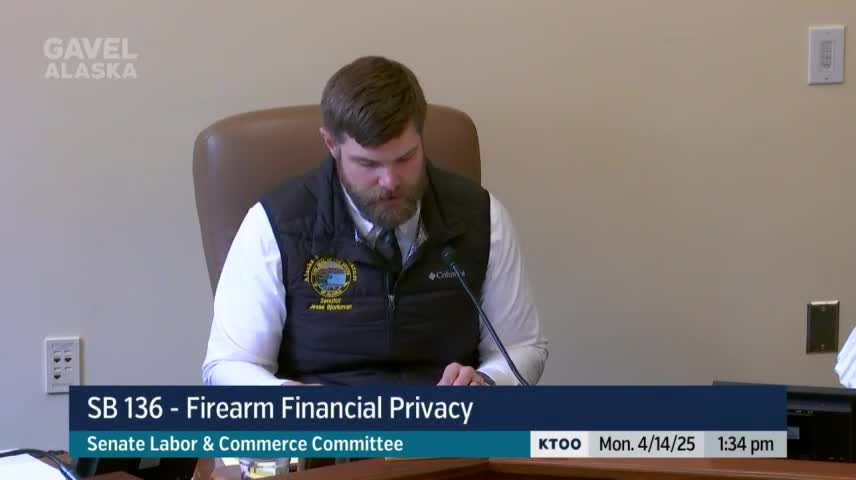
Senate committee hears bill to limit financial tracking of firearm purchases; no vote taken
Summary
Senate Labor and Commerce heard testimony on SB136, which would bar financial institutions and payment networks from using firearm-specific merchant codes or keeping private registries of gun purchases; the committee took no final action and set the bill aside for further consideration.
Senate Labor and Commerce on April 14 heard testimony on Senate Bill 136, which would bar financial institutions and payment networks from discriminating against lawful firearm transactions and from keeping lists or registries of privately owned firearms except where required by law.
The bill sponsor, Senator Mike Cronk, introduced SB136 and his staff member, Paul Mankie, provided the committee with a sectional analysis. The measure would add a new section to Alaska Statutes (proposed AS 06.90.20) prohibiting financial institutions or payment networks from declining, limiting, charging higher fees for, or otherwise taking actions intended to impede lawful transactions involving firearms, accessories, components or ammunition. The bill also would add AS 44.99.515 to prohibit a person, the state, or a political subdivision from knowingly keeping a list, record or registry of privately owned firearms or owners, except for records kept during criminal investigations or as otherwise required by law.
"These financial institutions and payment networks have used the presence of these codes to throttle and in some case outright decline lawful transactions involving firearms," Senator Mike Cronk said in his presentation. He told the committee the bill is intended to "bolster Alaskan's rights of privacy and to keep and bear arms by enacting statutory provisions to prevent financial institutions and payment card networks from discriminating against law abiding citizens and retailers engaging in lawful commerce." Paul Mankie summarized the statutory changes and noted the bill would authorize the attorney general to investigate alleged violations and seek injunctions and fines; the draft sets a maximum fine of $10,000 for knowing violations and requires courts to award reasonable attorney fees to a prevailing petitioner.
Eileen Klein, state director for the National Rifle Association, testified in support and described the International Organization for Standardization's 2022 creation of a four-digit merchant category code (MCC) for firearm retailers. "This is necessary to prevent financial surveillance of firearm owners that can be... used to build a private gun owner registry," Klein told the committee, and said the bill would give Alaska legal recourse to prevent such surveillance.
Committee members asked multiple questions about constitutionality, potential preemption, and whether the bill would functionally eliminate registries or change law enforcement access to records. Senator Ray Jackson expressed concern that the state should not eliminate useful registries for law enforcement; staff explained that current federal law and practices (including the National Instant Criminal Background Check System and recordkeeping by Federal Firearms Licensees) govern seller records and criminal-investigation access. Paul Mankie told the committee that seven other states had adopted similar statutes and that California and New York had taken the opposite approach by creating or mandating firearm transaction codes.
Committee members also asked whether private companies could refuse service under freedom of contract principles and whether courts would treat financial institutions differently than other businesses. Paul Mankie and members of the committee acknowledged that constitutionality questions remain open and likely subject to litigation. The bill draft includes limited exceptions for records kept during criminal investigations or as otherwise required by law.
The committee did not vote on SB136. Chair Bjorkman said the fiscal note from the Division of Banking and Securities does not anticipate an expenditure impact, and the committee set the bill aside for further consideration at a later meeting.
The transcript records the presentation, invited testimony and committee questions but no formal motion to report or referral occurred for SB136 on April 14.