Get Full Government Meeting Transcripts, Videos, & Alerts Forever!
Get email alerts on the Automated License Plate Readers topic
No spam. Unsubscribe anytime.
Senate panel backs bill to regulate automated license‑plate readers, with civil‑liberties concerns raised
Summary
Senate Bill 447, defining authorized uses, retention limits and oversight for automated license‑plate readers, was advanced from a subcommittee after law‑enforcement testimony about investigative successes and civil‑liberties testimony urging tighter limits on private‑property surveillance and vague language.
A Senate Judiciary subcommittee on April 27 voted to report Senate Bill 447 favorably to the full committee after hearing competing testimony about the investigatory benefits of automated license‑plate readers (ALPR or LPR) and concerns about privacy and overly broad language.
The bill, as described by a staff presenter, would define which public entities may use ALPR systems, make unauthorized use a criminal offense, and set rules for system operation. It would permit comparing plate data against NCIC and other law‑enforcement lists, allow use for parking regulation, access control, public‑safety purposes, property‑theft and organized‑retail‑crime investigations, tolling, and to aid DOT and DPS in traffic management. The bill would require agencies that operate the systems to adopt policies covering oversight, training, access controls, security, and data retention. Data could be kept for up to 90 days and must be destroyed unless it is part of an ongoing investigation, in which case records laws would govern retention. The bill would bar government entities from selling plate‑reader data and authorize the Department of Transportation to permit camera installations on interstate right‑of‑way.
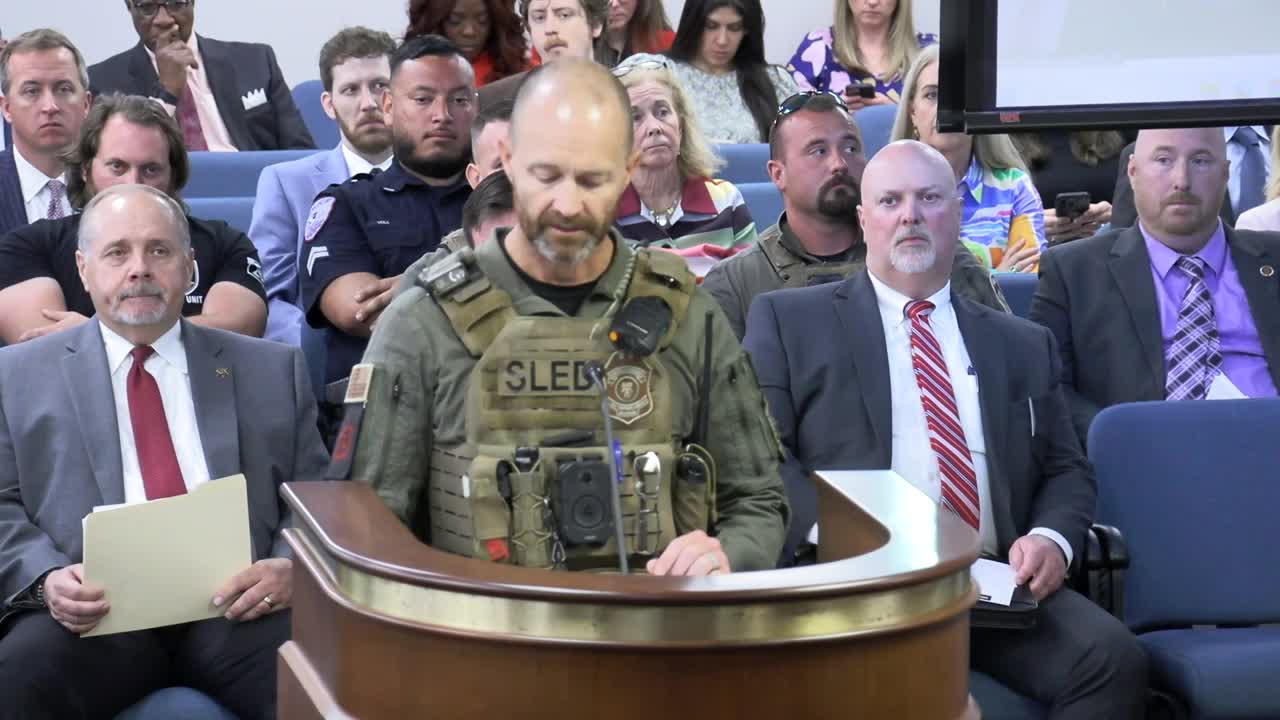
Law‑enforcement witnesses described multiple investigative uses. Oconee County Sheriff Crenshaw told the panel that in January he used an ALPR hit to locate a kidnapped 9‑year‑old by matching a vehicle description to the FLOC camera system and getting “a hit on it down in Edgefield County.” Conway Police Chief Dale Long said ALPRs helped locate a disoriented older man, and Camden’s chief said cameras aided a homicide investigation. A SLED agent, Mark Amos, described SLED’s role as state coordinator and noted that operators must be NCIC certified and that searches are tied to active investigations.
Civil‑liberties and defense groups urged narrower language. Josh Malkin, advocacy director for the ACLU of South Carolina, praised the bill’s ban on selling data but said “this technology has proven prone to abuse” and urged clearer limits on use near or to surveil private property and on vague language that allows use to “promote public safety” or “deter crime.” Kitty Sutton, executive director of the South Carolina Association of Criminal Defense Lawyers, proposed replacing the phrase “promote public safety and deter crime” with “in cases of public safety emergency” and restructuring the sections to create a separate provision for property‑theft and organized‑retail‑crime uses.
A representative from Enterprise Mobility said the company uses ALPRs on private property to inventory and recover rental vehicles and asked the committee to confirm private‑property commercial uses would remain allowed under the bill.
After testimony and questions, a subcommittee member moved that Senate Bill 447 be reported favorably to the full committee; the motion was seconded, members voted “aye,” and the chairman said the bill would move to the full committee.