Get Full Government Meeting Transcripts, Videos, & Alerts Forever!
Get email alerts on the Humanitarian Crisis topic
No spam. Unsubscribe anytime.
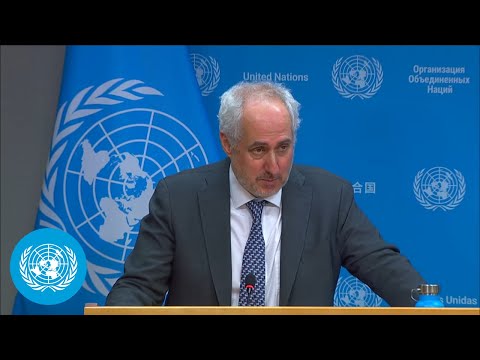
U.N. spokesperson: Sudan, Gaza, DRC and other crises have left millions in urgent need of aid
Summary
A United Nations spokesperson said the conflicts in Sudan and Gaza, along with violence and disasters in the Democratic Republic of the Congo, Myanmar and South Sudan, have left millions requiring urgent humanitarian assistance and that access for aid workers remains severely constrained.
A United Nations spokesperson said the conflicts in Sudan and Gaza, along with violence and disasters in the Democratic Republic of the Congo, Myanmar and South Sudan, have left millions requiring urgent humanitarian assistance and that access for aid workers remains severely constrained.
The spokesperson said more than 12,000,000 people have fled their homes in Sudan, and more than 3,800,000 of those have crossed into neighboring countries. "More than 30,000,000 people require humanitarian support," the spokesperson said, adding that about half of Sudans population roughly 25,000,000 peopleare acutely hungry and famine has been identified in at least five locations.
The Secretary-General, the spokesperson said, has urged an end to the fighting and called on outside parties to stop supplying arms: "The only way to ensure the protection of civilians is to end this senseless conflict," the spokesperson said, summarizing the Secretary-Generals statement. The spokesperson added that the Secretary-General's personal envoy is engaging regional interlocutors and that urgent political engagement is needed to prevent Sudans permanent fragmentation.
The briefing highlighted acute insecurity and displacement in North Darfur, where the International Organization for Migration has reported that up to 400,000 people fled Zamzam Camp in recent days. The spokesperson said Zamzam Camp is currently inaccessible and that a communications blackout has hindered independent verification. Local sources "are telling us that armed groups have taken control of the camp and are restricting the movement of those people who have chosen to remain," the spokesperson said. The U.N. was told that in the past three days more than 400 people, including 12 humanitarian workers, were reportedly killed in Zamzam and Qadala in North Darfur.
On Gaza, the spokesperson said humanitarian partners reported continued civilian casualties and damage to health infrastructure, citing an Israeli strike that injured staff at a Kuwaiti field hospital in Khan Yunis and an earlier strike that hit Alhali Arab Hospital in Gaza City. The World Health Organization reported that 21 of Gazas 36 hospitals remain only partially functioning, and humanitarian partners said food and medical supplies are at very low levels. The spokesperson said U.N. partners installed a backup generator at Kamal Adwan Hospital last week that provides about 20 cubic meters of clean water per hour.
Turning to Myanmar, the spokesperson said a U.N. Refugee Agency (UNHCR) charter flight carrying about 40 metric tons of aid landed in Yangon and delivered tents and household items for earthquake survivors. UNHCR has distributed stocks to tens of thousands of people and has appealed for $16,000,000 to assist 1,200,000 affected people through the end of the year, the spokesperson said.
In the Democratic Republic of the Congo, the Office for the Coordination of Humanitarian Affairs reported clashes in North and South Kivu that displaced tens of thousands of people, the spokesperson said, citing humanitarian assessments that last week fighting displaced roughly 80,000 people across Masisi, Walikale and Lubero territories. The briefing also noted that flooding in Tanganyika province displaced almost 10,000 people and that UNHCR has received about 20% of the funding it says it needs to respond.
The spokesperson described a deteriorating situation in South Sudan, quoting the U.N. humanitarian coordinator there, Anita Kikig Bejo, who reported that clashes and bombardments since March have killed more than 180 people, injured over 250 and displaced roughly 125,000, and that four humanitarian workers have been killed while six health facilities were forced to close.
The briefing opened with a scheduling note that Amy Pope, the director-general of the International Organization for Migration, will brief virtually about her recent visit to Port-au-Prince and meetings with displaced families and Haitian officials to discuss access to documentation and reintegration.
Near the end of the session, a reporter asked about news reports of a leaked U.S. government memo proposing cuts to funding for the United Nations. The spokesperson said the U.N. had read press reports but would not comment on an apparent leaked internal U.S. government document.
The spokesperson repeatedly urged that "civilians must be respected and protected at all times," called for safe, unhindered access for aid workers and repeated the U.N.s request that hostages be released and a cease-fire restored without delay.
The briefing included statements and figures provided by U.N. agencies including UNHCR, the World Health Organization, UNICEF, UN Women and the Office for the Coordination of Humanitarian Affairs.