Get Full Government Meeting Transcripts, Videos, & Alerts Forever!
Get email alerts on the Environmental Monitoring topic
No spam. Unsubscribe anytime.
Groundwater, PFAS and methane monitoring emerge as central concerns in Coffin Butte discussion
Summary
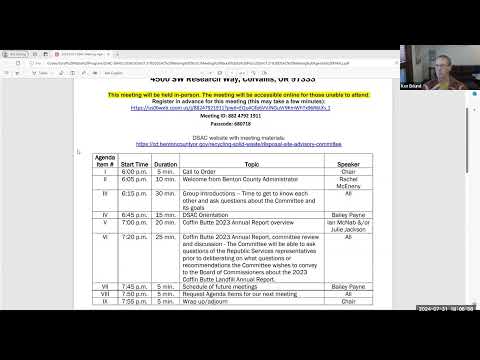
Republic Services and Benton County staff reviewed groundwater monitoring, PFAS, and methane control at Coffin Butte Landfill on July 31 and agreed to provide DSAC members with long-term monitoring reports and targeted appendices.
Republic Services and Benton County staff spent a substantial portion of the July 31 DSAC meeting reviewing the landfill’s environmental monitoring program and responding to questions about groundwater, PFAS and methane emissions.
Republic staff said Coffin Butte conducts semiannual groundwater monitoring at a network of approximately 35 wells and performs required leachate and underdrain sampling; they told DSAC that the most recent monitoring rounds showed results “below drinking water standards” for the parameters DEQ requires. Company presenters noted historic elevated arsenic in certain wells and described those measurements as stable and consistent with regional background levels rather than a new contaminant plume.
The committee and company discussed PFAS — the family of long-lasting per- and polyfluoroalkyl substances — and its presence in waste streams and leachate. Republic staff characterized landfills as receivers of PFAS-containing products, not producers of PFAS, and said the issue is evolving as state and federal agencies develop testing and treatment requirements. The company said it will work with wastewater partners and regulators as rules develop. Committee members asked for more targeted data from the landfill’s monitoring reports and appendices; Republic and county staff agreed to provide the annual environmental monitoring reports and to point committees to specific appendices that show long-term trends.
Methane and fugitive emissions drew extensive discussion. Republic representatives described the site’s gas control system — noting an investment of roughly $9.5 million since 2019 and saying Coffin Butte has “about 3 times” the number of gas wells per acre compared with an industry average — and explained that state and federal regulations currently require quarterly or prescribed walkover monitoring by technicians using EPA-approved methods. Several committee members urged the company to use aerial or advanced remote-sensing approaches that have become available (for example, emissions mapping flown by third parties) to detect fugitive methane more frequently and with different detection technologies; company staff said they are engaged at the national level with EPA and other organizations to evaluate emerging monitoring methods and that they are participating in broader efforts to standardize newer approaches.
Republic also described routine operational sampling and remediation of isolated contamination allegations: staff said they removed topsoil where equipment had been washed outside a maintenance shop, tested the area with a third-party firm and placed the removed soil into a permitted cell; the firm’s follow-up testing, Republic said, cleared the area.
Committee members requested easier public access to the county’s and the company’s monitoring files, including long-term trend plots and appendices that show results for specific monitoring wells. Republic and county staff said they will help direct DSAC members to the appropriate annual monitoring report sections and to historical data archives where available.