Get Full Government Meeting Transcripts, Videos, & Alerts Forever!
Get email alerts on the Methane Monitoring topic
No spam. Unsubscribe anytime.
Committee questions methane monitoring after EPA, aerial surveys show multiple actionable readings
Summary
DSAC members and Republic Services staff discussed surface emissions monitoring (SEM) and recent EPA/remote-sensing findings; Republic said their quarterly SEM program is ongoing, remediation follows actionable readings, and stronger context is needed to interpret plume maps and counts of exceedances.
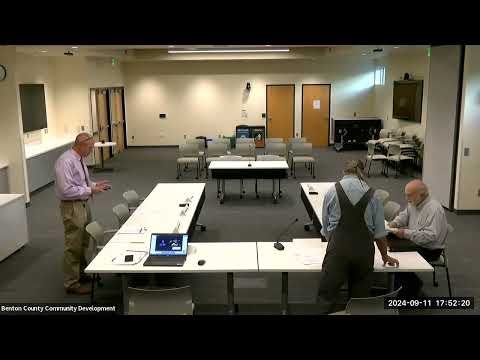
Benton County's Disposal Site Advisory Committee discussed recent methane-monitoring results and national attention on landfill emissions at its Sept. 11 meeting, pressing the operator for context on how often surface emissions monitoring (SEM) detects actionable points and what remedial steps follow.
Committee members referred to remote-sensing and third-party data (including Carbon Mapper flyovers reported in the press) and an unannounced EPA survey that identified multiple actionable methane readings on the Coffin Butte site. A DSAC member summarized the apparent discrepancy between monitoring runs: a Republic-contracted SEM event earlier in the quarter found six actionable readings in one dataset, while an EPA survey about nine days later showed many more "hot spots," prompting questions about sampling differences and how to interpret results.
Ian McNabb (DSAC chair) and committee members pressed Republic representatives for technical detail. Davis and other Republic staff explained that the industry uses several different measurement methods (on-the-ground handheld instruments, quarterly SEM walks and remote-sensing flyovers) and that results can vary because of changes in barometric pressure, recent operations, grid spacing and other site dynamics. "You can actually, there's, you could do a 3 days in a row and come with different things," Davis said, noting methane emissions are temporally and spatially variable.
Republic described its own quarterly SEM program conducted by third-party contractors and said it uses corrective timelines required by state guidance (for example, remediation steps to be completed in 10, 30 or 120 days depending on the finding). Committee members asked for context that would make the EPA and Carbon Mapper outputs interpretable to the public: total samples taken, proportion of samples above action limits, the area surveyed, and how corrective measures (soil cover, repairs, additional wells) change the results.
Republic staff said many corrective measures are familiar: repairing tarp tears or cover, adding soil, local repair around wells, and installing additional extraction wells if needed. Staff also noted that the PNGC gas plant and on-site engines are used to consume gas; flares and the enclosed burner provide capacity for excess gas or during maintenance outages. Davis said the operator has added wells as recently as the summer expansion and that some remediation and monitoring work is ongoing.
Ending
Committee members asked Republic to return with clearer contextual materials: examples of recent quarterly SEM reports, definitions and sampling rates used in the field protocol, and a summary of corrective actions taken after hits above action limits. The DSAC scheduled continued discussion at a future meeting.