Get Full Government Meeting Transcripts, Videos, & Alerts Forever!
Get email alerts on the Landfill Operations topic
No spam. Unsubscribe anytime.
Republic Services details Coffin Butte operations, proposed smaller expansion and environmental investments
Summary
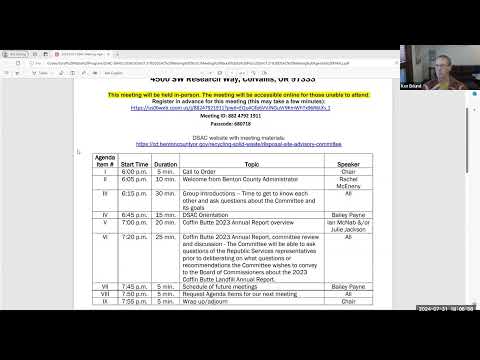
Republic Services presented its 2023 annual report to the DSAC on July 31, covering Coffin Butte Landfill’s operations, gas collection investments, compost/diversion programs, financial assurances, and a proposed reduced expansion tied to a conditional use review.
Republic Services representatives briefed Benton County’s Disposal Site Advisory Committee on July 31 about Coffin Butte Landfill operations, recent investments in landfill gas collection and composting, and a revised expansion proposal they say is smaller than an earlier application.
Brett Davis, general manager for Republic Services’ Western Oregon region, and other company staff described Coffin Butte as a broadly regional facility that accepts waste from across the Willamette Valley. Davis said the site covers about 740 acres, of which roughly 24% is currently used for active disposal (about 178 acres); the remaining property includes closed, capped cells and managed wetlands. Ian McNabb, the Republic representative on the committee, said Republic has increased investment in the landfill gas system, and “on average, landfills have about 1 gas well per acre. In Coffin Butte, we have 3 gas wells per acre.” He and other Republic staff noted an existing power-generation partnership that they said supplies enough energy to power about 4,000 homes.
Republic told the committee the company recently reduced the footprint of its expansion request compared with an earlier 2021 submission. The reduced proposal would be about half the size of the prior request and — according to company remarks at the meeting — would extend the landfill’s capacity by roughly 18 years. Company representatives also said that without expansion, active airspace in the currently permitted area would provide substantially fewer years of life (commenters gave different figures in the meeting transcript for remaining life without expansion; see clarifying details).
Republic discussed diversion and recycling programs tied to the site. Company presenters said the facility and partners divert roughly 40,000 tons a year of yard debris and organics for composting and related products; Republic noted a local compost product marketed to agriculture and retail customers. The company also described investments and funds used for environmental protection: staff referenced an environmental trust fund established years ago (reported balance noted as approximately $16 million in the meeting) and stated that closure and post-closure financial assurances are updated annually by professional engineers and submitted to the Oregon Department of Environmental Quality (DEQ).
Company staff described operational topics including quarry rock use for cell construction, road and traffic measures included in the expansion proposal (Republic said it will keep Coffin Butte Road open and add turn lanes and bike lanes), and controls for leachate handling (Republic reported agreements to accept some leachate at Corvallis and Salem wastewater plants). Republic representatives also identified other routine permits the site holds and said the facility had no regulatory violations last year.
Committee members asked about capacity, the quarry timeline and traffic routing, and requested copies of the county’s environmental monitoring reports and the company’s annual monitoring appendices. Republic offered to arrange a site tour of Coffin Butte and nearby Pacific Region Compost in the fall.