Get Full Government Meeting Transcripts, Videos, & Alerts Forever!
Get email alerts on the Landfill Environmental Health topic
No spam. Unsubscribe anytime.
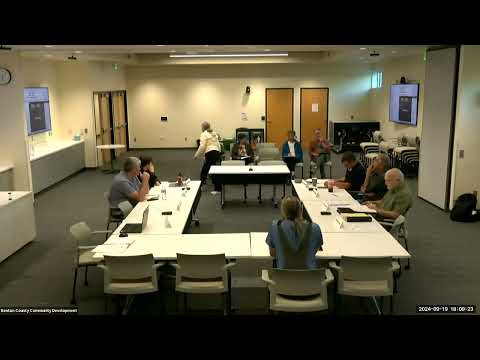
Residents raise arsenic, dust and fire safety concerns at Benton County landfill meeting
Summary
At a Sept. 19 Disposal Site Advisory Committee meeting, residents and neighbors pressed county officials and committee members about Coffin Butte landfill contamination, worker safety, truck washing, daily cover practices and recent fires; the committee agreed to seek follow-up and assigned a volunteer to prepare a report on 2024 fires.
Residents and neighbors urged Benton County officials on Sept. 19 to press workers and the landfill operator, Republic Services, for clearer data and stronger safeguards after years of community complaints about Coffin Butte landfill operations.
Speakers at the Disposal Site Advisory Committee (DSAC) public-comment period cited groundwater testing results, air and dust concerns at the working face, truck-wash procedures, daily cover methods and two fires this year. Kate Harris, a Soap Creek resident, asked why an industrial hygienist was not hired until 2024 after an Oregon OSHA inspection and a workers’ strike: “My question is why it took until 2024 past the OSHA inspection and a recent workers strike to hire an industrial hygienist…has that yet been completed?”
Committee members and multiple speakers said the annual environmental reports and related materials lacked context or detail they wanted. Joel Guyer, a north Benton County resident, told the committee that the updated annual report did not properly address arsenic and monitoring results: “Both of these…are actually above the EPA standards,” he said, referring to reported averages and a separate monitoring well spike to about 70 parts per billion in a non‑compliance well reported in the 2023 monitoring data. Guyer also flagged manganese exceedances in monitoring well 27, which he said has been above the site‑specific limit for eight consecutive readings.
Other public comments focused on daily cover and on‑site washing of equipment and trucks. Kevin said the report’s description of “daily cover” was misleading because, in photos and testimony, the working face frequently had only netting instead of soil: “It’s deceiving to the public when they read your report…what you typically use as a daily cover is nothing more than mesh netting.” DSAC member Ian responded that the landfill is using heavy-duty tarps as an approved alternative daily cover and described them as “a heavy duty 200 by 200 foot tarp…approved alternative daily cover.”
Multiple speakers linked landfill operations to impacts at the nearby E.E. Wilson Wildlife Area. Mark (last name not specified), speaking from the public, said the wildlife refuge “is absolutely and intimately connected to Coffin Butte” and urged that any analysis of expansion include impacts to that area.
Safety and fire risks also drew sustained attention. Committee member David (last name not specified, who lives near the landfill) volunteered to prepare a short report on the 2024 fires and related fire‑safety questions for DSAC review; committee members agreed that David would draft the report for the group to review before sending recommendations on fire safety to the commissioners.
Clarifying details raised during public comment and committee discussion included: Republic’s stated spending of $71,800 to hire an industrial hygienist; an OSHA correction deadline cited in public testimony of April 29, 2024; a proposed $100,000 project to add additional membrane cover to divert stormwater mentioned in Republic’s materials; testing of a new enclosed flare scheduled for Oct. 22 (source testing); and monitoring-well references (well 23 spike reported to ~70 ppb arsenic; manganese exceedances in wells 26 and 27 cited by speakers). Speakers asked that the committee and the county request more of the raw monitoring data and clearer context (for example, number of samples taken vs. number of exceedances).
The committee did not itself adjudicate technical claims but agreed to consolidate public concerns and request further information from staff and from Republic Services. Several members suggested forming a technical subcommittee to review groundwater and air monitoring data outside the public‑comment period. The DSAC chair said the committee will bring these items back for further agenda discussion and will aim to provide the commissioners a clear set of questions for Republic’s updated annual report.
Ending: Committee members urged residents to submit any specific data or questions in writing so the committee can compile them, and they said DSAC would return the topic to a future meeting for deeper technical review and to approve any formal recommendations to the county commissioners.