Get Full Government Meeting Transcripts, Videos, & Alerts Forever!
Get email alerts on the Therapeutic Interventionists And Court Appointed Providers topic
No spam. Unsubscribe anytime.
Parents tell Arizona committee court‑appointed psychologists, therapeutic interventionists and coordinators can harm families; advocates call for oversight
Summary
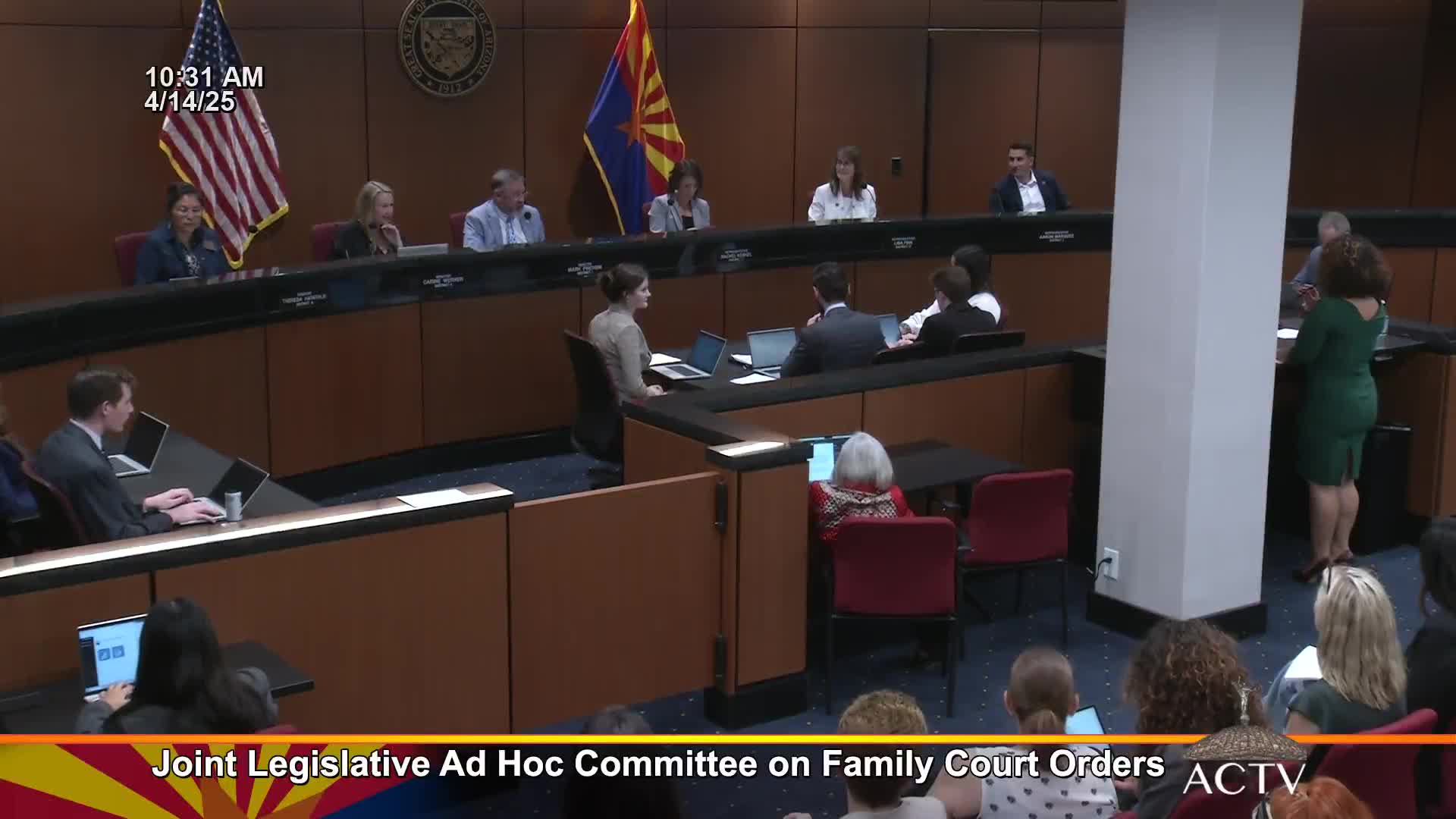
More than two dozen public speakers told the joint legislative ad hoc committee about costly, prolonged family‑court interventions they said harmed children and parents; witnesses described high fees, long separations, and judges deferring to court‑appointed providers.
Dozens of parents and some professionals told an Arizona legislative ad hoc committee that court‑appointed professionals — including therapeutic interventionists (TIs), custody evaluators, parenting coordinators and court‑appointed psychologists — can cause harm to families, impose substantial costs and operate with insufficient oversight.
Several witnesses described long, costly processes. “I have spent right at a million dollars,” said Angie Nielsen, who said she has been involved in family court for 14 years and currently has supervised parenting time limited to four hours a week. “I pay $2,000 a month to see my 16‑year‑old son,” she told the committee. Dominic Scappatigi said he now sees his child “8 hours a month” and called the process “pay to play.” Robert Del Garbino said he and his ex‑spouse spent more than $80,000 in three years, and that a different evaluator resolved his family’s dispute in weeks at a fraction of that cost.
Multiple speakers described court appointment practices, alleging judges defer to appointed providers. “Whenever we would go to court, the judge would turn to the therapeutic interventionist or the assigned psychologist and ask, ‘What do you think?’” Del Garbino said. Several witnesses described orders that resulted in little or no contact with their children for months. Rachel Cardona Barnett described alleged abusive conduct and said she remains without custody since June 27, 2023; she told the committee she filed complaints with the behavioral health board but was told the board lacked jurisdiction over court‑appointed roles.
A 15‑year‑old witness, Sophia Clever, described court orders that she said reversed custody “with no evidence” and said her family had spent about $550,000 over five years on court‑appointed services. Dr. Michelle Fox said she had documented abuse confirmed by forensic interviews and medical records but saw courts repeatedly deny and dismiss the evidence until a judge rotated onto her case and restored some parenting rights.
Several speakers asked who monitors court‑appointed professionals. Committee members noted statutory limits: ombudsman jurisdiction generally excludes courts; licensing boards oversee professional licensees; and judges can impose orders within the bounds of statute. Kristen Alcott, who identified herself as a parent and a professional working in court systems, told the committee the services labeled TI are rooted in family systems therapy and are intended, when applied correctly, to address entrenched, high‑conflict cases. She acknowledged cost and role clarity are common concerns and said some cases are clinically complex and not representative of most family court cases.
Speakers urged legislative action and evidence gathering. Representative Keshel and Senator Finchem told attendees the committee will take additional testimony, accept documentary evidence and consider statutory fixes; no votes were taken at the hearing.