Get Full Government Meeting Transcripts, Videos, & Alerts Forever!
Get email alerts on the Energy Wind Farms topic
No spam. Unsubscribe anytime.
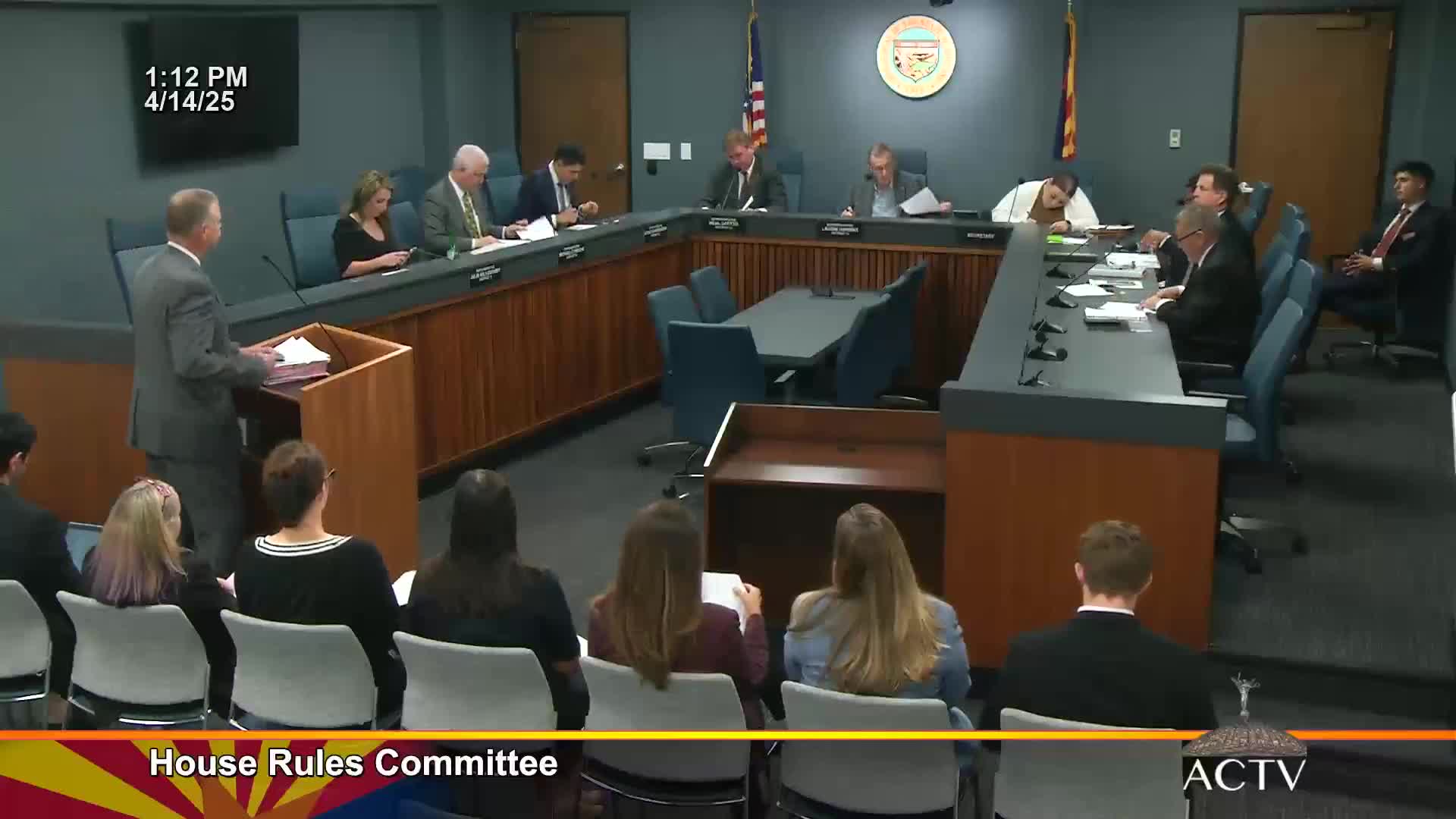
Committee backs Senate Bill 1150 strike‑everything amendment on wind farms but flags potential federal law issues
Summary
The Rules Committee recommended Senate Bill 1150, which imposes state-level restrictions on wind farms including ownership-transfer consent and a six‑mile buffer from rezoned residential areas, while committee counsel said federal-law interplay needs further review.
The Arizona Senate Rules Committee voted to recommend Senate Bill 1150, including a strike‑everything amendment, as constitutional and in proper form, while counsel said some provisions may raise potential conflicts with federal law.
Tim Fleming, rules attorney, told members the strike‑everything amendment contains several provisions regulating renewable-energy wind farms, including restrictions tied to the use of state land and provisions that would apply to federally authorized facilities. He said the amendment includes a provision that would require county supervisor consent before the transfer of ownership of a wind farm sited on certain federal facilities and a distance restriction barring a wind farm within six miles of an area rezoned for residential use.
Fleming said he found a “possibility” of federal-law interplay or conflict, particularly where the amendment applies state-level transfer restrictions to facilities on federal land. He also noted federal oversight and multiple federal statutes, including potential Clean Water Act implications, govern some land and siting decisions. “I couldn't find anything in federal law that created the same kind of a distance limitation,” Fleming said, adding that he had not conducted an exhaustive search and could not conclude whether a conflict actually exists.
On potential remedies, Fleming suggested legislators could add language recognizing federal law limits — for example, a savings clause such as “unless prohibited by federal law” or similar safety guards at the specific points of concern. “Whether it's necessary or not, I can't say that it is,” he said.
The committee recorded a roll call of five ayes and three nays: Representative Carbone (Aye); Representative Contreras (Nay); Representative Delos Santos (Nay); Representative Mathis (Nay); Speaker Montenegro (Aye); Representative Willoughby (Aye); Vice Chairman Carter (Aye); Chairman Hendricks (Aye). The committee recommended the bill as constitutional and in proper form.
Committee counsel characterized the federal‑preemption questions as unresolved and recommended further review if members are concerned about conflicts with federal statutes or federal agency approvals.