Lifetime Citizen Portal Access — AI Briefings, Alerts & Unlimited Follows
Alaska school boards push career-guide model to connect students to jobs
Loading...
Summary
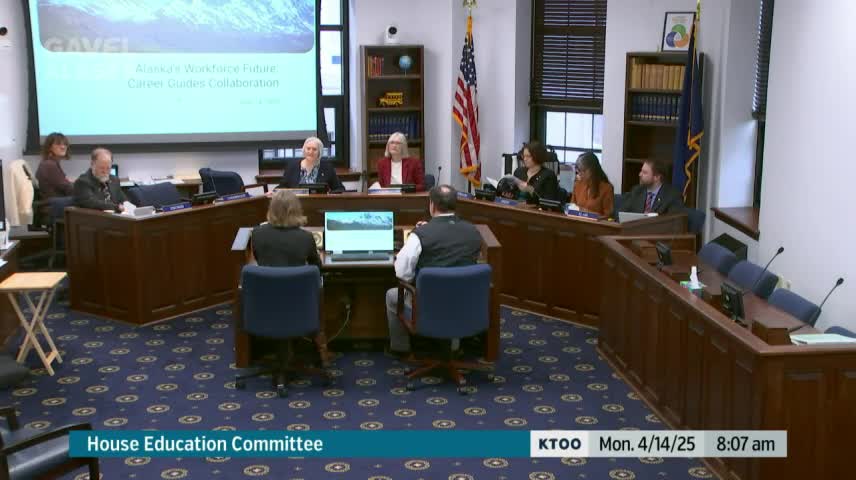
At an April 14 House Education Committee hearing, the Association of Alaska School Boards described 'career guides' — staff who coach students into postsecondary education, training and work — as a key strategy to address Alaska’s shrinking working‑age population and an anticipated need for thousands of new workers.
Emily Ferry, family engagement manager for the Association of Alaska School Boards (AASB), told the House Education Committee on April 14 that “career guides is one of the six strategies” identified in a recent cross‑industry workforce report to help connect K‑12 students to postsecondary education, training and employment.
The proposal centers on placing trained people — called career guides, coaches or advisors — in schools or regional hubs to help students plan and access education, apprenticeships, certifications or local employment. Ferry said the approach aims to counter long‑term declines in Alaska students’ postsecondary enrollment and a high rate of “disconnected youth” who are neither in school nor work.
Why it matters: Alaska’s high school senior enrollment in 2‑ or 4‑year degree programs has fallen from about 52% in 2013 to roughly 33% today, Ferry told the committee, citing the Alaska Commission on Postsecondary Education’s Higher Education Almanac. Ferry also said only about 21% of Alaska seniors had completed the Free Application for Federal Student Aid (FAFSA) as of April 4, compared with a 44% national average; she told the committee that failing to complete FAFSA could leave about $7.4 million in federal aid unclaimed by Alaskan students.
Committee members pressed for operational details. Representative Andy Story asked whether the current Regional Career Guide pilot — which places guides through the Department of Labor in regional hubs rather than as school employees — should be compared with prior in‑school pilots. “Isn’t it important to take note that this Regional Career Guide pilot program is different from the program we had before ... the people were stationed in the high school?” Story said. Ferry replied that both models exist in Alaska and that what matters most is the guide’s relationship with students and school counselors.
Ferry pointed to a past example in Bethel: a grant‑funded career‑guide program at Bethel Regional High School that she said produced a 65% rate of seniors enrolling in 2‑ or 4‑year programs in February 2016 — about double current statewide rates — until the program ended for lack of sustained funding. She described ongoing collaborations involving SeaAlaska Heritage Institute, Bristol Bay Region CTE, the Department of Labor and the Department of Education and Early Development (DEED) to pilot new, sustainable models.
Funding and sustainability were recurring concerns. Ferry said districts sometimes absorb career‑guide positions into regular budgets, but that many programs have relied on federal grants and philanthropic partners; she warned those grants may not be permanent. She said RootEd Alliance and other national partners are working with Alaskan communities to adapt models to rural and culturally specific contexts.
Several members raised the question of how career‑guide metrics should account for Alaska‑specific activities such as subsistence work. Ferry acknowledged the limitation of national metrics and said the committee should consider how measures capture meaningful local contributions in rural and Indigenous communities.
Ferry described the guides as people who do not necessarily need a master’s degree but do require training, and she emphasized that the model can include a range of postsecondary pathways — from trade certificates and CTE programs to 2‑ and 4‑year degrees — to suit students’ goals.
The AASB told the committee it is tracking pilot outcomes and intends to return with more evidence about cost effectiveness and student outcomes. Ferry and AASB executive director Lon Garrison said they are collecting data from pilot sites and coordinating partners so the committee can review results before recommending sustained funding or statutory changes.
The presentation prompted committee members to request more detail on program design, funding sources, and whether data collection will track student outcomes beyond traditional college enrollment.