Get Full Government Meeting Transcripts, Videos, & Alerts Forever!
Get email alerts on the Retirement Benefits Sbs topic
No spam. Unsubscribe anytime.
State actuaries and retirement officials outline employer delinquencies, large account balances in Alaska Supplemental Benefits System
Summary
Division of Retirement and Benefits staff and an actuarial consultant outlined SBS design, participant account balances and a list of delinquent employers. Officials said SBS participation is mandatory for employers who elected it, described investment options and said 18 employers are delinquent; nine are in long-term termination studies.
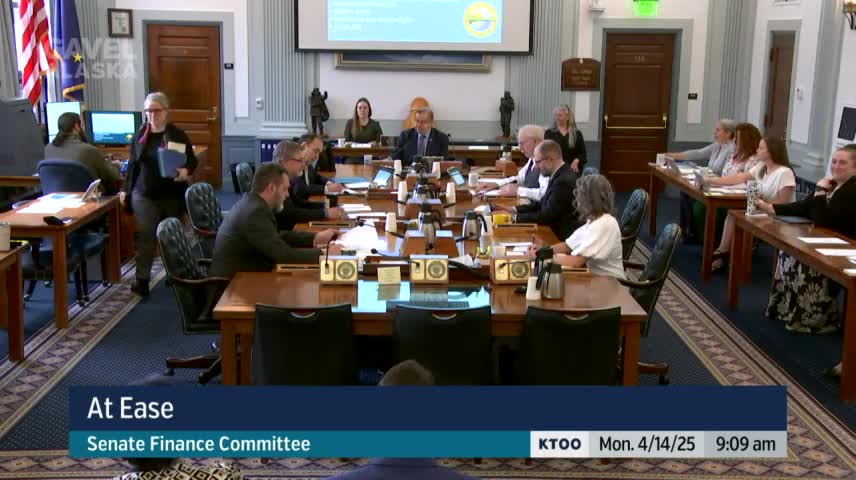
At a Senate Finance Committee meeting April 14, Division of Retirement and Benefits Director Kathy Lee and staff presented an overview of the Alaska Supplemental Benefits System (SBS), including investment options, participant withdrawal choices and employer participation. An actuarial consultant, David Kirschner of Gallagher, reviewed how normal cost and present-value calculations underpin employer contribution rates for PERS and TERS.
Lee told the committee SBS was created in 1979 and that, after a 1980 employee referendum, the state ceased participation in Social Security and entered SBS as a Social Security replacement for many employers. “Participation in SBS is mandatory,” Lee said, and described the contribution structure: employees pay 6.13% of wages and employers match 6.13%, for a total contribution rate of 12.26%.
The division described the plan’s investment lineup and default. Members who do not make an investment election are placed in an age-based target-date trust that automatically rebalances; other options range from U.S. small-cap to stable-value funds. Lee said members may keep accounts in the plan after termination, take annuities or lump sums, or roll funds to IRAs.
The division displayed participant account balances and identified two participants with balances “up to $4,700,000.” Lee said those accounts appear to reflect high salaries (about $200,000–$220,000) and long retention of funds in the plan, sometimes including rollovers from other accounts.
On employer participation, operations manager Brandon Roomsburg reported the division tracks participation across plans: 54 employers in PERS, 21 in SBS, 85 participating in Social Security, and 17 in the state deferred compensation plan. Roomsburg told senators there is only one deferred-compensation employer that currently provides a matching contribution (6%).
Roomsburg said 18 employers are currently delinquent: nine have long-standing delinquencies and are in termination studies to determine the present liability for employees who remain in the plan; nine more are recent delinquents with contributions and interest accruing. He described interest on late contributions as “1 and a half times the base interest rate, which is 7 and a half percent.”
Lee explained how termination costs are calculated: terminated employers must pay the actuarial amount necessary to fund costs for their terminated employees, including retiree health, disability and death benefit components. For defined-benefit employers, additional past-service costs are added and continue until the past-service liability is extinguished. “Those employers that cannot pay their contributions also cannot pay this part of the requirement either,” she told the committee.
Actuary David Kirschner summarized valuation methodology used to set normal cost and contribution rates for PERS and TERS. He described the present-value-of-future-benefits approach, the entry-age normal cost method, and the use of demographic and economic assumptions — including a 7.25% assumed investment return — to project liabilities and normal costs. He confirmed the ARM board conducts an experience study every four years and that the next study will cover the four years ending June 30, 2025.
Senators asked for additional details the division said it could provide later, including appendices that show example account balance projections based on a $60,000 starting salary with specified salary-growth and investment-return assumptions. The division repeatedly emphasized that statutory and contractual rules determine participation and that statutory language provides limited guidance on remedies for participant protections when employers fail to remit contributions.