Get Full Government Meeting Transcripts, Videos, & Alerts Forever!
Get email alerts on the Utilities topic
No spam. Unsubscribe anytime.
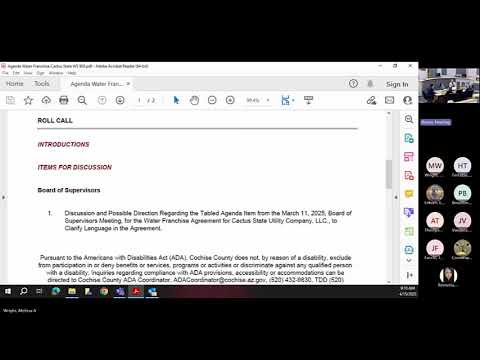
Cochise County supervisors direct staff to revise Cactus State utility franchise language and seek voter approval for any future franchise fees
Summary
Cochise County supervisors instructed county attorneys on Monday to revise the county's draft franchise agreement for Cactus State Utility Company, add language requiring financial assurances and indemnity, and prepare a separate resolution that would refer any future franchise fee to voters in the affected service area.
Cochise County supervisors instructed county attorneys on Monday to revise the county's standard franchise agreement for Cactus State Utility Company, remove language that would explicitly authorize franchise fees in the contract, add provisions requiring financial assurances and indemnity for environmental or abandonment risk, and prepare a separate resolution that would require voter approval before any future franchise fee could be imposed in the affected service area.
The action came during a Cochise County Board of Supervisors work session in the Supervisor's Hearing Room. Paul Kreia, the county's chief civil deputy and attorney for the board, led discussion of a draft franchise agreement and the statute the board relies on to set terms and conditions for utilities using county rights of way.
Kreia said the statute the board cited gives the county authority to impose restrictions and conditions on use of public roads. He summarized the current draft's paragraph 10, quoting its core reservation: "the county reserves the right to alter or amend the terms of the franchise in any manner necessary to protect the safety or welfare of the public or the public interest." Kreia and supervisors discussed whether that language, as written, could be read to allow franchise fees in the future without a separate public process.
Why it matters: supervisors expressed concern that if a future board or the legislature authorized franchise fees, those fees could be passed through to consumers and would affect only customers in the franchise's service area. Several supervisors argued that any new recurring fee of that type should be approved by voters in the area that would pay it.
Board members debated two parallel steps: (1) finalize franchise-contract language that protects the county from environmental contamination, abandonment of infrastructure, or obsolescence by requiring the grantee to post financial assurances (for example, a bond or letter of credit) and to indemnify the county; and (2) prepare a separate county resolution obligating the board to refer any future franchise-fee proposal to voters in the impacted service area rather than imposing it administratively.
Kreia recommended a relatively short contractual approach that mirrors the statute and allows the county to require bonds or other financial assurances "upon its sole determination of substantial risk of environmental contamination, abandonment of infrastructure, obsolescence, or similar events," and to require indemnity from the grantee to cover cleanup or remediation costs. He noted a past state contract that required posting of a bond to fund monitoring wells for contamination as an example of the approach working in practice.
Supervisors raised practical concerns about the effect of removing franchise-fee language from a 25-year contract: one supervisor observed that a signed 25-year franchise that expressly precludes fees would limit flexibility and could prevent the county from collecting an otherwise-authorized fee for the life of that contract. Others urged a separate resolution so any future fee would require a ballot referral for voters within the franchise's service area or precincts affected, not the entire county.
The board asked staff to prepare two items for a future public agenda: an amended franchise agreement for Cactus State Utility Company that (a) strikes or clarifies any explicit "franchise fee" language and (b) adds the combined-safeguard clause requiring financial assurances and indemnity; and a separate resolution that, if the legislature authorizes counties to impose franchise fees in the future, would require the board to determine the affected service area and refer a ballot measure to voters in that area to approve the fee.
Kreia said the county will post the proposed franchise agreement and then return to the board for approval and final signatures after the public-notice period. The board did not take a formal vote during the work session; supervisors indicated consensus to have staff draft the contract language and the ballot-referral resolution and return them for consideration.
The meeting record shows supervisors discussed examples and numbers during debate: one supervisor cited a 25-year contract term, Sierra Vista's practice of charging a 4% franchise fee plus a 1% right-of-way fee on gas service, and a hypothetical $200,000 annual right-of-way collection used to illustrate how fees might be accounted for. Supervisors repeatedly emphasized that fees meant to cover specific reimbursable costs should be segregated for that use, and that a general tax differs legally from a fee intended to reimburse a specific expense.
The session was a board work session; public comment was not taken. County staff will return to a future public meeting with the revised franchise agreement and the proposed resolution for formal consideration and posting.
The board adjourned the work session and scheduled a budget work session at 10:00 a.m. to discuss the sheriff's department budget.