Get Full Government Meeting Transcripts, Videos, & Alerts Forever!
Get email alerts on the Public Finance topic
No spam. Unsubscribe anytime.
Cochise County treasurer outlines portfolio strategy, liquidity and callable-security risks
Summary
Cochise County Treasurer Catherine Trewick and her investment adviser, Michael Bell of Stifel, briefed the Board of Supervisors at a work session on the county's investment portfolio, its composition and how staff manage liquidity and call risk.
Cochise County Treasurer Catherine Trewick and her investment adviser, Michael Bell of Stifel, briefed the Board of Supervisors at a work session on the county's investment portfolio, its composition and how staff manage liquidity and call risk. The presentation, given during a work session where public comment was not taken pursuant to ARS 38-431.02(H), described a laddered portfolio of federal-agency debentures, a program of rolling maturities and tools the treasurer uses to meet operational cash needs.
Why it matters: Trewick told the board the county pools money from many local public entities and invests it to preserve principal and maintain liquidity while earning yield. That pool of investable funds supports daily county operations and special districts; board members raised a separate, informal idea about borrowing from county-held funds to finance a proposed jail project, which the treasurer said would raise legal and operational questions and is not a formal proposal.
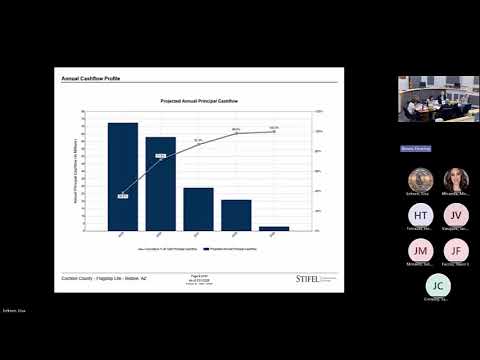
Trewick and Bell said the portfolio is managed to keep maturities distributed across years so that cash becomes available regularly. Michael Bell said the portfolio is "about as perfectly laddered as any time we've been in our relationship," and noted that roughly $30 million in securities are scheduled to mature in 2025. Bell described the current mix as approximately 40% in noncallable (convex) securities and about 60% in callable federal-agency debentures such as those issued by Fannie Mae, Freddie Mac, Farmer Mac and the Federal Home Loan Bank system.
The presentation emphasized three policy priorities: safety of principal, liquidity to meet operating needs and modest yield pickup. Bell explained that choosing callable agency issues can add 10 to 50 basis points of yield compared with strictly bullet (noncallable) securities, but callable instruments carry optionality because issuers may redeem them early. Trewick described operational controls and separation of duties: she said she does not move money herself, that a trade packet is prepared for each purchase and that distinct staff create and approve transfers.
The report materials reviewed by the board include a detailed safekeeping list showing individual securities, next-call dates and maturity timelines; Bell said those pages help the treasurer plan for probable cash inflows. Bell summarized interest-rate sensitivity using scenario "shock" pages that model portfolio duration if rates move up or down. He provided an average-life figure of about 1.1 years and said the portfolio has a five-year legal maturity limit for invested funds.
On holdings and vehicles, the pair described the county's use of a state Local Government Investment Pool (LGIP) for flexible cash and said the treasurer also invests in agency debentures rather than mortgage-backed securities or long-term treasuries for a balance of yield and liquidity. Trewick noted that, operationally, the county's pooled funds include money for the county and many separate local entities and special districts; she characterized her office as "the bank for the county," receiving fees, fines and tax receipts and holding them until the county issues warrants or other disbursements.
Board members asked practical questions about scenarios and alternatives. One supervisor asked whether the county could internally borrow from funds held in the treasurer's pooled accounts to help finance a possible jail project instead of issuing bonds to the public. Trewick responded that such an approach would raise legal and operational issues: "I'm terrified by it ... I am not issuing debt," and she said she would not act as a broker to issue debt on the county's behalf. The discussion was exploratory; no formal direction or motion was made.
Bell also described underwriting and how broker-dealer fees operate for new agency issues: underwriters receive an underwriting fee set by the issuing agency, rather than a portfolio-percentage management fee paid by the county. The advisers said Stifel provides the safekeeping and reporting platform at no charge to the county and that underwriting fees are set by the agency issuer when a new-issue sale is arranged.
Board members and staff raised several operational clarifications: the LGIP can provide same-day or short-notice liquidity up to certain amounts, larger redemptions may require 24 hours' notice, and certificates of deposit are limited by FDIC insurance thresholds to relatively small per-issuer amounts. Bell noted market volatility and recent pressure on tax-exempt muni markets tied to tax-date and margin-call flows.
The session closed with the treasurer and Bell offering to answer follow-up questions, and a reminder that the next work session will cover franchise agreements. No votes or formal policy changes occurred; the session was a staff briefing and discussion.