Get Full Government Meeting Transcripts, Videos, & Alerts Forever!
Get email alerts on the Housing Finance topic
No spam. Unsubscribe anytime.
Planning commission backs three tax‑increment finance plans to support workforce housing
Summary
The Bend Planning Commission unanimously recommended city council approve three site‑specific tax‑increment finance (TIF) plans — Bridgeridge, Century (Century West & Century Bluff) and Viridian — intended to fund rebates that promote housing affordable to households at about 90 percent of area median income.
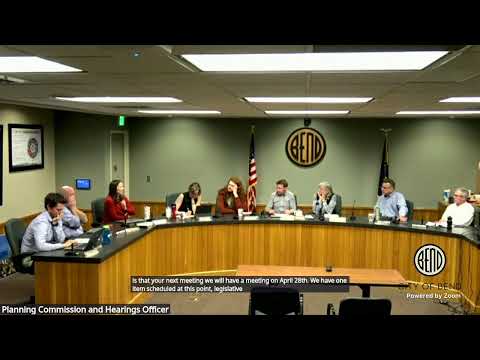
BEND, Ore. — The Bend Planning Commission on April 14 recommended that city council adopt three site‑specific tax‑increment finance plans intended to support new housing projects that include affordable units for workforce households.
The commission voted unanimously to forward plans described in staff materials as Bridgeridge (a northwest Bend site), Century (two adjacent projects referred to in staff materials as Century West and Century Bluff) and Viridian (a high‑density site near NorthWest Mount Washington and Shevlin Park Road). Staff said the targeted developments are already in the city’s site‑plan pipeline and that the TIF plans would be used to rebate a portion of the property taxes paid by those projects if they meet the agreed affordability, local sourcing and energy efficiency conditions.
City staff explained that the Bend Urban Renewal Agency adopted a policy enabling property tax rebate assistance for housing developments that provide units affordable to households at roughly 90 percent of area median income (AMI). The proposed TIF plans set maximum rebate terms — in these cases 30 to 32 years — and anticipate that projects complying with the affordability and local‑contractor incentives would receive a portion of the incremental property tax revenues as annual rebates.
Elizabeth Ochsall of the city attorney’s office and John Angeli, urban renewal project manager, briefed commissioners on the plan boundaries, estimated maximum indebtedness (a forecasting figure representing the upper limit of anticipated rebate payments), and the statutory and local plan‑conformance findings required under Oregon law. Staff emphasized that these site‑specific plans differ from broad urban‑renewal districts because each plan is tied to a known project that has already obtained site‑plan approval, allowing a specific nexus between the proposed use of incremental taxes and the comprehensive plan goals supporting infill and housing near transit and services.
The three sites differ in ownership, size and context. Century comprises two parcels near Southwest Reed Market and Mount Washington Drive and was described by staff as mixed‑use employment land appropriate for multiunit housing near transit and employment centers. Bridgeridge (staff also referenced a name used in the draft materials) is a roughly 6‑acre parcel staff identified for housing that meets gap—workforce—affordability objectives. Viridian was presented as a high‑density residential plan on publicly owned land that will transfer to private development under a lease and then be subject to tax increment accounting; that parcel’s frozen base value is zero because it is publicly owned today.
Staff tied each plan to the Bend Comprehensive Plan policies that promote compact development, infill near transit corridors and mixed‑use activity centers, and to the city’s housing goals and the state’s housing‑needs assessment. Commissioners asked questions about how rebate amounts are calculated (they reflect the anticipated incremental portion of the city’s share of property taxes) and how the program is administered each year (projects must both pay property taxes and certify compliance with affordability and other program conditions before any rebate is paid).
After the staff presentation, the commission voted to recommend that city council adopt the three TIF plans. The commission’s recommendation will be transmitted to council for a May 21 public hearing; the Bend Urban Renewal Agency’s previous action recommending the plans was cited in staff materials.
Why it matters: The proposed plans use tax increment financing in a narrow, project‑by‑project way to reduce developers’ operating cost by rebating a portion of property taxes when the projects provide units targeted to households at about 90 percent AMI. Staff presented the approach as a measured way for the city to leverage urban renewal resources to deliver workforce housing without broad new borrowing across a large urban renewal district.
Next steps: The planning commission’s unanimous recommendation will be forwarded for a public hearing before city council on May 21. If council adopts the plans, the developments would still need to meet their site‑plan and building‑permit requirements; rebates would be paid only after each project certifies ongoing compliance with affordability and related conditions each year.