Get Full Government Meeting Transcripts, Videos, & Alerts Forever!
Get email alerts on the School Finance topic
No spam. Unsubscribe anytime.
Sierra Vista board approves revised annual financial report and budget revision, moves capital to cover classroom shortfall
Summary
The Sierra Vista Unified District governing board on Tuesday approved a revised 2023–24 annual financial report and a second revision to the 2024–25 expenditure budget during a special finance meeting, officials said.
The Sierra Vista Unified District governing board on Tuesday approved a revised 2023–24 annual financial report and a second revision to the 2024–25 expenditure budget during a special finance meeting, officials said.
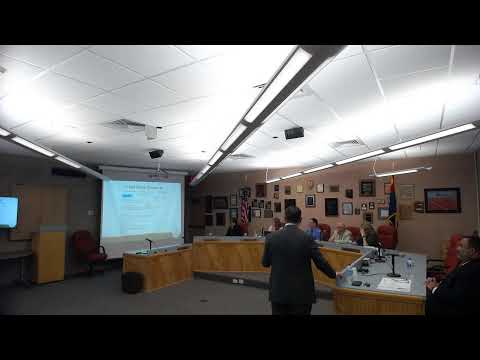
The actions were presented by Ken McGovern, the district's budget and finance presenter, who said the district is adjusting its figures to reflect recent changes in average daily membership (ADM), carry-forward calculations and state budget factors. “This is a constant cycle. It never stops, and you're never stuck in just one,” McGovern said during the presentation.
Why it matters: The board and administration described the changes as necessary to keep the district in statutory compliance and to avoid a negative maintenance-and-operations (M&O) balance. Administrators also recommended a temporary transfer of unrestricted capital funds into M&O as a one-time “safety valve” to cover projected shortfalls driven in part by declining regular ADM and growth in higher-cost special-education ADM.
Board action and votes
• Revised annual financial report (FY2023–24): Approved 5–0. The board accepted the revised AFR for submission to the Arizona Department of Education (ADE) and for posting on the district website. Administrators cited ARS 15-904 and ARS 15-915 as the statutory authorities governing AFR submission and allowed revisions.
• FY2024–25 second budget revision: Approved 5–0. The revision incorporates updated state budget factors, the district’s most recent ADM figures and the approved carry-forwards. Administration recommended moving available unrestricted capital outlay (District Additional Assistance/DAA) into the M&O control limit to prevent an M&O deficit; staff said the move is reversible if other funds become available.
• Routine agenda adoption and adjournment motions: Each passed 5–0.
What the presentation covered
McGovern reviewed the district’s annual budget cycle and deadlines: the proposed budget is due in early July, the adopted budget in mid-July, the district may file revisions during the year and the AFR is due Oct. 15. He stressed that state reports (the so-called “budget 25” and “budget 75” forms) and ADE reviews determine official carry-forward and control limits.
McGovern also warned that ADM figures are volatile and drive the district's revenue-control limit: “If we don't put a line item on the budget, if it's not in the budget, we can't spend it,” he said, explaining the need to estimate and re-estimate enrollment and specific revenue streams such as tuition and grant lines.
Administrators told the board that some apparent increases in ADM on the revision are concentrated in special-education add-on funding, which raises costs more than it raises revenue. McGovern said the district had been losing more than 200 students per year and that special-education ADM increases can leave the district more exposed financially despite surface-level increases in weighted ADM.
On monthly financial oversight, staff pointed to a March report showing several negative cash positions and said they have mitigation plans in place. McGovern noted one near-term figure of almost $3 million negative cash as of the March report and described transfers and indirect-cost recoveries that have reduced shortfalls.
Transfer of capital funds to M&O
As part of the budget revision, administration recommended temporarily moving unrestricted capital allocation into M&O to cover short-term operating needs. Administrators described the transfer as a budget-time option available to the board to prevent statutory violations (an M&O deficit) and called it a safety valve rather than a permanent reallocation. The amount discussed in the meeting was cited by staff as about $2.7 million; staff said the transfer can be reversed if other revenues or savings materialize.
Legal and reporting context
Board members were reminded that the AFR revision and budget submission must comply with Arizona statutes and ADE reporting requirements. ARS 15-904 requires the AFR submission and ARS 15-915 allows districts to revise AFRs when needed. McGovern walked the board through the district’s required forms and public-notice requirements for budget hearings.
Votes at a glance
• Motion to adopt the meeting agenda — Passed 5–0. • Approval of FY2023–24 revised annual financial report (for submission to ADE and publication) — Passed 5–0. • Approval of second revision to the FY2024–25 expenditure budget (including recommended temporary transfers) — Passed 5–0. • Motion to adjourn — Passed 5–0.
What’s next
McGovern said the presentation slides and revised documents will be provided to board members and posted where required by ADE. Administration recommended monitoring ADM at the 40th-day and 100th-day reporting points and returning to the board with any further necessary revisions.
The meeting record shows no dissenting votes on the budget items; board members asked questions during the presentation and staff answered with line-item and process clarifications. The board's approvals trigger the formal submission of the revised AFR to ADE and posting of the revised FY2024–25 budget revision as required by state law.